
Context and Recent Trigger
- U.S. President Donald Trump criticised the UK’s decision to hand over sovereignty of the Chagos Islands to Mauritius, citing strategic and security concerns.
- The UK government has defended the move, stating that a deal is being finalised to transfer sovereignty to Mauritius by May 2026, while retaining the Diego Garcia military base on lease for at least 99 years.
Chagos Islands: Strategic and Historical Background
Geographic and Strategic Significance
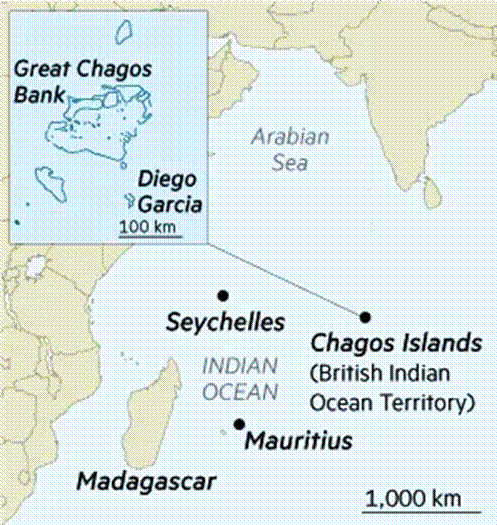
- The Chagos Archipelago is located in the central Indian Ocean, astride major sea lanes connecting Africa, West Asia, and the Indo-Pacific.
- Diego Garcia, the largest island, hosts a U.S.–UK military base, critical for operations in the Middle East, Indo-Pacific, and Africa.
Colonial Legacy
- The UK separated Chagos from Mauritius in 1965, three years before Mauritius gained independence in 1968, creating the British Indian Ocean Territory (BIOT).
- Between 1967–1973, over 1,500–2,000 Chagossians were forcibly evicted to enable the U.S. military base—raising serious human rights concerns.
Relevance
- GS 2: International law, ICJ opinions, UN system, sovereignty disputes, and India’s foreign policy principles.
Legal and Diplomatic Developments
International Court of Justice (ICJ) Opinion, 2019
- The ICJ (2019) held that:
- The decolonisation of Mauritius was not lawfully completed.
- The UK is under an obligation to end its administration of Chagos as rapidly as possible.
United Nations General Assembly (UNGA) Resolution
- Following the ICJ opinion, the UNGA voted overwhelmingly demanding that the UK withdraw from Chagos within six months.
- Though advisory, the opinion strengthened Mauritius’ diplomatic and legal position.
The UK–Mauritius Deal (Proposed)
Key Features
- Sovereignty over Chagos to be transferred to Mauritius.
- Diego Garcia base to remain under UK–US control via a long-term lease (≈99 years).
- Guarantees for continued military access for the U.S. and UK.
UK’s Rationale
- Aims to:
- Comply with international legal obligations.
- Reduce diplomatic isolation in the UN.
- Secure long-term legitimacy of the Diego Garcia base.
Implications for India and the Indian Ocean Region
Decolonisation and Global South Solidarity
- The issue resonates with India’s long-standing support for decolonisation and territorial integrity, consistent with its stance at the UN.
- Strengthens Global South demands for post-colonial justice.
Indian Ocean Security Architecture
- Diego Garcia remains central to:
- Indo-Pacific security.
- Freedom of navigation.
- Counter-terror and logistics operations.
- Stability in Chagos supports India’s interest in a stable, rules-based Indian Ocean Region.
Broader Global Order Implications
Rules vs Power
- The Chagos case illustrates tension between:
- International law and decolonisation norms, and
- Great-power security imperatives.
Precedent Setting
- Compliance with ICJ opinions reinforces international legal institutions.
- Defiance risks accelerating erosion of the rules-based order.
Way Forward
Balanced Resolution
- Sovereignty transfer with binding security guarantees offers a middle path reconciling law and strategy.
Human-Centric Approach
- Address Chagossian resettlement, compensation, and dignity as integral to any final settlement.
Multilateral Transparency
- Greater engagement with UN mechanisms and regional stakeholders to ensure long-term legitimacy.


