
Why in news ?
- DRDO successfully demonstrated Solid Fuel Ducted Ramjet (SFDR) technology from ITR Chandipur, Odisha, marking a major milestone in India’s advanced missile propulsion and air-combat capability development.
- With SFDR success, India joins a small group of nations possessing this technology, strengthening indigenous capacity for next-generation long-range air-to-air missiles and strategic deterrence.
- Defence Minister termed the test a major boost to Aatmanirbhar Bharat in defence, highlighting growing public–private partnership in high-end missile technologies.
Relevance
- GS3 (Science & Tech): Missile propulsion systems
- GS3 (Security): Defence preparedness, deterrence
Basics and background
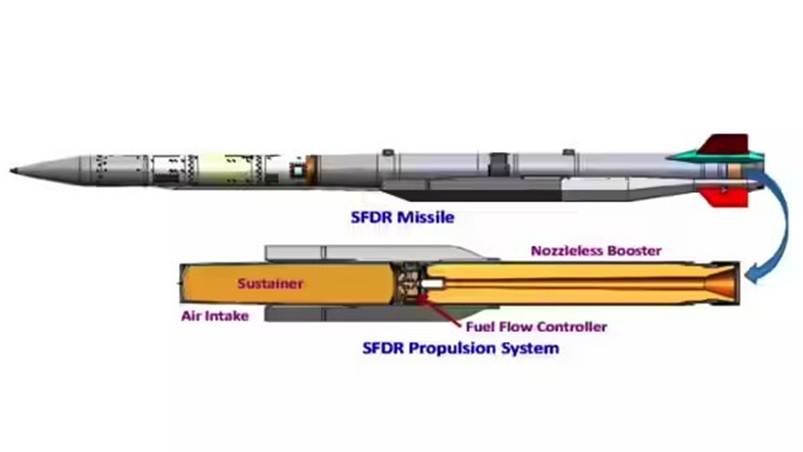
- Solid Fuel Ducted Ramjet (SFDR) is an advanced air-breathing propulsion system using solid fuel with ramjet combustion, enabling sustained supersonic speeds and higher missile range than conventional rockets.
- Unlike ballistic propulsion, SFDR uses atmospheric oxygen for combustion, improving fuel efficiency, range, and speed during cruise phase of missile flight.
- SFDR is particularly suited for beyond-visual-range (BVR) air-to-air missiles, enhancing aerial dominance and interception capability against agile enemy aircraft.
Strategic and security dimension
- SFDR-powered missiles allow longer engagement ranges, higher no-escape zones, and sustained high speeds, giving Indian fighters tactical superiority in contested airspaces.
- Strengthens India’s deterrence posture amid regional security competition with China and Pakistan, both investing heavily in advanced missile and air-combat technologies.
- Supports Indian Air Force need for long-range precision engagement, especially in high-altitude or maritime theatres.
Technological dimension
- SFDR integrates ramjet propulsion, nozzle-less boosters, and flame stabilisation systems, demanding high precision in materials, aerodynamics, and combustion control.
- Demonstrates India’s maturity in complex propulsion engineering, an area historically dominated by few advanced defence powers.
- Builds on DRDO’s earlier successes in BrahMos, Astra, Akash, and ballistic missile programmes.
Governance and institutional dimension
- Developed by DRDO with Indian industry partners, reflecting growing defence R&D ecosystem and private-sector participation in strategic technologies.
- Aligns with Defence Acquisition Procedure (DAP) and indigenisation push, reducing reliance on imported missile systems.
- Supports long-term goal of self-reliance in critical defence technologies.
Economic and industrial dimension
- Indigenous missile technologies reduce high-cost imports and save foreign exchange in defence procurement.
- Boosts domestic defence manufacturing ecosystem under Make in India and defence corridors.
- Potential future defence exports if integrated into operational missile systems.
Global and geopolitical dimension
- Only a few countries like USA, Russia, and some European powers possess operational ramjet/ducted ramjet missile technologies.
- Entry into this group enhances India’s technological credibility and strategic signalling.
- Supports India’s image as a major defence technology developer, not just importer.
Challenges and limitations
- Translating technology demonstration into reliable, deployable missile systems requires extensive user trials and integration with fighter platforms.
- High R&D and testing costs demand sustained funding and long-term policy support.
- Advanced propulsion systems require robust quality control and supply chains.
Way forward
- Accelerate integration of SFDR into Astra Mk-III or future BVR missile programmes for operational deployment.
- Expand collaboration between DRDO, startups, and private industry in propulsion and materials research.
- Invest in testing infrastructure and simulation capabilities to shorten development cycles.
- Link missile R&D with broader theatre command and airpower modernisation strategy.


