
Content
- Govt. unveils new CPI series; retail inflation in Jan. at 2.75%
- Dal Lake – environmental degradation and conservation challenges
- Substantive motion in Parliament
- Pothole-related road fatalities jumped 53% in 5 years
- How Tamil, Sanskrit, Prakrit names ended up on walls of Egyptian tombs
- Civil society, scientists raise alarm over safety gaps in WHO pandemic pact
Govt. unveils new CPI series; retail inflation in Jan. at 2.75%
Source :The Hindu
Why in news ?
New base year and latest inflation
- MoSPI released a new CPI series with base year 2024, replacing 2012, reporting January 2026 retail inflation at 2.75%, within RBI’s tolerance band.
- As it is the first release under the new base, long-term comparison with old series is limited, a common transition issue seen in statistical rebasing globally.
Relevance
- GS III (Indian Economy): Inflation measurement, monetary policy, RBI inflation targeting, statistics in policymaking.
Practice question
- Discuss the importance of accurate inflation measurement for monetary policy and welfare delivery in India.(250 Words)
Basics and static context
What is CPI and why it matters ?
- Consumer Price Index (CPI) measures change in retail prices of a fixed basket of goods and services consumed by households; it is India’s main indicator of inflation and cost of living.
- CPI is used by the RBI for inflation targeting (4% ±2%) under the Monetary Policy Framework Agreement, guiding repo rate decisions that affect loans, savings and growth.
Who compiles CPI ?
- CPI is compiled by MoSPI’s National Statistical Office (NSO) through nationwide price collection; methodology aligns with international standards used by UN, IMF and ILO for comparability.
- India publishes multiple CPIs (Rural, Urban, Combined), but CPI-Combined is the key headline number for macroeconomic policy and RBI targeting.
What changed in the new CPI ?
Updated consumption basket
- Total items increased from 299 to 358, reflecting diversification of consumption; goods rose to 308 and services to 50, capturing modern spending like telecom and services better.
- Basket weights are derived from HCES 2023–24, ensuring CPI mirrors current household spending, unlike outdated baskets that may over/understate inflation.
Wider data coverage
- Rural price collection expanded to 1,465 markets (from 1,181) and urban to 1,395 (from 1,114), improving geographical representation and statistical reliability.
- Larger sample sizes reduce volatility and bias, similar to how periodic updates improved accuracy in GDP and IIP series.
Economic rationale for rebasing
Reflecting structural change
- Over a decade, rising incomes, urbanisation and digitalisation shift spending toward services, health, education and communication, requiring updated CPI weights.
- Without rebasing, inflation may be mismeasured; for example, over-weighting cereals when diets diversify could distort true cost-of-living changes.
Policy credibility
- Accurate CPI strengthens monetary policy credibility, as RBI decisions depend on realistic inflation signals.
- Investors and rating agencies rely on credible inflation data for macroeconomic assessments.
Limitations and cautions
Comparability issues
- New base breaks direct comparison with older series; analysts often create back-casted series later for continuity.
- Short-term movements may reflect methodological shifts as well as real price changes.
Data challenges
- Informal markets, quality changes and new products complicate price measurement, a universal CPI challenge noted by statistical agencies worldwide.
- Rapid tech evolution (e.g., smartphones) requires frequent basket updates to avoid substitution bias.
Way forward
Strengthening price statistics
- Regular 5-year rebasing cycles can keep CPI aligned with fast-changing consumption patterns.
- Greater use of digital price collection and scanner data can improve timeliness and coverage.
Communication and transparency
- Clear public communication on methodology helps avoid misinterpretation of inflation trends during base changes.
- Publishing concordance tables between old and new series aids researchers and policymakers.
CPI vs WPI
| Feature | CPI (Consumer Price Index) | WPI (Wholesale Price Index) |
| Meaning | Measures change in retail prices faced by consumers | Measures change in wholesale prices at producer/wholesaler level |
| Compiled by | NSO (MoSPI) | Office of Economic Adviser, DPIIT (Ministry of Commerce) |
| Base Year (latest) | 2024 (new series) | 2011–12 |
| Purpose | Measures cost of living & inflation for consumers | Measures price trends in bulk trade/production |
| Coverage | Goods + Services | Only Goods (no services) |
| No. of items | ~358 items (new series) | ~697 items |
| Major weight | Food & beverages have high weight (~45% earlier series) | Manufactured products have highest weight (~64%) |
| Population scope | CPI-Rural, CPI-Urban, CPI-Combined | Single national index |
| Policy relevance | RBI uses CPI for inflation targeting (4% ±2%) | Used for business decisions, deflator in national accounts |
| Reflects | Demand-side inflation (consumer impact) | Supply-side/producer inflation |
| Volatility | More volatile due to food & fuel | Less volatile than CPI in many cases |
| Global comparability | Internationally used for inflation targeting | Less used globally for policy targeting |
| Example use | DA revision, wage indexation | Industrial price trends, contract escalation |
Dal Lake – environmental degradation and conservation challenges
Source :The Hindu
Why in news ?
Policy shift in conservation
- J&K government shelved the ₹416.72-crore Dal restoration plan (approved 2009) and proposed an in-situ conservation approach, allowing dwellers to continue living on the lake.
- The earlier plan targeted relocation of ~9,000 families, but only 1,808 families were rehabilitated in 17 years, achieving about 27% of intended conservation outcomes.
Relevance
- GS III (Environment): Wetland degradation, eutrophication, urban ecology, conservation policy.
- GS I (Geography): Lakes, catchment impacts, land-use change.
Practice question
- What is eutrophication and how does it affect urban lakes like Dal?(250 Words)
Basics and static context
Location and physical features
- Dal Lake is an urban freshwater lake in Srinagar, Jammu & Kashmir, fed by springs and channels from the Zabarwan range, historically covering ~22–25 sq km including marshes and floating gardens.
- It is divided into basins like Gagribal, Lokut Dal, Bod Dal and Nigeen, with interconnected channels; shallow depth and slow flushing make it naturally vulnerable to pollution accumulation.
Ecological and economic significance
- Dal Lake supports tourism, fisheries, lotus cultivation and houseboat livelihoods, forming a key part of Kashmir’s economy and cultural identity.
- It functions as an urban ecological buffer, moderating microclimate, supporting biodiversity, and storing floodwaters in the Jhelum basin.
Environmental pressures
Sewage and pollution load
- Untreated sewage from households, hotels and houseboats enters the lake through point and non-point sources; SKUAST (2022) flagged “extreme pollution loads” and deteriorating water quality.
- High organic load raises BOD and nutrient levels, accelerating eutrophication, a pattern also observed in other urban lakes like Bengaluru’s Bellandur.
Eutrophication and weed growth
- Excess nitrogen and phosphorus from sewage and fertilisers cause algal blooms and macrophyte overgrowth, choking open water and reducing dissolved oxygen for fish.
- Proliferation of weeds like Eichhornia (water hyacinth) reduces water spread and impedes navigation and recreation.
Catchment degradation
- Deforestation, grazing and agriculture in the catchment increase silt and nutrient inflow, shrinking effective water area and altering lake morphology.
- Land use change in the Zabarwan foothills has increased runoff and sedimentation, a common driver of lake ageing.
Encroachment and population pressure
- Expansion of settlements, houseboats and floating gardens (raad) leads to encroachment and solid waste generation, converting water areas into marshy land.
- Urban lakes worldwide show similar stress where shoreline regulation is weak, e.g., Dal-like pressures on Nainital Lake.
Reduced inflows and circulation
- Blocked or reduced inflows and internal channels lower water circulation and flushing, concentrating pollutants and accelerating stagnation.
- Hydrological fragmentation disrupts natural self-cleansing capacity of the lake.
Invasive species and biodiversity loss
- SKUAST noted invasive plants and animals altering native biodiversity; invasive macrophytes outcompete native flora and change habitat structure.
- Biodiversity simplification reduces ecological resilience and fisheries productivity.
Substantive motion in Parliament
Source : The Hindu
Basics and concept
What is a substantive motion ?
- A substantive motion is a self-contained, independent proposal submitted for the decision of the House, drafted to express a definite opinion, will, or order of Parliament.
- It is different from subsidiary or procedural motions because it does not depend on another motion and itself becomes the subject of debate and voting in the House.
Source in parliamentary practice
- Not explicitly in the Constitution but derived from Rules of Procedure of Lok Sabha and Rajya Sabha and classical texts like Kaul & Shakdher: Practice and Procedure of Parliament.
- Rooted in the Westminster parliamentary tradition, where motions are primary tools for the House to articulate collective decisions and hold members or government accountable.
Relevance
- GS II (Polity & Governance): Parliamentary procedures, legislative accountability, deliberative democracy.
Practice question
- What is a substantive motion? How is it different from other motions?(150 Words)
Types and scope
Common examples
- Motion of Thanks to the President’s Address, election/removal motions for Speaker or Deputy Speaker, and motions on matters of public importance are classic substantive motions.
- Substantive motions can relate to privileges, conduct of members, or policy positions, provided they meet admissibility rules and are framed in proper parliamentary language.
Who can move it ?
- Usually moved by any member who gives prior notice; in certain cases (like motions concerning ministers), conventions and rules determine who may move it.
- Notice period and format are regulated by the Rules of Procedure, ensuring seriousness and preventing frivolous use.
Procedure
Admissibility and listing
- The Speaker/Chairman decides admissibility, checking relevance, clarity, and conformity with rules; motions cannot raise matters sub judice or violate privilege norms.
- Once admitted, it is listed for business, and time for discussion is allocated by the Business Advisory Committee or by the Chair.
Debate and voting
- Members debate the motion; the mover has a right of reply at the end of discussion, a key feature of substantive motions.
- The motion is then put to vote; if passed, it becomes the formal decision or opinion of the House.
Constitutional and governance relevance
Link with collective responsibility
- Though distinct from a no-confidence motion, substantive motions contribute to the system where the executive is accountable to the legislature under Article 75 (collective responsibility).
- They provide a structured way for Parliament to record positions on governance, ethics, and institutional matters.
Instrument of deliberative democracy
- They enable discussion on public issues beyond routine law-making, strengthening Parliament’s role as a deliberative forum, not merely a legislative factory.
- By requiring formal notice and voting, they promote reasoned debate and recorded decisions, key to transparent governance.
Distinction from other motions
Vs. no-confidence motion
- A no-confidence motion targets the Council of Ministers and, if passed, has direct political consequences; a substantive motion may not necessarily test government majority.
- All no-confidence motions are substantive, but not all substantive motions are no-confidence motions, showing broader scope.
Vs. adjournment and calling attention
- Adjournment motions are exceptional devices to discuss urgent matters and interrupt normal business; they have stricter admissibility and are not routine substantive expressions of House opinion.
- Calling attention is informational and does not culminate in a formal decision of the House, unlike substantive motions that end in a vote.
Significance
Institutional accountability
- Substantive motions can address conduct of high authorities or members, helping maintain ethical standards and institutional integrity within Parliament.
- They create a formal parliamentary record, which can guide future conventions and interpretations.
Democratic value
- They operationalise the idea that Parliament is the sovereign deliberative body in a parliamentary democracy, expressing the will of the people through elected representatives.
- Their structured nature balances free speech of members with procedural discipline.
Types of Motions in Indian Parliament
| Type of Motion | Meaning / Purpose | Key Features | Example / Use |
| Substantive Motion | Independent, self-contained proposal for House decision | Needs notice; debated and voted; expresses definite opinion/will of House | Motion of Thanks to President’s Address |
| Substitute Motion | Moved in place of original motion | If adopted, replaces original; must relate to same subject | Alternative version of a policy motion |
| Subsidiary Motion | Depends on another motion | Cannot stand alone; aids discussion or disposal of main motion | Amendments, procedural motions |
| Amendment Motion | Seeks to modify a motion | Can add/delete/alter words; voted before main motion | Amending Motion of Thanks |
| No-Confidence Motion | Tests majority of Council of Ministers | Lok Sabha only; needs 50 members’ support to admit; if passed, govt resigns | Used to remove government |
| Confidence Motion (Trust Vote) | Govt proves majority | Initiated by govt; simple majority required | During coalition uncertainty |
| Adjournment Motion | Raises urgent matter of public importance | Interrupts normal business; exceptional device; LS mainly | Major accident/scam issue |
| Calling Attention Motion | Draws minister’s attention to urgent matter | Minister makes statement; no voting; informational | Law & order issue |
| Privilege Motion | Addresses breach of parliamentary privilege | Against MP/minister for misleading House | False statement in House |
| Censure Motion | Expresses strong disapproval of govt policy | Must state reasons; LS; political pressure but not removal | Policy failure criticism |
| Cut Motions | Reduce demands in Budget | Types: Policy, Economy, Token; tool for financial control | Reduce demand for a ministry |
| Half-Hour Discussion Motion | Clarifies matters needing explanation | Based on starred/unstarred questions; short duration | Clarifying policy detail |
| Closure Motion | Ends debate | If accepted, House votes on main motion | To avoid prolonged debate |
Pothole-related road fatalities jumped 53% in 5 years
Source : Indian Express
Basics and static context
What counts as pothole-related accidents ?
- Pothole-related accidents are crashes where road surface defects directly cause loss of control, recorded in police FIRs and compiled by MoRTH in its annual Road Accidents in India reports.
- They fall under infrastructure-related causes, alongside poor signage and road design; globally, WHO notes road infrastructure quality significantly influences crash risks, especially for two-wheelers and pedestrians.
Scale of the problem in India
- India records about 1.7 lakh road deaths annually (2024), the highest in the world; even small shares from potholes translate into thousands of preventable deaths.
- India has the second-largest road network (~63 lakh km), including ~1.46 lakh km of National Highways, making maintenance a massive governance and fiscal challenge.
Relevance
- GS III (Infrastructure): Road safety, public infrastructure management.
- GS II (Governance): Accountability of agencies, urban governance.
Practice question
- Road accidents in India are as much a governance failure as a transport issue. Discuss with reference to pothole deaths.(250 Words)
Why in news ?
Sharp rise in fatalities
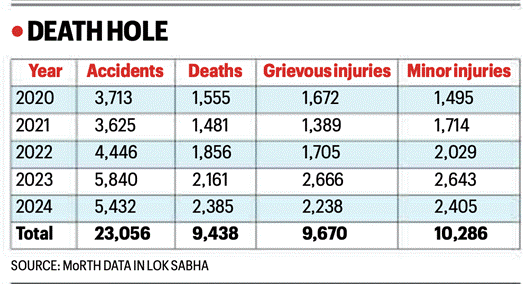
- Lok Sabha data show pothole deaths rose from 1,555 (2020) to 2,385 (2024) — a 53% jump, signalling worsening road maintenance outcomes despite rising infrastructure spending.
- Total pothole-linked deaths over 2020–24 reached 9,438, averaging nearly 5 deaths daily, highlighting that potholes are not minor defects but serious safety hazards.
Data and trends
Accident and injury pattern
- Pothole accidents increased from 3,713 (2020) to 5,432 (2024); grievous injuries also remained high, showing that many victims survive with long-term disabilities.
- Minor injuries crossed 10,000 cases in five years, indicating a broader safety burden beyond fatalities, including healthcare costs and productivity losses.
State-wise concentration
- Uttar Pradesh contributes the largest share of deaths, consistent with its overall high road fatality numbers and vast road network.
- MP, Punjab, Tamil Nadu, Assam together account for over 80% of pothole deaths, showing regional clustering linked to traffic density and maintenance gaps.
Governance and policy dimension
Maintenance vs construction bias
- India’s road policy has prioritised new highway construction, but maintenance budgets and monitoring often lag, leading to rapid deterioration, especially after monsoons.
- Contracts sometimes focus on asset creation, not lifecycle upkeep; performance-based maintenance is less uniformly enforced across states and urban local bodies.
Accountability issues
- Multiple agencies (NHAI, PWDs, municipalities) share responsibility, causing diffused accountability when pothole deaths occur.
- Though courts have occasionally held authorities liable, routine criminal or financial accountability for negligence remains rare.
Economic and social implications
Economic costs
- Road crashes cost India an estimated ~3–5% of GDP annually (various government and World Bank estimates); pothole crashes add to repair costs, medical bills and productivity losses.
- Logistics delays from poor road quality raise transport costs, indirectly affecting inflation and competitiveness.
Social justice angle
- Victims are often two-wheeler riders and lower-income commuters, who are more exposed and less protected than car occupants.
- Families of victims face sudden income shocks, linking road safety with poverty and social protection concerns.
Environmental and urban angle
Urban flooding and potholes
- Poor drainage and waterlogging accelerate pothole formation; cities with clogged stormwater systems see roads degrade quickly after heavy rains.
- Climate change–linked extreme rainfall events can worsen this cycle, raising maintenance demands.
Challenges and way forward
Structural challenges
- Reactive “patchwork repairs” dominate over scientific resurfacing, leading to recurring potholes within a single season.
- Weak data integration between police, transport and road agencies limits targeted interventions on blackspots.
Reform priorities
- Adopt performance-based maintenance contracts with penalties for defects, as used in some highway PPP models.
- Use geo-tagging, citizen-reporting apps and third-party audits to monitor road quality; some cities already pilot such digital grievance systems.
- Integrate road safety with Safe System Approach (safer roads, vehicles, speeds, users, post-crash care) recommended by WHO.
How Tamil, Sanskrit, Prakrit names ended up on walls of Egyptian tombs
Source : Indian Express
Why in news ?
New academic findings
- Recent publication of the 30-inscription corpus strengthens evidence of early India–Egypt links, moving beyond speculative trade theories to direct epigraphic proof of Indian presence in Egypt.
- It feeds into broader debates on ancient globalisation, showing mobility across the Red Sea and Indian Ocean two millennia ago, comparable to Roman–Indian trade evidenced by Muziris finds.
Relevance
- GS I (Ancient History & Culture): Indo-Roman trade, cultural contacts.
Practice question
- What do Indian inscriptions in Egypt reveal about ancient trade networks?(150 Words)
Basics and historical context
What are these inscriptions
- Graffiti-style inscriptions in Tamil-Brahmi, Prakrit and Sanskrit found in Egypt’s Valley of the Kings (c. 300 BCE–200 CE), showing visiting foreigners carved names, origins, and devotional messages, like ancient travel records.
- Unlike royal hieroglyphs, these are informal visitor inscriptions, similar to pilgrimage graffiti at Indian Buddhist sites like Sanchi, where travellers recorded names, places, and religious sentiments.
Who deciphered them ?
- A 2024–25 study by Charlotte Schmid (EFEO, Paris) documented 30 Indian-language inscriptions, using epigraphy and comparative linguistics to identify Tamil-Brahmi scripts and Indo-Aryan linguistic features.
- Cross-referencing letter forms with Sangam-era Tamil-Brahmi (3rd BCE onward) helped date inscriptions, as shapes of “ra,” “na,” and vowel markers match early South Indian cave inscriptions.
What the names show ?
- Names like “Korran,” “Kopan,” and “Saman” resemble Tamil and Prakrit naming traditions; for example, “Korran” parallels Sangam titles for chieftains and warriors in Chera–Pandya regions.
- Some inscriptions include place-based identifiers, implying travellers linked identity to homeland, similar to donative inscriptions in India stating “so-and-so from Karur or Madurai.”
Trade and connectivity dimension
Indian Ocean trade networks
- Between 1st BCE–2nd CE, Indo-Roman trade flourished; Roman coins found in Tamil Nadu and the Periplus of the Erythraean Sea describe Indian merchants sailing to Egyptian Red Sea ports like Berenike.
- These inscriptions suggest some traders or pilgrims travelled onward to the Nile valley, showing routes were not just maritime but linked to inland cultural landmarks.
Cultural cosmopolitanism
- Ancient port cities like Alexandria and Berenike were multicultural hubs; archaeological finds include Indian beads and pepper, supporting textual evidence of Indo-Mediterranean exchange.
- Multilingualism was common among merchant groups; Prakrit and Tamil functioning as trade languages parallels use of Aramaic or Greek across West Asian trade corridors.
Social and cultural insights
Travel motivations
- Not all travellers were merchants; some inscriptions resemble pilgrimage-style declarations, suggesting curiosity, ritual travel, or status display, similar to elites visiting sacred or famous sites.
- Valley of the Kings was a famed site even in antiquity; Greek and Latin graffiti there show it functioned as an early tourist destination by 1st millennium BCE–CE.
Identity expression
- Writing one’s name in native script abroad signals strong cultural identity; comparable to Indian merchant guild inscriptions in Southeast Asia asserting community presence.
- Scripts acted as cultural markers; Tamil-Brahmi use abroad indicates literacy among sections of early South Indian trading communities.
Historiographical significance
Rethinking isolationist views
- Findings challenge older views that ancient Indian societies were regionally confined, instead supporting models of long-distance mobility and interaction across Afro-Eurasia.
- They complement evidence like Indian cotton in Egypt and Roman gold in South India, forming a multi-source case for deep connectivity.
Limits of evidence
- Small sample size (≈30 inscriptions) means presence, not population scale; like Roman coins in India, they indicate contact but not large migration.
- Epigraphy shows who left marks, not entire communities; absence of evidence elsewhere doesn’t negate wider interaction networks.
Civil society, scientists raise alarm over safety gaps in WHO pandemic pact
Source : Down to Earth
Why in news ?
Ongoing WHO negotiations
- WHO members are negotiating the PABS annex before the 79th World Health Assembly (May 2026), making it the last unresolved operational pillar of the first global pandemic treaty.
- February 2026 open letters from scientists and civil society flagged weak biosecurity and diluted benefit-sharing, warning current draft may prioritise speed over safety and fairness.
Relevance
- GS II (IR): Global health governance, WHO reforms, equity in global commons.
- GS III (S&T + Health): Biosecurity, biotechnology risks.
Practice question
- COVID-19 exposed inequities in global health governance. Discuss how new pandemic agreements can address these gaps.(250 Words)
Basics and static context
What is pathogen sharing and why it exists ?
- Pathogen sharing involves countries providing virus samples and genetic sequences to global databases for surveillance, vaccine R&D and diagnostics; e.g., rapid SARS-CoV-2 sequencing in 2020 enabled mRNA vaccine design within months.
- WHO-led systems like GISRS for influenza since 1952 show pathogen sharing accelerates risk detection; seasonal flu vaccines are reformulated biannually using globally shared strains, demonstrating long-standing public-health value.
What is PABS under the Pandemic Agreement ?
- Pathogen Access and Benefit Sharing (PABS) links rapid sharing of pathogens with fair access to vaccines, drugs and diagnostics; conceptually similar to WHO’s Pandemic Influenza Preparedness (PIP) Framework.
- The Pandemic Agreement (2025) emerged after COVID-19 exposed governance gaps; despite COVAX, high-income countries pre-purchased large shares of early doses, leaving low-income countries dependent on donations and delayed supply.
Global equity dimension
COVID-era lessons
- During COVID-19, over 70% of people in low-income countries had not received a first dose by mid-2021, while many rich countries had surplus contracts, illustrating structural inequity in vaccine access.
- Countries like South Africa shared variant data (e.g., Omicron) but later faced travel bans and delayed vaccine access, creating distrust around “share-now, benefit-later” arrangements.
Biosecurity and technology risks
Misuse of genetic data
- Public genetic sequences can enable synthetic reconstruction of viruses; in 2017, researchers recreated horsepox virus, showing feasibility of synthesising large viral genomes using commercially available DNA fragments.
- Costs of DNA synthesis have fallen sharply over two decades, lowering entry barriers for advanced labs and raising dual-use concerns when oversight and identity verification are weak.
AI and synthetic biology
- AI tools can assist in protein design and sequence optimisation; while beneficial for vaccines, the same tools could hypothetically help design more transmissible or immune-evasive variants if misused.
- Experts note bio-risk now combines digital (cyber + data) and biological domains, requiring cybersecurity standards for genomic databases similar to those used in critical digital infrastructure.
Governance and legal concerns
Accountability gaps
- Civil society letters argue draft PABS makes benefit sharing optional, allowing companies to choose contribution types; contrast this with PIP Framework where manufacturers commit specific benefit contributions.
- Lack of mandatory reporting for lab accidents or cyber breaches contrasts with biosafety norms in many countries where notifiable incidents are legally reportable to regulators.
Transparency deficits
- Critics highlight limited pre-sharing of negotiation texts and restricted civil society participation, unlike some climate negotiations where draft texts are circulated widely for stakeholder input.
Public health and development implications
Trust and cooperation
- If countries fear unfair returns, they may delay sharing samples; Indonesia in 2007 withheld H5N1 samples over vaccine access concerns, showing how equity disputes can hinder surveillance.
- Reduced sharing slows variant detection, undermining early warning systems that saved time during Ebola, Zika and COVID-19 responses.
Way forward
Stronger safeguards
- Mandate verified identities and access logs for genomic databases, similar to controlled-access clinical data repositories used for human genome research.
- Require reporting of lab incidents and risky research, aligning with Biosafety Level (BSL) norms already applied in high-containment laboratories worldwide.
Fair benefit sharing
- Create binding financial and product commitments from companies, with predefined shares for WHO stockpiles, learning from advance market commitments used in pneumococcal vaccines.
- Guarantee technology transfer and licensing during emergencies, as seen in mRNA tech-transfer hubs supported by WHO in countries like South Africa.


