
A. Issue in Brief
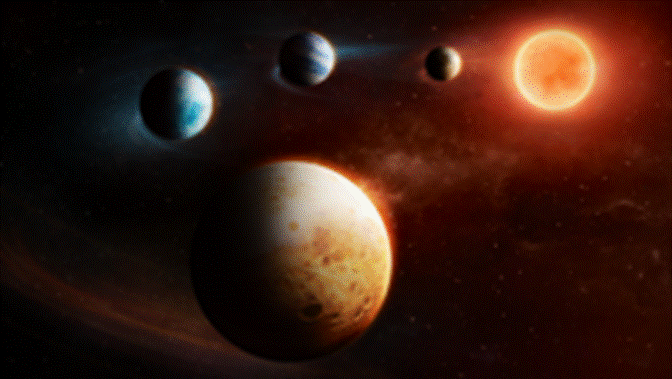
- Astronomers identified a four-planet system around red dwarf star LHS 1903 (117 light-years away) that challenges existing planet formation theories.
- System contains 2 rocky super-Earths + 2 gaseous mini-Neptunes, but unusually the outermost planet is rocky instead of gaseous, contradicting classical models.
- Observed using ESA’s CHEOPS (Characterising Exoplanet Satellite) space telescope dedicated to exoplanet studies.
- One rocky planet has estimated surface temperature ~60°C, placing it near the inner edge of habitable conditions.
Relevance
- GS-III (Science & Technology — Space)
- Exoplanets, astronomy
- Space missions and telescopes
B. Static Background
What are Exoplanets?
- Planets outside our solar system; over 5,500 exoplanets confirmed (NASA Exoplanet Archive, recent data).
- Detection methods:
- Transit method (most common)
- Radial velocity
- Direct imaging
Planet Formation Theory
- Standard model:
- Planets form in a protoplanetary disk of gas and dust.
- Inner planets = rocky (gas evaporates due to heat).
- Outer planets = gaseous (retain hydrogen-helium).
- LHS 1903 system deviates from this expected pattern.
Red Dwarf Stars
- Make up ~70–75% of stars in Milky Way.
- Smaller, cooler, longer-lived than Sun:
- LHS 1903 is ~50% Sun’s mass
- Only ~5% Sun’s luminosity
- Habitable zones closer to the star due to low luminosity.
C. Key Dimensions
1) Scientific Significance
- Rocky outer planet suggests:
- Sequential formation rather than simultaneous.
- Gas depletion before last planet formed.
- Alternative hypothesis:
- Planet lost atmosphere due to stellar radiation or collision.
2) Habitability Angle
- Surface temperature ~60°C:
- High but potentially within extremophile tolerance.
- Habitability also depends on:
- Atmosphere
- Water presence
- Magnetic field
- Many potentially habitable exoplanets found around red dwarfs.
3) Technology & Space Science
- CHEOPS mission (launched 2019):
- ESA mission focused on characterising known exoplanets.
- Measures planet size, density, and orbit.
- Complements missions like:
- NASA’s TESS
- James Webb Space Telescope
D. Critical Analysis
Opportunities for Science
- Forces refinement of planetary formation models.
- Improves understanding of atmospheric evolution and planetary migration.
- Expands search criteria for habitable worlds.
Limitations
- Habitability inference based on temperature alone is incomplete.
- Red dwarfs emit strong stellar flares:
- Can strip atmospheres and harm life prospects.
- Distance (117 light-years) makes direct study difficult.
E. Way Forward
- Use JWST spectroscopy to detect atmospheric gases.
- Study more red dwarf systems to see if pattern repeats.
- Integrate findings into next-gen planet formation simulations.
F. Exam Orientation
Prelims Pointers
- Exoplanets = planets outside solar system.
- Red dwarfs most common stars.
- CHEOPS = ESA exoplanet mission.
- Super-Earth vs mini-Neptune distinction.
Mains Practice Question (10–15M)
- “Recent exoplanet discoveries are reshaping our understanding of planetary formation and habitability.”Discuss with examples.


