
Content
- Supreme Court Upholds ‘Right to Die with Dignity’ for Man in Vegetative State
- How the War in West Asia Exposes India’s LPG Dependence
- A Revision of GDP and its Implications
- Creamy Layer Status of OBCs Cannot Be Decided Solely by Salary Income: Supreme Court
- India’s Renewable Transition Caught Between Stranded Power and Institutional Inertia
- Impeachment Motion Against Chief Election Commissioner (CEC)
- LIGO-India Gravitational Wave Observatory: Project in Limbo
- Jal Jeevan Mission 2.0: Cabinet Approves Extension till 2028
Supreme Court Upholds ‘Right to Die with Dignity’ for Man in Vegetative State
Why in News?
- The Supreme Court upheld the right to die with dignity of Harish Rana, a 32-year-old man in a persistent vegetative state for nearly 13 years.
- The Court permitted withdrawal of Clinically Assisted Nutrition and Hydration (CANH) and directed his transfer to AIIMS Delhi for implementation of the decision.
- The judgment clarified the distinction between active euthanasia and passive euthanasia, reaffirming constitutional protections for end-of-life dignity.
Relevance
GS Paper II – Polity
- Fundamental rights and judicial interpretation of Article 21 (Right to Life)
- Legal framework governing euthanasia in India
GS Paper IV – Ethics
- Medical ethics and end-of-life decisions
- Autonomy, dignity, and compassionate care
Practice Question
- Discuss the constitutional and ethical dimensions of the “right to die with dignity” in India. How has the Supreme Court shaped the legal framework governing withdrawal of life-support treatment? (250 words)
Case Background
- Harish Rana, a former student of Panjab University, suffered severe head injuries after a fall in 2013, leaving him in a persistent vegetative state with 100% quadriplegic disability.
- His parents approached the Supreme Court seeking permission to withdraw life-supporting treatment, arguing that continued intervention only prolonged suffering.
- The Court allowed withdrawal of clinically assisted nutrition and hydration (CANH) following medical evaluation.
Supreme Court’s Key Observations
Right to Die with Dignity
- The Court reaffirmed that the right to life under Article 21 includes the right to die with dignity in cases of irreversible medical conditions.
Distinction Between Active and Passive Euthanasia
Active Euthanasia
- Involves deliberate intervention to cause death, such as administering a lethal injection.
- Death occurs due to a new external act initiated by the physician.
- Illegal in India.
Passive Euthanasia
- Involves withdrawing or withholding life-sustaining treatment such as ventilators or artificial nutrition.
- Death occurs due to the natural progression of the patient’s underlying illness, not because of medical intervention.
- Permissible under strict guidelines.
Evolution of Euthanasia Law in India
Aruna Shanbaug Case (2011)
- Supreme Court allowed passive euthanasia under strict judicial supervision.
- Required High Court approval for withdrawal of life support.
Common Cause Case (2018)
- Constitution Bench recognised right to die with dignity under Article 21.
- Legalised living wills or advance directives.
- Allowed withdrawal of life support with approval of two medical boards.
Procedure for Withdrawal of Life Support
Medical Evaluation
- Treating physicians must confirm that the patient has no reasonable chance of recovery.
Two Medical Boards
- A primary hospital medical board reviews the patient’s condition.
- A secondary independent medical board confirms the decision.
Consent and Implementation
- The decision must involve consultation with family members and proper documentation.
- Life-support measures may then be withdrawn in a controlled medical setting.
Ethical Dimensions
Autonomy
- Respecting patient wishes reflects the ethical principle of individual autonomy in medical decision-making.
Dignity in Death
- Allowing withdrawal of futile treatment ensures a death free from unnecessary suffering and prolonged medical intervention.
Compassionate Care
- The Court described the decision as an act of compassion rather than surrender, recognising the emotional burden on families.
Implementation Challenges
Lack of Awareness
- Many doctors and families remain unaware of legal provisions governing withdrawal of life support.
Fear of Criminal Liability
- Medical practitioners often hesitate due to fear of legal consequences or litigation.
Institutional Barriers
- Hospitals may lack clear protocols and trained medical boards for such decisions.
Family Disagreements
- Differences among family members can complicate end-of-life decisions.
Significance of the Judgment
Strengthening Patient Rights
- Reinforces the constitutional principle that life must be lived with dignity, including at its end.
Clarity in Medical Ethics
- Provides clearer distinction between active euthanasia and withdrawal of treatment.
Humanising End-of-Life Care
- Encourages compassionate decision-making for patients with irreversible medical conditions.
Way Forward
Standardised Medical Protocols
- Hospitals should develop clear guidelines for withdrawal of life-support treatment.
Awareness Among Medical Practitioners
- Training and legal awareness programmes for doctors can reduce hesitation.
Public Awareness of Living Wills
- Encouraging individuals to create advance medical directives can simplify decision-making.
Conclusion
- The Supreme Court’s ruling reaffirms that the right to life under Article 21 includes the right to die with dignity. By clarifying the legal and ethical framework governing withdrawal of life-support treatment, the judgment strengthens compassionate healthcare practices while maintaining safeguards against misuse.
How the war in West Asia exposes India’s LPG dependence
Why in News?
- The U.S.–Israel–Iran conflict and tensions around the Strait of Hormuz have raised concerns about disruptions in India’s Liquefied Petroleum Gas (LPG) supply.
- India imports around 60% of its LPG requirements, mainly from West Asian countries, making it vulnerable to geopolitical disruptions.
- Domestic LPG prices recently increased by ₹60 per cylinder, reflecting rising global energy prices.
Relevance
GS Paper III – Economy
- Energy security and import dependence
- Petroleum pricing and subsidy policies
GS Paper II – International Relations
- Impact of West Asian geopolitics on India’s energy supply
GS Paper III – Environment
- Transition toward cleaner cooking fuels
Practice Question
- India’s growing LPG consumption has improved clean energy access but increased import dependence. Examine the challenges this poses for India’s energy security and suggest measures to address them. (250 words)
Basics: What is LPG?
Definition
- Liquefied Petroleum Gas (LPG) is a mixture of propane and butane gases compressed into liquid form for easier storage and transport.
- It is widely used for:
- Household cooking
- Industrial heating
- Commercial kitchens
- Transport fuel in some cases.
Advantages of LPG
- Cleaner than traditional fuels such as firewood, coal, or kerosene.
- Produces lower particulate emissions, reducing indoor air pollution.
- Improves health outcomes, especially for women and children.
LPG Sector in India
Domestic Production vs Imports
- India produces about 40% of its LPG requirement domestically.
- The remaining 60% is imported, making the country highly dependent on international markets.
Rising LPG Consumption
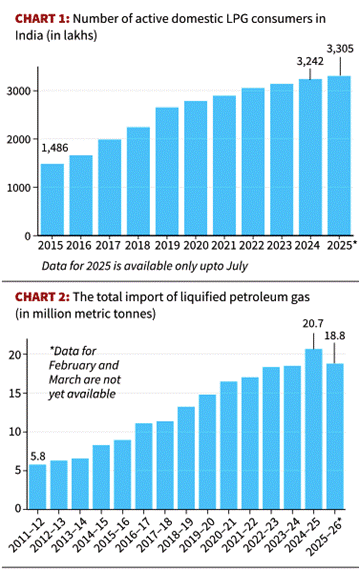
- The number of domestic LPG consumers increased from 1,486 lakh in 2015 to 3,305 lakh by July 2025, a rise of more than 120% in a decade.
- LPG coverage increased from 62% of households in 2016 to nearly universal coverage today.
Government Schemes Promoting LPG
Pradhan Mantri Ujjwala Yojana (PMUY)
- Launched in 2016 to provide free LPG connections to women from poor households.
- Aims to reduce indoor air pollution and promote clean cooking fuels.
Direct Benefit Transfer for LPG (PAHAL)
- Subsidies are transferred directly to beneficiaries’ bank accounts.
- Reduces leakages and improves targeting.
Ujjwala 2.0
- Extended benefits to migrant households and additional beneficiaries.
- Simplified documentation for LPG connections.
India’s LPG Import Dependence
Major Import Sources
- Qatar – about 34% of India’s LPG imports
- UAE – about 26%
- Kuwait – about 8%
- Most imports come from West Asia, making supply vulnerable to geopolitical disruptions.
Strategic Shipping Route
- The Strait of Hormuz, located between Iran and Oman, is one of the world’s most critical energy chokepoints.
- A significant share of global oil and gas shipments passes through this narrow waterway.
- Closure or disruption can severely impact India’s LPG and LNG imports.
Rising LPG Imports
- India’s LPG imports increased from 16.48 million metric tonnes (MMT) in 2020-21 to over 18 MMT in 2025-26.
- According to the International Energy Agency (IEA), India’s LPG imports have nearly tripled over the past decade due to clean cooking programmes.
LNG and Energy Linkages
- India’s Liquefied Natural Gas (LNG) imports reached 27 MMT in 2024-25, the highest ever.
- LNG is used in:
- Fertiliser production
- Electricity generation
- Transport and commercial kitchens.
- About half of India’s LNG imports also come from Qatar.
Government Response to Supply Risks
Boosting Domestic Production
- The government directed oil refineries and petrochemical complexes to maximise LPG production.
- Refiners were instructed to divert LPG output from petrochemicals to domestic cooking gas supply.
Prioritising Household Consumption
- Public Sector Oil Marketing Companies (OMCs) such as:
- Indian Oil Corporation (IOCL)
- Bharat Petroleum Corporation (BPCL)
- Hindustan Petroleum Corporation (HPCL)
- have been directed to prioritise domestic LPG supply.
Fiscal Burden of LPG Subsidy
- The government compensated OMCs with ₹30,000 crore in 2024 to offset losses from selling LPG at subsidised prices.
- However, the 2026-27 Union Budget reduced LPG subsidy allocation by 27%, from ₹15,121 crore to ₹11,085 crore.
Challenges Facing India’s LPG Sector
High Import Dependence
- Heavy reliance on West Asian suppliers exposes India to geopolitical risks.
Price Volatility
- Global oil price spikes, such as Brent crude rising close to $120 per barrel, increase LPG prices.
Fiscal Pressure
- Rising subsidies place pressure on government finances and public oil companies.
Energy Security Risks
- Disruptions in maritime routes like the Strait of Hormuz can threaten fuel availability.
Way Forward
Diversifying Import Sources
- Expanding LPG import partnerships beyond West Asia can reduce supply concentration risks.
Increasing Domestic Production
- Enhancing refinery capacity and natural gas processing can boost domestic LPG supply.
Strategic Energy Reserves
- Developing LPG storage infrastructure and strategic reserves can cushion supply shocks.
Promoting Alternative Clean Fuels
- Expanding electric cooking, biogas, and solar cooking technologies can reduce dependence on imported LPG.
Conclusion
- India’s rapid transition to clean cooking fuels has increased LPG consumption significantly, improving health and environmental outcomes. However, the country’s heavy reliance on imports, especially from geopolitically sensitive regions, poses major energy security challenges. Strengthening domestic production, diversifying supply sources, and promoting alternative clean energy solutions will be essential to ensure long-term energy stability.
A revision of GDP and its implications explained
Why in News?
- The National Statistical Office (NSO) released a new GDP series with base year 2022–23, replacing the earlier 2011–12 base year series after an 11-year gap.
- The revision was significant because the 2011-12 GDP series faced criticism from economists and international agencies regarding reliability and methodology.
- The revision also follows updated global statistical standards under the UN System of National Accounts (SNA) 2025 framework.
Relevance
GS Paper III – Economy
- National income accounting
- GDP measurement and economic statistics
- Structural changes in the economy
GS Paper II – Governance
- Institutional credibility of statistical agencies
- Evidence-based policymaking
Practice Question
- Why are GDP base year revisions necessary in national income accounting? Discuss the key changes introduced in India’s new GDP series with base year 2022–23 and their implications for economic analysis. (250 words)
What is GDP?
Definition
- Gross Domestic Product (GDP) measures the total value of final goods and services produced within a country during a specific period, usually one year.
- It represents the size and performance of an economy and is the most widely used macroeconomic indicator.
GDP and Gross Value Added (GVA)
- GDP is calculated by aggregating Gross Value Added (GVA) across all sectors and adding taxes while subtracting subsidies.
- GVA measures the value created by each sector of the economy after subtracting intermediate inputs.
Why GDP Base Year is Revised ?
Capturing Structural Changes
- As economies evolve, the composition of goods and services produced changes, requiring updates in statistical measurement.
- New industries, technologies, and consumption patterns must be incorporated into national accounts.
Improving Data Sources
- Base year revisions allow statisticians to incorporate better datasets, surveys, and administrative records.
- This improves the accuracy of sectoral estimates and economic structure measurement.
Price Adjustments
- Rebasing helps capture changes in price structures and inflation patterns, allowing better measurement of real GDP growth.
Key Changes in the New GDP Series
Decline in Absolute GDP Size
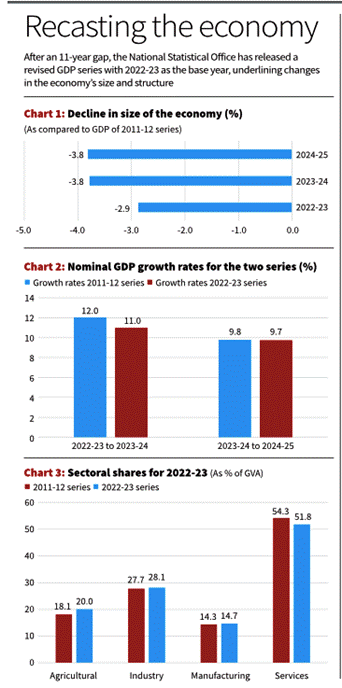
- The revised series indicates that the absolute size of India’s GDP is about 3–4% smaller than previously estimated.
- However, the annual growth rates remain broadly similar, differing by about ±1 percentage point compared with the earlier series.
Changes in Sectoral Composition
Agriculture
- The share of agriculture in GDP has increased slightly, reflecting better measurement of rural and farm sector activities.
Industry
- The industrial sector’s share has increased marginally, with manufacturing rising from 14.3% to about 14.7% of GDP.
Services
- The services sector share has declined slightly, though it remains the largest contributor to India’s GDP.
Manufacturing Sector Trends
- Although the share of manufacturing has increased slightly, the absolute size of the sector has declined by about 1.5–1.6% compared with the previous series.
- This adjustment is important because manufacturing data was widely debated during the earlier revision.
Institutional Classification of GDP
Non-Financial Private Corporate Sector
- The share of the private corporate sector (PCS) in GDP has declined from 35.4% to 33.9% in the new series for 2022-23.
- The decline becomes steeper in 2023-24, with a gap of about 3.4 percentage points.
Household and Informal Sector
- The share of the household or informal sector has increased slightly, partly reflecting improved accounting of agriculture and small-scale activities.
Concerns with the Previous GDP Series (2011-12)
Overestimation Concerns
- Several economists argued that the 2011-12 series overestimated GDP growth, especially in sectors such as manufacturing.
Private Corporate Sector Data Issues
- The earlier revision significantly increased the estimated size of the non-financial private corporate sector, which many experts questioned.
International Criticism
- The International Monetary Fund (IMF) reportedly awarded India a ‘C’ grade for the quality of its National Accounts Statistics, raising concerns about statistical credibility.
Implications of the New GDP Series
Possible Correction of Overestimation
- The reduction in GDP size may represent a statistical correction, addressing earlier concerns about inflated estimates.
Impact on Economic Targets
- A smaller GDP base could potentially delay India’s target of becoming a $5 trillion economy, initially envisioned by the government.
Improved Measurement of Informal Sector
- The increase in the household sector’s share suggests improved measurement of the informal economy.
Remaining Concerns
Limited Methodological Transparency
- Experts note that full methodological details of the new GDP series have not yet been released, making independent evaluation difficult.
Dependence on Data Sources
- Changes in GDP estimates may reflect new datasets, revised statistical ratios, or methodological adjustments, rather than actual structural shifts.
Statistical Credibility
- Restoring trust in national accounts requires greater transparency and continuous improvement in statistical systems.
Way Forward
Greater Transparency
- The government should publish detailed methodological notes and datasets to enable independent scrutiny of the revised GDP series.
Strengthening Statistical Institutions
- Improving the capacity and autonomy of institutions such as the National Statistical Office (NSO) can enhance credibility.
Better Data Integration
- Incorporating administrative databases, digital transactions, and enterprise surveys can improve measurement of economic activity.
Conclusion
- The new GDP series with 2022-23 as the base year represents an important statistical revision aimed at improving the accuracy of India’s national accounts. While the revision appears to correct certain inconsistencies in earlier estimates, the credibility of the new series will depend on greater transparency, methodological clarity, and continuous strengthening of India’s statistical systems.
Creamy Layer Status of OBCs Cannot Be Decided Solely by Salary Income: Supreme Court
Why in News?
- The Supreme Court rejected the Centre’s plea challenging judgments of the Madras, Kerala, and Delhi High Courts regarding determination of OBC creamy layer status.
- The Court ruled that creamy layer status cannot be determined solely on the basis of parental income from salaries of government, PSU, or private-sector employees.
- The judgment arose in cases concerning OBC–Non-Creamy Layer eligibility in Civil Services Examinations.
Relevance
GS Paper II – Polity
- Reservation policy and creamy layer principle
- Judicial review of government policies
- Constitutional equality provisions
GS Paper I – Indian Society
- Social justice and backward class empowerment
- Equity within reservation categories
Practice Question
- Explain the concept of the creamy layer in India’s reservation policy. Discuss the implications of the Supreme Court’s recent ruling on determining creamy layer status for OBCs. (250 words)
What is the Creamy Layer?
Concept
- The creamy layer refers to the relatively economically advanced and socially privileged members within the Other Backward Classes (OBCs).
- Such individuals are excluded from reservation benefits to ensure that affirmative action reaches the genuinely disadvantaged sections.
Origin
- The creamy layer concept was introduced by the Supreme Court in the Indra Sawhney v. Union of India (1992) judgment.
- The Court directed the government to exclude socially advanced members of OBCs from reservation benefits.
Legal Framework for Determining Creamy Layer
1993 Office Memorandum
- The Government of India issued an Office Memorandum on 8 September 1993 to implement the creamy layer exclusion.
- The determination of creamy layer status considers:
- Income and wealth levels
- Occupational status of parents
- Category of posts held by parents in public service.
2004 Clarificatory Letter
- A clarificatory letter issued on 14 October 2004 stated that income from salaries alone cannot be the sole criterion for creamy layer determination.
- Instead, the status and category of the parent’s occupation must also be considered.
Supreme Court Observations
Income Alone Cannot Determine Creamy Layer
- The Court held that determining creamy layer status solely on income brackets without considering occupational status is legally unsustainable.
Equality Principle
- Treating children of PSU or private-sector employees differently from government employees solely on income basis would lead to hostile discrimination.
- Such differential treatment violates the equality doctrine under Articles 14, 15, and 16 of the Constitution.
Importance of Occupational Status
- The Court emphasised that the category of posts held by parents (Group A, B, C, or D) remains a critical factor in determining creamy layer status.
Constitutional Provisions Involved
| Article | Provision |
| Article 14 | Equality before law |
| Article 15(4) | Special provisions for socially and educationally backward classes |
| Article 16(4) | Reservation in public employment |
| Articles 15 & 16 | Protection against discrimination |
Significance of the Judgment
Protecting the Purpose of Reservation
- The ruling ensures that reservation benefits continue to reach genuinely disadvantaged sections of OBC communities.
Preventing Arbitrary Classification
- It prevents arbitrary exclusion of candidates based purely on income without considering social status or occupational hierarchy.
Upholding Equality Doctrine
- The judgment reinforces the constitutional principle that similarly placed individuals cannot be treated differently without reasonable classification.
Challenges in Creamy Layer Determination
Complexity of Criteria
- Determining creamy layer status requires balancing income, occupation, and social status, making implementation complex.
Policy Ambiguity
- Confusion between the 1993 OM and later clarifications has resulted in inconsistent interpretations by authorities.
Periodic Revision of Income Limit
- The creamy layer income threshold must be periodically revised to reflect inflation and economic changes.
Way Forward
Clearer Policy Guidelines
- The government may need to issue updated guidelines harmonising income and occupational criteria.
Transparent Certification Process
- Improving transparency in Non-Creamy Layer certificate issuance can reduce disputes.
Data-Driven Reservation Policies
- Using updated socio-economic data can ensure reservation benefits reach genuinely disadvantaged groups.
Conclusion
- The Supreme Court’s ruling reinforces that the creamy layer exclusion must be applied carefully and constitutionally, ensuring equality while preserving the objective of reservation policies. By emphasising occupational status alongside income, the judgment safeguards both fairness and social justice in India’s affirmative action framework.
India’s Renewable Transition Caught Between Stranded Power and Institutional Inertia
Why in News?
- At the Bharat Climate Forum (BCF) 2026, experts highlighted transmission congestion and institutional delays as major risks to India’s renewable energy transition.
- In Rajasthan, more than 4,000 MW of commissioned renewable capacity remains unable to supply electricity during peak hours due to grid congestion.
- The issue reflects a deeper problem where transmission infrastructure exists but remains underutilised because of operational conservatism and institutional inefficiencies.
Relevance
GS Paper III – Energy
- Renewable energy expansion and grid integration
- Power transmission infrastructure
- Energy transition challenges
GS Paper II – Governance
- Institutional coordination in energy governance
- Regulatory accountability in infrastructure utilisation
Practice Question
- India’s renewable energy expansion is increasingly constrained by transmission and institutional challenges rather than generation capacity. Examine the issues and suggest measures to improve renewable energy integration into the national grid. (250 words)
India’s Renewable Energy Expansion
Rapid Growth in Renewable Capacity
- India has emerged as a global leader in renewable energy expansion, supported by ambitious targets and policy initiatives.
- The country aims to achieve 500 GW of non-fossil fuel capacity by 2030 as part of its climate commitments.
Key Government Initiatives Supporting Renewable Energy
- National Solar Mission promotes large-scale solar capacity deployment across India.
- PM-KUSUM Scheme supports solarisation of agriculture pumps and decentralised renewable energy.
- Production Linked Incentive (PLI) Scheme for Solar Modules aims to strengthen domestic solar manufacturing.
- Green Energy Corridor Project focuses on strengthening transmission infrastructure for renewable power evacuation.
- National Green Hydrogen Mission promotes clean hydrogen production using renewable energy.
Transmission Bottlenecks in Renewable Energy
Example: Rajasthan
- Rajasthan currently has about 23 GW of installed renewable capacity, but the available transmission evacuation margin is only 18.9 GW.
- This mismatch results in significant curtailment during peak solar generation hours.
Unequal Curtailment of Renewable Projects
- Projects operating under Temporary General Network Access (T-GNA) face 100% curtailment during congestion periods.
- Projects with Permanent GNA continue operating normally, concentrating financial losses on a specific group of developers.
Under-utilisation of Transmission Infrastructure
High-Capacity Transmission Lines
- 765 kV double-circuit transmission corridors, designed to evacuate approximately 6,000 MW, are sometimes operating at only 600–1,000 MW.
- Utilisation levels below 20% of capacity are becoming increasingly common in certain regions.
Financial Implications
- Transmission infrastructure investments exceeding ₹1 lakh crore nationally are recovered through consumer tariffs.
- When corridors remain underutilised, consumers effectively pay for infrastructure that delivers only a fraction of its intended value.
Institutional and Governance Challenges
Conservative Grid Operations
- Grid operators prioritise system stability and risk avoidance, sometimes leading to overly cautious operational limits.
- While stability is critical, excessive conservatism can result in chronic underutilisation of transmission assets.
Lack of Accountability
- There are no formal utilisation benchmarks or review triggers when major transmission assets operate significantly below capacity.
- Renewable developers bear most of the financial consequences, while planning and operational institutions face limited accountability.
Planning–Operations Disconnect
- The Central Transmission Utility (CTU) plans transmission corridors based on projected renewable capacity.
- Developers receive General Network Access approvals assuming adequate transmission capacity will be available.
- However, operational restrictions by grid operators can drastically reduce usable capacity.
Technical Constraints
Grid Stability Issues
- Operators cite voltage oscillations and potential grid instability as reasons for limiting transmission utilisation.
- These concerns are legitimate but can be addressed through advanced technologies.
Available Technological Solutions
- STATCOM (Static Synchronous Compensators) improve voltage stability.
- Advanced reactive power management systems help balance power flows.
- Special protection schemes and adaptive line ratings enable safer utilisation of transmission capacity.
Global Best Practices in Grid Management
- Advanced grid operators increasingly use dynamic security assessment and real-time contingency analysis.
- Techniques such as probabilistic risk assessment and adaptive line rating systems allow higher utilisation of transmission assets while maintaining grid reliability.
Implications for India’s Energy Transition
Stranded Renewable Capacity
- Renewable energy plants that cannot evacuate electricity effectively become stranded assets, reducing investor confidence.
Financial Stress on Developers
- Developers who have invested billions based on transmission approvals face unexpected revenue losses due to curtailment.
Impact on Climate Targets
- Transmission constraints could slow India’s progress toward its renewable energy and climate commitments.
Way Forward
Mandating Asset Utilisation Targets
- Grid operators should be evaluated on both system reliability and efficient utilisation of transmission infrastructure.
Fair Curtailment Mechanisms
- Curtailment during congestion should be distributed proportionately across generators, rather than concentrated on specific categories such as T-GNA projects.
Dynamic Allocation of Transmission Capacity
- Unused General Network Access capacity should be dynamically reassigned through transparent and real-time protocols.
Strengthening Regulatory Oversight
- Persistent underutilisation of major transmission assets should trigger mandatory regulatory reviews and public reporting.
Technology Deployment
- Accelerated deployment of STATCOMs, advanced grid management tools, and dynamic monitoring systems can improve grid stability and utilisation.
Conclusion
- India’s renewable energy transition is not constrained by generation capacity but increasingly by transmission bottlenecks and institutional inertia. Ensuring efficient utilisation of grid infrastructure, strengthening regulatory accountability, and adopting modern grid management technologies will be critical for sustaining the country’s clean energy transition.
Impeachment Motion Against Chief Election Commissioner (CEC)
Why in News?
- Parties of the INDIA opposition bloc are considering moving an impeachment motion against Chief Election Commissioner (CEC) Gyanesh Kumar.
- The issue is linked to controversy over the Special Intensive Revision (SIR) of electoral rolls in West Bengal, where allegations of voter deletions have been raised.
- Opposition leaders claim they have sufficient numbers to introduce the motion in either Lok Sabha or Rajya Sabha.
Relevance
GS Paper II – Polity
- Independence and accountability of the Election Commission of India (ECI)
- Removal procedure of Chief Election Commissioner
- Parliamentary oversight of constitutional authorities
Practice Question
- Discuss the constitutional provisions governing the removal of the Chief Election Commissioner. How do these safeguards ensure the independence of the Election Commission of India? (250 words)
Election Commission of India (ECI)
Constitutional Status
- The Election Commission of India is a constitutional body established under Article 324 of the Constitution.
- It is responsible for supervising, directing, and controlling elections to:
- Parliament
- State Legislatures
- Office of the President
- Office of the Vice-President.
Composition
- The Election Commission consists of:
- Chief Election Commissioner (CEC)
- Two Election Commissioners (ECs).
- The President appoints the CEC and Election Commissioners.
Constitutional Protection of the CEC
Security of Tenure
- Article 324(5) provides that the CEC cannot be removed from office except in a manner similar to the removal of a Supreme Court judge.
- This protection ensures the independence of the Election Commission from political or executive pressure.
Procedure for Removal of the Chief Election Commissioner
Initiation of Motion
- An impeachment motion may be introduced in either House of Parliament.
- The motion must be supported by:
- 100 members in the Lok Sabha, or
- 50 members in the Rajya Sabha.
- The motion must clearly state the grounds for removal.
Investigation by Committee
- Once admitted, the Presiding Officer of the House constitutes a special investigation committee.
- The committee examines allegations and determines whether misbehaviour or incapacity is proven.
Parliamentary Voting
- If the committee finds the CEC guilty, the motion is put to vote in both Houses of Parliament.
- The motion must be passed by a two-thirds majority of members present and voting.
Final Removal
- After approval by both Houses, the President of India issues the final order removing the Chief Election Commissioner from office.
Significance of Constitutional Safeguards
Ensuring Electoral Independence
- Strong removal safeguards prevent political actors from arbitrarily removing election authorities, thereby preserving electoral integrity.
Institutional Autonomy
- The constitutional protection strengthens the credibility and neutrality of the Election Commission, which is essential for democratic legitimacy.
Democratic Accountability
- At the same time, the impeachment mechanism ensures that constitutional authorities remain accountable for misconduct or incapacity.
Challenges in the Current Debate
Political Polarisation
- Impeachment attempts against constitutional authorities may reflect deep political divisions, potentially affecting public confidence in institutions.
Institutional Credibility
- Allegations against the Election Commission can undermine trust in the electoral process, particularly during politically sensitive periods.
High Threshold for Removal
- The requirement of two-thirds majority in both Houses makes removal extremely difficult, ensuring stability but limiting accountability in practice.
Way Forward
Strengthening Electoral Transparency
- Greater transparency in electoral roll revisions and election administration can reduce controversies and build public trust.
Institutional Reforms
- Implementation of reforms suggested by various committees to strengthen independence and accountability of the Election Commission.
Constructive Political Engagement
- Political parties should address disputes through institutional dialogue and constitutional mechanisms to preserve democratic norms.
Conclusion
- The proposed impeachment motion against the Chief Election Commissioner highlights tensions between institutional accountability and constitutional independence. The stringent removal process under Article 324 ensures that the Election Commission remains insulated from political pressure while maintaining democratic oversight.
LIGO-India Gravitational Wave Observatory: Project in Limbo
Why in News?
- The ₹1,600-crore Engineering, Procurement and Construction (EPC) tender for India’s Laser Interferometer Gravitational Wave Observatory (LIGO-India) in Maharashtra’s Hingoli district has not yet been awarded nearly a year after it was floated.
- Despite the delay, the Department of Atomic Energy (DAE) has stated that the mega-science project is still expected to be completed by its original deadline of 2030.
- The project is part of the global network of gravitational-wave observatories that began detecting gravitational waves in 2015, confirming predictions of Einstein’s General Theory of Relativity.
Relevance
GS Paper III – Science and Technology
- Gravitational wave astronomy
- Mega science projects and technological capability
- Global scientific collaboration
GS Paper II – Governance
- Implementation challenges in large public infrastructure projects
- International scientific partnerships
Practice Question
- Discuss the significance of the LIGO-India project for India’s scientific and technological development. What challenges affect the implementation of mega-science projects in India? (250 words)
What is LIGO?
Concept
- LIGO (Laser Interferometer Gravitational Wave Observatory) is a large-scale scientific instrument designed to detect gravitational waves, which are ripples in spacetime caused by extreme cosmic events.
- These waves were predicted by Albert Einstein in 1916 in the General Theory of Relativity and were first detected experimentally in 2015 by LIGO observatories in the United States.
Working Principle
- LIGO observatories consist of two vacuum arms about 4 kilometres long arranged at right angles.
- Laser beams are sent through these arms and reflected back by mirrors.
- When a gravitational wave passes, it slightly changes the length of the arms, which can be detected through interference patterns in the laser beams.
LIGO-India Project
Location
- The facility will be built at Aundha in Hingoli district, Maharashtra, on land allocated by the state government.
Institutional Collaboration
- The project is jointly implemented by:
- Department of Atomic Energy (DAE)
- Department of Science and Technology (DST)
- Collaboration with LIGO Laboratory (USA) and the National Science Foundation (NSF).
- Key Indian partner institutions include:
- Inter-University Centre for Astronomy and Astrophysics (IUCAA), Pune
- Raja Ramanna Centre for Advanced Technology (RRCAT), Indore
- Institute of Plasma Research (IPR), Gandhinagar.
Timeline and Cost
- The project received Cabinet approval in 2023 with an estimated cost of about ₹2,600 crore.
- Construction is expected to take around four years once work begins, with completion targeted by 2030.
Significance of LIGO-India
Advancement of Astrophysics
- Gravitational wave detection enables scientists to study cosmic phenomena such as black hole mergers, neutron star collisions, and supernova explosions, which cannot be observed through conventional electromagnetic telescopes.
Global Scientific Network
- LIGO-India will become the fifth detector in the global gravitational-wave observatory network, alongside LIGO (USA), Virgo (Italy), and KAGRA (Japan).
- The addition of a detector in India improves sky localisation accuracy and detection sensitivity.
Technological Development
- The project will advance high-precision engineering, laser technology, vacuum systems, and data processing capabilities in India.
- It will also strengthen India’s capacity in big science infrastructure and frontier physics research.
Human Resource Development
- The project is expected to create opportunities for scientists, engineers, and students, strengthening India’s research ecosystem in astrophysics and advanced instrumentation.
Challenges Facing the Project
Tender and Administrative Delays
- The ₹1,600-crore EPC tender has not yet been awarded, slowing the commencement of construction activities.
Complex Scientific Infrastructure
- Building ultra-sensitive instruments capable of detecting extremely small distortions in spacetime requires advanced engineering precision and international collaboration.
Coordination Challenges
- The project involves coordination among multiple government agencies, scientific institutions, and international partners, increasing administrative complexity.
Way Forward
Accelerating Project Implementation
- Streamlining tender processes and project management mechanisms can help ensure timely construction of the observatory.
Strengthening International Collaboration
- Continued collaboration with global LIGO partners can ensure technology transfer, expertise sharing, and scientific integration.
Developing Scientific Ecosystem
- Investments in research institutions, training programmes, and academic collaborations can maximise the scientific benefits of the project.
Conclusion
- LIGO-India represents a landmark step in India’s participation in global frontier science and gravitational wave astronomy. Once operational, it will strengthen India’s role in international scientific research while advancing technological capabilities in high-precision instrumentation and astrophysics.
Jal Jeevan Mission 2.0: Cabinet Approves Extension till 2028
Why in News?
- The Union Cabinet approved the extension of the Jal Jeevan Mission (JJM) till December 2028, restructuring the programme toward a service-delivery model for sustainable rural drinking water supply.
- The total outlay of the programme has been enhanced to ₹8.69 lakh crore, with central assistance increased to ₹3.59 lakh crore.
- The restructured JJM 2.0 focuses on structural reforms, digital monitoring, community ownership, and sustainable operation of rural piped water systems.
Relevance
GS Paper II – Governance
- Implementation of rural drinking water schemes
- Cooperative federalism and decentralised water governance
- Community participation in public service delivery
GS Paper III – Environment / Water Resources
- Sustainable water management
- Rural water infrastructure
- Climate resilience and water security
Practice Questions
- The Jal Jeevan Mission marks a major shift in India’s rural water governance from infrastructure creation to service delivery. Examine the key features of Jal Jeevan Mission 2.0 and its significance for sustainable rural water management.(250 Words)
What is Jal Jeevan Mission?
Launch and Objective
- The Jal Jeevan Mission (JJM) was launched in 2019 to provide Functional Household Tap Connections (FHTC) to every rural household.
- The mission aims to supply 55 litres per capita per day (LPCD) of safe and adequate drinking water on a regular and long-term basis.
Key Goals
- Universal rural household tap water connections
- Safe drinking water quality and monitoring
- Community participation in water management
- Sustainable water source protection
Progress under Jal Jeevan Mission
Expansion of Rural Tap Water Coverage
- In 2019, only 3.23 crore rural households (17%) had tap water connections.
- As of 2026, over 12.56 crore additional households have been connected under the mission.
- Currently 15.80 crore rural households (81.61%) out of 19.36 crore households have tap water access.
Key Features of Jal Jeevan Mission 2.0
Shift from Infrastructure to Service Delivery
- JJM 2.0 aims to move beyond infrastructure creation toward continuous and reliable drinking water services, ensuring sustainable operation and maintenance of rural water supply systems.
Digital Water Governance – “Sujalam Bharat”
- A national digital framework called Sujalam Bharat will assign each village a unique “Sujal Gaon / Service Area ID”.
- This system will digitally map the entire drinking water supply chain from source to household tap, improving transparency and monitoring.
Community Ownership and Local Governance
- Gram Panchayats and Village Water & Sanitation Committees (VWSCs) will play a central role in managing and certifying water supply infrastructure.
- Through the “Jal Arpan” initiative, Gram Panchayats will formally certify completion and operational readiness before declaring Har Ghar Jal status.
Community Participation – Jal Utsav
- The mission will promote “Jal Utsav”, an annual community-led review and maintenance event encouraging local participation in water conservation and infrastructure upkeep.
Cooperative Federalism
- The Centre will sign separate Memoranda of Understanding (MoUs) with States and UTs, ensuring accountability in meeting coverage targets and maintaining water supply services.
Impact of Jal Jeevan Mission
Reduction in Women’s Drudgery
- According to SBI Research, the programme has freed nearly 9 crore women from daily water-fetching responsibilities, enabling greater participation in education, livelihoods, and social activities.
- The World Health Organization (WHO) estimates that JJM has reduced women’s drudgery by saving 5.5 crore hours daily previously spent collecting water.
Public Health Improvements
- WHO estimates that improved drinking water access could prevent 400,000 diarrhoeal deaths and save 14 million Disability Adjusted Life Years (DALYs).
- Improved water quality contributes to reduced child mortality and improved hygiene conditions.
Child Health and Mortality Reduction
- Nobel Laureate Michael Kremer estimates that universal access to safe drinking water could reduce under-five mortality by nearly 30%, potentially saving 1.36 lakh children annually.
Employment Generation
- Studies by IIM Bangalore and the International Labour Organisation (ILO) estimate that JJM has generated 59.9 lakh direct and 2.2 crore indirect person-years of employment.
Governance Innovations under JJM 2.0
Decentralised Water Management
- Greater involvement of Panchayati Raj Institutions ensures local accountability and sustainability of water supply infrastructure.
Integrated Government Approach
- A Whole-of-Government approach will enable convergence among multiple ministries and departments for sustainable water source management.
Source Sustainability
- The mission emphasises groundwater recharge, water conservation, and sustainable source management to ensure long-term availability of drinking water.
Challenges in Rural Drinking Water Supply
Water Source Sustainability
- Excessive groundwater extraction and climate variability threaten long-term availability of rural drinking water sources.
Operation and Maintenance Issues
- Many rural water supply schemes face operational challenges due to lack of trained personnel, funds, and technical capacity at the village level.
Regional Inequality
- Some states continue to lag behind in providing universal tap water connections due to geographical, infrastructural, and financial constraints.
Water Quality Concerns
- Issues such as fluoride, arsenic, and iron contamination continue to affect drinking water quality in several rural regions.
Way Forward
Strengthening Local Water Governance
- Capacity building of Gram Panchayats and VWSCs is necessary for sustainable management of rural water supply systems.
Integrated Water Resource Management
- Convergence with programmes such as Atal Bhujal Yojana, MGNREGA, and watershed development initiatives can improve source sustainability.
Technology and Data Monitoring
- Expanding digital monitoring platforms such as Sujalam Bharat can enhance transparency, real-time monitoring, and service delivery efficiency.
Climate-Resilient Water Infrastructure
- Investments in rainwater harvesting, aquifer recharge, and watershed management can strengthen long-term water security.
Conclusion
- The extension of the Jal Jeevan Mission under JJM 2.0 marks a shift from infrastructure expansion toward sustainable and citizen-centric water service delivery. By combining digital governance, community participation, and inter-governmental coordination, the mission aims to ensure universal, reliable, and safe drinking water access, contributing significantly to rural development and the vision of Viksit Bharat 2047.


