
Content
- Cauvery Basin Drying Trend till 2050
- India’s 60% Non-Fossil Energy Target by 2035
- Vande Mataram Advisory and Freedom of Expression Debate
- WTO MC14 and Crisis of Multilateral Trade Order
- Women’s Reservation and Delimitation Constitutional Challenge
- Extension of IVFRT for Immigration Governance
- FCRA Amendment 2026 and Regulation of Foreign Funding
Cauvery basin to face dry spell until 2050, says study
Why in news ?
- IIT Gandhinagar study (Earth’s Future, March 2026) projects ~3.5% decline in Cauvery streamflow (2026–2050), contrasting sharply with increasing flows in major basins like Indus, Ganga, Krishna.
Issue in brief
- Despite projected increase in monsoon rainfall, Cauvery basin exhibits declining effective water availability, highlighting regional asymmetry of climate change impacts and decoupling of rainfall–runoff relationship in peninsular rivers.
- Historical data shows ~28% decline in streamflow (1951–2012) at Kollegal, indicating structural drying trend, not short-term variability, reinforcing concerns of long-term hydrological stress in the basin.
Relevance
- GS I (Geography): River regimes, monsoon variability, climate change impacts on peninsular rivers.
- GS III (Environment): Climate change, water stress, river basin management.
- GS II (Inter-State Relations): Cauvery dispute, federal water governance (CWDT, SC judgment).
Practice Questions
- Q1. Climate change is altering river hydrology in India with regional asymmetries. Examine with reference to the Cauvery basin. (250 words)
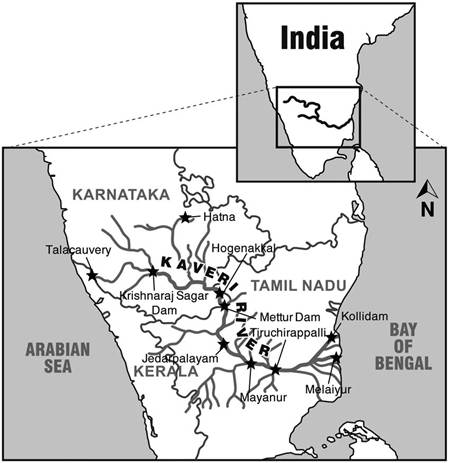
Static background – Cauvery river
- Origin at Talakaveri in Brahmagiri Hills, river length ~800 km, draining into Bay of Bengal, covering states of Karnataka, Tamil Nadu, Kerala, Puducherry.
- Major tributaries include Kabini, Hemavati, Bhavani, Harangi, supporting extensive irrigation networks and dense population, making basin highly sensitive to hydrological and climatic fluctuations.
- River depends on both South-West and North-East monsoons, increasing vulnerability to temporal variability and climate shifts, unlike Himalayan rivers with relatively stable glacial and snow-fed contributions.
Water sharing framework
- Cauvery Water Disputes Tribunal (CWDT) allocated 740 TMC ft, notified in 2013, later modified by Supreme Court of India (2018) adjusting shares between Tamil Nadu and Karnataka.
Methodological nuance – constrained vs unconstrained models
- Unconstrained CMIP6 models project ~5% increase in streamflow, but fail to capture Indian monsoon seasonality, leading to potentially misleading conclusions for regional water policy formulation.
- Constrained models (Chuphal & Mishra) filter only skillful models (8/22) matching historical observations (1951–2012), reversing projection to ~3.5% decline, enhancing policy reliability and scientific robustness.
- Demonstrates limitation of global climate models, emphasizing need for region-specific downscaling and validation, especially for monsoon-dependent basins like Cauvery with complex hydrological behaviour.
Human vs Natural dimension
- Study assesses naturalized flows (without human extraction), isolating pure climate impact, but real-world scenario includes intensive anthropogenic pressures significantly worsening water stress beyond projected decline.
- Around 80% water used in agriculture, coupled with rapid urbanisation (Bengaluru ~20 million by 2030), amplifies scarcity, making climate-induced decline a lower-bound estimate of actual stress.
Why Cauvery is drying ?
- Rising temperatures increase evapotranspiration, reducing effective runoff even with higher rainfall, altering hydrological balance and decreasing sustained river flows across seasons.
- Erratic rainfall patterns, with high-intensity short-duration events, reduce groundwater recharge and infiltration, leading to lower base flows and increased surface runoff losses.
- Dependence on dual monsoon system (SW + NE) increases exposure to inter-annual variability, making Cauvery more vulnerable compared to single-monsoon dependent basins.
Anthropogenic drivers
- Catchment degradation due to deforestation and land-use change reduces soil moisture retention and infiltration capacity, weakening natural water storage mechanisms.
- Urbanisation and infrastructure expansion lead to impervious surfaces, disrupting hydrological cycles and reducing groundwater recharge in upper catchment regions.
- Excessive groundwater extraction diminishes base flows, creating surface-groundwater disconnect, exacerbating seasonal drying and long-term decline in river discharge.
Constitutional / legal dimension
- Article 262 empowers Parliament to adjudicate inter-state river disputes, operationalised through Inter-State River Water Disputes Act, 1956, forming basis of tribunal-based resolution mechanism.
- Increasing judicial intervention by Supreme Court reflects shift from tribunalisation to judicialisation, raising concerns about institutional overlap and federal tensions.
- Fixed allocations under CWDT face challenge from dynamic climate realities, necessitating evolution towards adaptive and flexible legal frameworks for water sharing.
Governance / Federal dimension
- Cauvery Water Management Authority tasked with implementation and regulation, but suffers from limited enforcement powers, data opacity, and political non-compliance among basin states.
- Climate stress intensifies competitive federalism, where upstream–downstream conflicts escalate due to shrinking resource base and rigid allocation mechanisms.
Case study – Mekedatu dispute (2025–26)
- Karnataka proposes ₹9000 crore balancing reservoir for Bengaluru drinking water, while Tamil Nadu fears flow regulation and violation of riparian rights, escalating dispute.
- Supreme Court of India termed Tamil Nadu’s challenge “premature”, allowing Karnataka to proceed with revised DPR, highlighting legal ambiguity in anticipatory water disputes.
Economic dimension
- Cauvery delta serves as “rice bowl of Tamil Nadu”, and declining flows threaten agricultural productivity, farmer incomes, and food security in already water-stressed regions.
- Reduced flows impact hydropower generation reliability, increasing dependence on thermal energy, with implications for energy security and emissions.
- Urban water crises, especially in Bengaluru, can disrupt industrial productivity, investment climate, and service sector growth, affecting regional economic stability.
Environmental dimension
- Declining environmental flows threaten aquatic biodiversity, wetland ecosystems, and deltaic stability, particularly in ecologically fragile Cauvery delta region.
- Reduced flows increase salinity intrusion in coastal Tamil Nadu, degrading agricultural land and freshwater resources, impacting long-term sustainability.
Strategic project linkages
- Proposed Godavari–Cauvery interlinking aims to address scarcity, but raises concerns of ecological feasibility, financial cost, and interstate consensus challenges.
- Cauvery–Vaigai–Gundar link canal (Tamil Nadu) faces legal challenge from Karnataka, indicating shift from inter-state to intra-state water conflicts under scarcity conditions.
Challenges / criticisms
- Static tribunal awards incompatible with dynamic hydrological variability under climate change, leading to frequent disputes and governance challenges.
- Lack of transparent, real-time data sharing undermines trust between states and weakens effectiveness of institutional mechanisms like CWMA.
- Over-reliance on supply-side solutions (dams, links) neglects demand-side management and ecological sustainability considerations.
- Limited accuracy of regional climate projections introduces uncertainty in long-term water planning and policy decisions.
Way forward
- Transition to adaptive water-sharing frameworks based on real-time hydrological data and climate projections, ensuring flexibility and resilience in allocation mechanisms.
- Strengthen CWMA with statutory enforcement powers and transparent data systems, improving compliance, coordination, and trust among basin states.
- Promote water-use efficiency through micro-irrigation, crop diversification (millets), and pricing reforms, reducing excessive agricultural demand.
- Enhance urban water resilience via recycling, rainwater harvesting, wastewater reuse, reducing dependency on river systems for growing cities.
- Invest in indigenous climate modelling and basin-level planning, integrating IMD, IITs, and global datasets for accurate, policy-relevant projections.
- Restore catchment ecosystems through afforestation and wetland conservation, improving natural recharge, base flows, and long-term hydrological sustainability.
Prelims pointers
- Cauvery originates at Talakaveri (Karnataka) and drains into Bay of Bengal, covering four states including Puducherry (UT).
- CWDT established in 1990, final award notified in 2013, later modified by Supreme Court (2018).
- CMIP6 models represent latest generation of global climate projections, widely used in IPCC assessments.
India aiming for 60% non-fossil fuel power sources by 2035
Why in News ?
- Union Cabinet approved India’s updated NDC on 25 March 2026 for submission to United Nations Framework Convention on Climate Change under the Paris Agreement cycle (post-2030 targets).
- India’s third NDC submission comes ahead of global climate negotiations after COP29–30 cycle, signalling enhanced ambition and Global South leadership.
Issue in Brief
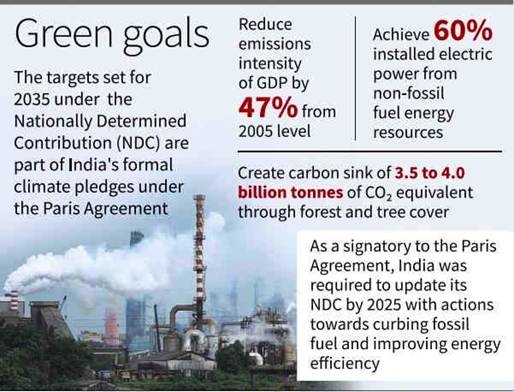
- India commits to:
- 47% reduction in emissions intensity of GDP (from 2005 levels) by 2035
- 60% installed power capacity from non-fossil sources by 2035
- 3.5–4 billion tonnes CO₂ equivalent carbon sink
- Targets build upon earlier commitments (2022 NDC) and align with Net-Zero target of 2070 and Viksit Bharat 2047 vision.
Relevance
- GS III (Environment & Economy): Energy transition, climate commitments, NDCs.
- GS II (IR): Global climate negotiations, CBDR-RC principle.
- GS III (Energy Security): Renewable energy, decarbonisation.
Practice Questions
- Q1. India’s updated NDC reflects a balance between development and climate responsibility. Critically analyse. (250 words)
Static Background
- NDC (Nationally Determined Contribution): Voluntary national climate targets under Paris Agreement (2015) to reduce emissions and adapt to climate change.
- Guided by principle of CBDR-RC (Common But Differentiated Responsibilities) balancing development needs with climate responsibility.
- Reviewed every 5 years, based on Global Stocktake (GST, first completed in 2023) assessing global progress toward 1.5°C goal.
Comparison with Previous Targets
2015 NDC (Original)
- 33–35% emissions intensity reduction by 2030
- 40% non-fossil capacity
- 2.5–3 billion tonnes carbon sink
2022 Updated NDC
- 45% emissions intensity reduction by 2030
- 50% non-fossil capacity by 2030
2026 Updated NDC (2031–35)
- 47% emissions intensity reduction by 2035
- 60% non-fossil capacity by 2035
- 3.5–4 billion tonnes carbon sink
India’s Current Progress
- ~36% emissions intensity reduction achieved (2005–2020), close to 2030 target well in advance.
- ~52% installed power capacity from non-fossil sources (2025–26), exceeding earlier 50% target ahead of deadline.
- ~2.3 billion tonnes CO₂ carbon sink created (2005–2019), nearing lower bound of earlier NDC target.
- Forest and tree cover increased from ~21% (2005) to ~24.6% (2021), though below 33% national target.
Key Analysis
1. Energy Transition & Power Sector
- Moving to 60% non-fossil capacity by 2035 driven by solar, wind, hydro, nuclear, biomass, along with battery storage and green hydrogen.
- However, only ~25% of actual electricity generation is non-fossil, indicating capacity vs generation gap due to intermittency and coal dependence.
2. Emissions Intensity Reduction
- Target of 47% reduction by 2035 reflects incremental ambition beyond 45% (2030), but remains moderate given India’s current trajectory and growth constraints.
- Indicates focus on energy efficiency + structural economic shift, not absolute emission cuts.
3. Carbon Sink Expansion
- Target of 3.5–4 billion tonnes CO₂ sink requires large-scale afforestation and ecosystem restoration, beyond current ~2.3 billion tonnes achievement.
- Forest cover still ~24.6% vs 33% policy goal, indicating significant gap in land and ecological capacity.
4. Strategic Positioning
- India’s NDC reflects balance between climate ambition and energy security, especially amid global energy shocks and fossil fuel volatility (West Asia conflicts).
- Positions India as leader of Global South, especially as developed countries show policy rollback and slow progress.
Challenges / Criticism
- Coal dependency (~70% electricity generation) likely to continue till 2035, limiting deep decarbonisation despite rising renewable capacity.
- 60% non-fossil target seen as conservative, given projections of ~70% capacity by 2035–36 (CEA estimates).
- Climate finance gap and technology dependence constrain faster transition, especially in storage, green hydrogen, and industrial decarbonisation.
- Global context of weak climate ambition by developed countries undermines collective progress towards 1.5°C pathway.
Way Forward
- Accelerate renewable energy + storage integration to bridge capacity vs generation gap.
- Scale up green hydrogen, electrification (transport, industry) to reduce fossil dependence structurally.
- Expand afforestation and nature-based solutions to meet enhanced carbon sink targets.
- Strengthen domestic manufacturing (solar, batteries) to reduce import dependence and enhance energy security.
- Leverage platforms like ISA, BRICS, G20 to secure climate finance and technology transfer.
Prelims Pointers
- NDCs are voluntary commitments, not legally binding emission targets.
- CBDR-RC principle recognises differentiated responsibilities of developed vs developing countries.
- India’s Net-Zero target year: 2070.
‘Vande Mataram advisory not a threat to conform’
Why in News ?
- Supreme Court (March 2026) upheld Union Home Ministry advisory dated 28 January 2026 on playing Vande Mataram, clarifying it is non-binding and not enforceable by law.
- Petition challenged advisory as coercive and violative of individual conscience, but Court termed it “premature” and based on vague apprehensions.
Issue in Brief
- Advisory prescribes protocol for playing National Song at public/ceremonial events, including suggestion for community singing in schools, but uses non-mandatory language (“may”).
- Core debate: Whether such advisories create indirect coercion (“social burden”) violating freedom of expression and conscience under Constitution.
Relevance
- GS II (Polity): Fundamental Rights (Art. 19, 21), Fundamental Duties (Art. 51A), executive vs law.
- GS IV (Ethics): Constitutional patriotism vs coercive nationalism.
Practice Questions
- Q1. “Patriotism cannot be enforced by law.” Examine in light of recent debates on national symbols. (250 words)
Static Background
- National Anthem: Jana Gana Mana (adopted 24 January 1950).
- National Song: Vande Mataram (given equal cultural status but no constitutional/legal equivalence with Anthem).
- Article 51A(a) (Fundamental Duty): Respect for National Flag and National Anthem, but no mention of National Song.
- Key case: Bijoe Emmanuel v. State of Kerala (1986) → SC held students cannot be compelled to sing National Anthem if it violates conscience.
Key Legal Analysis
1. Advisory vs Mandatory Law
- SC clarified advisory is “only protocol, not enforceable”, hence no penal consequences or legal sanction for non-compliance.
- Distinction: Executive advisory ≠ statutory mandate, thus does not violate Article 19(1)(a) or Article 21 unless coercion is proven.
2. Individual Conscience & Liberty
- Petition argued “social pressure = indirect coercion”, burdening individuals who refuse to sing National Song.
- SC held absence of legal penalty or discrimination evidence weakens claim; liberty violation must show clear nexus with state action.
3. Anthem vs National Song (Legal Status)
- Constitution recognises only National Anthem under Article 51A, giving it higher legal sanctity than National Song.
- Historical clarification by Rajendra Prasad (1950) settled dual status but without equal enforceability in law.
4. Judicial Approach
- Court emphasised “prematurity doctrine” → no adjudication without actual violation or discrimination case.
- Left open remedy: Individuals can approach SC if future coercive implementation or discrimination occurs.
Implications
- Reinforces principle that patriotism cannot be legally compelled, unless backed by clear statutory mandate.
- Protects executive flexibility to issue cultural advisories while safeguarding constitutional freedoms.
- Highlights evolving tension between symbolic nationalism vs individual liberty in public spaces.
Challenges / Concerns
- Even without legal sanction, advisories may create informal social pressure, especially in institutions like schools.
- Lack of clarity may lead to over-enthusiastic enforcement by local authorities, risking misuse.
- Blurring distinction between “voluntary respect” and “enforced conformity” may create future constitutional disputes.
Way Forward
- Clearly define legal vs advisory nature of such circulars to prevent misinterpretation at institutional level.
- Issue guidelines safeguarding individual conscience, especially in educational institutions.
- Promote constitutional patriotism (voluntary respect) rather than coercive or symbolic nationalism.
Prelims Pointers
- Article 51A(a) → Fundamental duty to respect National Flag and National Anthem only.
- Bijoe Emmanuel case (1986) → Right not to sing Anthem protected under freedom of conscience.
- National Song has no statutory backing, unlike provisions related to National Anthem (Prevention of Insults Act, 1971).
What is at stake at the WTO’s MC14?
Why in News ?
- 14th WTO Ministerial Conference (MC14) scheduled from 26–29 March 2026 in Yaoundé, Cameroon, amid deep crisis in global trade governance and weakening multilateralism.
- Occurs in backdrop of U.S. tariff actions, Appellate Body paralysis, and rise of unilateral trade measures, threatening the rules-based global trading system.
Issue in Brief
- MC14 to deliberate on WTO reforms, dispute settlement restoration, plurilateral agreements, and e-commerce moratorium, which are critical for future of global trade governance.
- Developing countries, including India, seek to preserve core WTO principles (MFN, SDT), while developed countries push for flexibility and rule changes.
Relevance
- GS II (IR): WTO crisis, global trade governance, India’s position.
- GS III (Economy): Trade rules, tariffs, digital trade, globalisation.
Practice Questions
- Q1. The WTO faces a crisis of relevance in the era of unilateralism. Critically analyse. (250 words)
Static Background
- World Trade Organization established in 1995; currently has 166 member countries.
- Ministerial Conference (MC) is highest decision-making body, meeting every 2 years, empowered to amend WTO rules.
- Core principles:
- Most Favoured Nation (MFN) → non-discrimination in trade
- Bound tariffs → no tariffs beyond agreed limits
- Consensus-based decision-making
Context: Why WTO is in Crisis ?
1. Rise of Unilateralism
- U.S. imposing arbitrary tariffs and trade restrictions, violating MFN principle and tariff bindings, undermining WTO credibility.
- Shift towards bilateral coercive trade agreements, bypassing multilateral rules.
2. U.S.–China Rivalry
- WTO increasingly shaped by strategic competition between U.S. and China, especially over state subsidies and industrial policy.
- U.S. dissatisfaction due to China’s rise despite WTO membership, questioning effectiveness of rules-based system.
3. Dispute Settlement Paralysis
- Appellate Body non-functional since 2019, due to U.S. blocking appointments, crippling WTO’s enforcement mechanism.
- Weakens rule-based adjudication, leading to power-based trade relations.
4. Stagnation in Rule-Making
- WTO has delivered only 2 major agreements in 30 years:
- Trade Facilitation Agreement (2013)
- Fisheries Subsidies Agreement (2022)
- Consensus requirement among 166 members leads to policy paralysis, pushing countries towards FTAs and regional blocs.
Key Issues at MC14
1. Plurilateral Agreements
- Agreements like Investment Facilitation (120+ countries) and E-commerce Agreement involve subset of members.
- Debate:
- Proponents: Faster rule-making
- Opponents (India): Risk of fragmentation and erosion of multilateralism
2. E-Commerce Moratorium (1998–2026)
- Temporary ban on custom duties on electronic transmissions, expiring 31 March 2026.
- Issue:
- Developed countries → want permanent extension
- Developing countries → fear loss of tariff revenue amid rising digital trade
3. Special & Differential Treatment (SDT)
- Provides flexibilities to developing and least-developed countries.
- U.S. pushing to deny SDT benefits to large economies (India, China, Brazil), challenging development-based differentiation.
4. Dispute Settlement Reform
- Demand for restoration of Appellate Body to revive WTO’s judicial function.
- Proposals include alternative mechanisms (voting-based appointments) due to consensus deadlock.
Implications
- Failure of MC14 could accelerate shift from rule-based to power-based global trade system, disadvantaging developing countries.
- Weakening WTO may lead to fragmented global trade architecture dominated by FTAs and regional blocs.
- Digital trade rules (e-commerce) will shape future global economic order and taxation rights.
India’s Position
- Supports multilateralism and preservation of WTO principles (MFN, SDT).
- Opposes plurilateral agreements within WTO framework due to risk of two-tier system.
- Concerned about e-commerce moratorium reducing fiscal space and digital sovereignty.
- Expected to act as voice of Global South, building coalitions with developing countries.
Challenges / Criticism
- WTO’s consensus-based model increasingly ineffective with 166 members and divergent interests.
- Developed countries shifting towards unilateralism and protectionism, weakening collective framework.
- Developing countries face dilemma between integration into global trade vs safeguarding policy space.
Way Forward
- Restore Appellate Body to revive credibility of dispute settlement system.
- Reform decision-making (e.g., qualified majority or flexible consensus) to overcome deadlock.
- Balance plurilateral flexibility with multilateral inclusivity to avoid fragmentation.
- Safeguard SDT provisions while ensuring fair participation of developing countries.
- Develop equitable digital trade rules protecting fiscal interests of developing economies.
Prelims Pointers
- WTO established in 1995, successor to GATT (1947).
- Appellate Body = highest dispute settlement authority (currently non-functional).
- MFN principle ensures equal treatment to all WTO members.
Women quota: Govt plan to expand LS, State constitutional hurdles
Why in News ?
- Government considering expansion of Lok Sabha seats (~543 → ~816, ~50% increase) to implement Nari Shakti Vandan Adhiniyam (Women’s Reservation Act, 2023) after delimitation.
- Proposal raises constitutional issues on delimitation, equality (Article 14), and “one person, one vote” principle under Article 81.
Issue in Brief
- Women’s Reservation Act mandates 33% reservation in Lok Sabha and State Assemblies, but implementation is linked to delimitation after next Census (post-2026).
- Government exploring seat expansion using 2011 Census, which may face legal challenges regarding population parity and constitutional limits.
Relevance
- GS II (Polity): Delimitation, Articles 81, 82, 170; equality vs reservation debate.
- GS II (Governance): Electoral reforms, federalism.
Practice Question
- Q1. Implementation of women’s reservation raises complex constitutional and federal challenges. Discuss. (250 words) (250 words)
Static Background
- Article 81: Ensures “one vote, one value”, mandating equal population-seat ratio across states and constituencies.
- Article 82: Provides for readjustment of seats after every Census via Delimitation Commission.
- Article 170: Similar provisions for State Assemblies.
- Current cap: Lok Sabha strength limited to 550 (Article 81(1)) → requires constitutional amendment for expansion.
Delimitation Freeze
- 1976 (42nd Amendment) → froze seat allocation based on 1971 Census.
- 2001 (84th Amendment) → extended freeze till first Census after 2026.
- Therefore, delimitation using 2011 Census may violate current constitutional framework unless amended.
Key Constitutional Issues
1. One Vote, One Value Principle
- Article 81 requires uniform population-seat ratio, but expansion based on 2011 Census may distort representation across states.
- Could be challenged as violation of equality under Article 14 + electoral parity principle.
2. Census Linkage & Legal Validity
- Constitution mandates delimitation based on “latest Census” (post-2026).
- Using 2011 Census (outdated data) risks judicial invalidation for violating Article 82 framework.
3. Need for Constitutional Amendment
- Increasing Lok Sabha strength from 543 → ~816 requires amendment to Article 81(1).
- Without amendment, expansion would be ultra vires Constitution.
4. Reservation vs Equality Debate
- Women’s reservation justified under Article 15(3) (special provisions for women).
- However, expansion + reservation may face scrutiny under Article 14 (reasonable classification test) if it distorts representation principles.
Governance / Political Implications
- Seat expansion may alter federal balance, benefiting high population states (UP, Bihar) disproportionately.
- Southern states may face relative decline in representation, raising federal tensions.
- Implementation delay persists as reservation is contingent on delimitation, not immediate.
Way Forward
- Conduct next Census (post-2026) and undertake delimitation based on updated population data for constitutional validity.
- Pass constitutional amendment to increase Lok Sabha strength before implementing reservation.
- Develop balanced delimitation formula addressing concerns of population control-performing states.
- Ensure phased and transparent implementation to maintain federal consensus.
Prelims Pointers
- Nari Shakti Vandan Adhiniyam (106th Amendment, 2023) → 33% reservation in LS & State Assemblies.
- Delimitation freeze valid till Census after 2026.
- Article 81 → population-seat ratio principle.
Cabinet extends immigration, visa tracking system for another five years
Why in News ?
- Union Cabinet (March 2026) approved continuation of Immigration, Visa, Foreigners Registration & Tracking (IVFRT) Scheme till 2031 with ₹1,800 crore outlay.
- Decision follows enactment of Immigration and Foreigners Act, 2025, requiring upgraded digital infrastructure for immigration control and foreigner management.
Issue in Brief
- IVFRT aims to create an integrated digital platform linking visa issuance, immigration clearance, and foreigner registration, ensuring efficient, secure, and real-time monitoring system.
- Focus on modernisation using emerging technologies, including faceless visa processing, biometrics, and automated immigration systems.
Relevance
- GS III (Internal Security): Border management, illegal migration.
- GS II (Governance): e-Governance, service delivery, digital state capacity.
- GS III (Tech): AI, biometrics, surveillance systems.
Practice Questions
- Q1. Digitalisation of immigration systems enhances both governance and security. Critically examine. (250 words)
Static Background
- IVFRT launched in 2010 with ₹1,011 crore outlay, initially targeting digitisation of immigration and visa processes.
- Implemented by Ministry of Home Affairs, covering Immigration Check Posts (ICPs), FRROs (Foreigners Regional Registration Offices), and data centres.
- Linked with e-Visa system, enabling online visa applications and digital approvals.
Key Features / Achievements
- 100% faceless and contactless visa system with online application, payment, and appointment scheduling.
- 91.24% e-Visas processed within 72 hours (last 5 years), significantly improving service efficiency.
- Immigration clearance time reduced from 5–6 minutes to 2.5–3 minutes per passenger, including biometric verification.
Key Analysis
1. Governance & Service Delivery
- Integration of visa, immigration, and registration databases enables real-time tracking of foreigners, improving administrative coordination.
- Introduction of mobile-based services and self-service kiosks enhances ease of travel and reduces human interface.
2. Internal Security Dimension
- Strengthens monitoring of illegal migration, visa overstays, and human trafficking networks, critical in context of border management challenges.
- Integration with intelligence databases enables risk profiling and early threat detection.
3. Technology & Digital Infrastructure
- Adoption of biometrics, AI-based analytics, and automated clearance systems improves accuracy and reduces fraud.
- Expansion of data centres and infrastructure ensures scalability and resilience of immigration systems.
4. Economic / Global Mobility Impact
- Faster visa processing and seamless entry improve ease of doing business, tourism, and global mobility flows.
- Supports India’s positioning as a global hub for trade, services, and investment.
Challenges / Concerns
- Risks related to data privacy and surveillance, especially with large-scale biometric and personal data collection.
- Need for cybersecurity safeguards to protect sensitive immigration databases from breaches.
- Coordination challenges across multiple agencies (MHA, MEA, intelligence agencies) for seamless implementation.
Way Forward
- Strengthen data protection frameworks (aligned with DPDP Act, 2023) to ensure privacy and accountability.
- Enhance AI-driven risk assessment systems for better detection of illegal activities.
- Improve inter-agency integration and real-time data sharing for holistic immigration governance.
- Expand infrastructure at high-traffic immigration checkpoints to handle increasing passenger volumes.
Prelims Pointers
- IVFRT implemented by Ministry of Home Affairs, not MEA.
- Covers visa issuance, immigration clearance, and foreigner registration.
- Introduced faceless e-Visa system with biometric integration.
FCRA Amendment Bill, 2026 – Regulation of Foreign Funding
Why in News ?
- Foreign Contribution (Regulation) Amendment Bill, 2026 introduced in Lok Sabha on 25 March 2026 by Ministry of Home Affairs to tighten control over foreign-funded NGOs and assets.
Issue in Brief
- Bill proposes creation of a “designated authority” to seize, manage, and dispose assets of NGOs whose FCRA registration is cancelled, surrendered, or ceased.
- Aims to enhance transparency, accountability, and national security safeguards, but raises concerns over executive overreach and property rights.
Relevance
- GS II (Polity & Governance): FCRA, NGO regulation, Article 19(1)(c), Article 300A.
- GS II (IR): Foreign funding and sovereignty.
- GS IV (Ethics): Transparency vs civil society autonomy.
Practice Questions
- Q1. Regulation of foreign funding is necessary but must balance democratic freedoms. Critically analyse. (250 words)
Static Background
- Foreign Contribution (Regulation) Act, 2010 regulates acceptance and utilisation of foreign contributions to prevent threats to sovereignty, public order, and national interest.
- Came into force 1 May 2011; amended in 2016, 2018, and 2020 to tighten compliance norms.
- Currently ~16,000 NGOs registered, receiving ~₹22,000 crore annually in foreign contributions.
Key Provisions of Amendment
- Establishment of designated authority to take control of foreign-funded assets upon cancellation or surrender of licence.
- Provides for vesting (transfer) of assets created from foreign contributions to government-controlled authority.
- Introduces prior Central Government approval for initiating investigations, centralising enforcement oversight.
Key Analysis
1. Governance & Transparency
- Government rationale: Prevent misuse of foreign funds for activities against national interest, including illegal conversions and financial irregularities.
- Centralised asset management aims to ensure proper utilisation of funds and prevent diversion after licence cancellation.
2. Constitutional Concerns
- Article 300A (Right to Property): Mandatory asset vesting without clear safeguards raises concerns about fairness, compensation, and due process.
- Article 14 (Equality before law): Requirement of prior government approval for investigation may lead to selective enforcement and arbitrariness.
3. Delegated Legislation Issue
- Bill criticised for “excessive delegation”, leaving key aspects (asset disposal, timelines, appeals) to executive rule-making, weakening legislative oversight.
4. Civil Society Impact
- Increased regulatory control may create compliance burden and operational uncertainty for NGOs, especially in development, health, and education sectors.
- Risk of shrinking civic space, affecting role of NGOs in governance and welfare delivery.
Challenges / Criticism
- Potential misuse of powers for targeting dissenting organisations, raising concerns about democratic freedoms.
- Lack of clear procedural safeguards and independent appellate mechanisms.
- Centralisation may reduce autonomy of civil society institutions.
Way Forward
- Clearly define procedural safeguards, timelines, and compensation mechanisms for asset vesting.
- Establish independent appellate authority to ensure fairness and accountability.
- Balance national security concerns with freedom of association (Article 19(1)(c)).
- Ensure transparency in enforcement to prevent selective or arbitrary application.
Prelims Pointers
- FCRA regulates foreign contribution and foreign hospitality.
- NGOs must obtain FCRA registration from Ministry of Home Affairs.
- FCRA amended multiple times (2016, 2018, 2020, 2026) to tighten norms.


