
Content
- From Steam to Speed: The Ever-Evolving Journey of Railways
- Naval Commanders’ Conference 2026
From Steam to Speed: The Ever-Evolving Journey of Railways
Why in News?
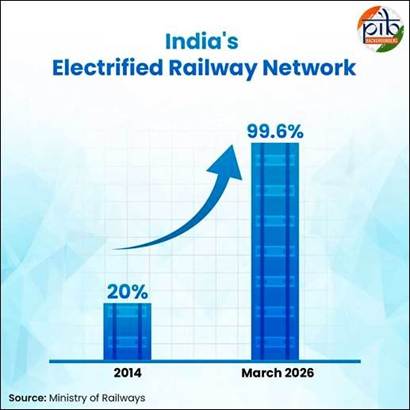
- 15 April 2026 (PIB): Highlights 173 years of Indian Railways, showcasing near-complete electrification (99.6%), modernisation, and record operational performance (2025–26).
Issue in Brief
- Indian Railways transitioned from steam-based colonial network (1853) to a modern, electrified, technology-driven system.
- Acts as backbone of India’s logistics, mobility, and economic growth, with massive scale and modernization push.
Relevance
- GS III (Economy & Infrastructure)
- Logistics efficiency, infrastructure investment, industrial growth, freight economics
- GS III (Environment & S&T)
- Electrification, energy efficiency, green transport, indigenous technologies (Kavach, Vande Bharat)
Practice Question
- “Indian Railways is central to India’s economic transformation but faces structural and operational challenges. Examine its role and suggest reforms for a future-ready railway system.” (250 words)
Static Background
- First train (1853): Bombay–Thane (34 km), operated by Great Indian Peninsula Railway.
- Gauge types: Broad (1.676 m), Metre (1 m), Narrow (<1 m), Standard (1.435 m).
- Post-independence: Integration of 42 railway systems → Indian Railways (1951–52 zones).
- Electrification: Shift from steam → diesel → electric traction for efficiency and sustainability.
Key Data & Evidence
- 99.6% electrification of 70,142 km broad gauge network (March 2026).
- Passengers (2025–26): ~741 crore; Freight: 1,670 MT (record).
- Revenue: ~₹80,000 crore.
- Diesel savings: 180 crore litres (2024–25); ~₹6,000 crore savings.
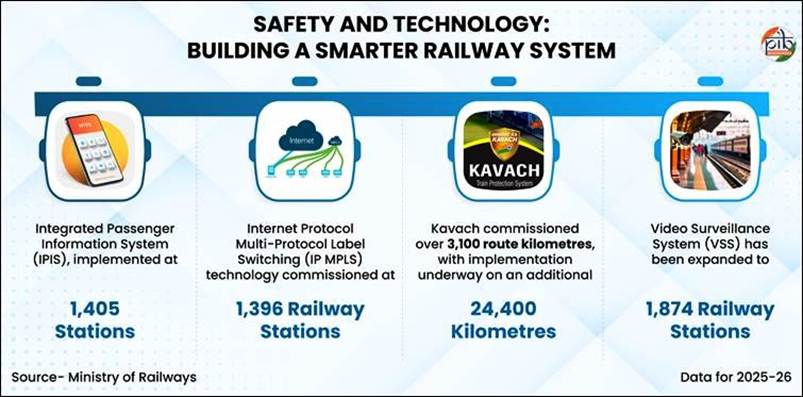
- Kavach: 3,100 km operational, 24,400 km under implementation.
- Daily trains: ~25,000.
Dimensions
Governance / Infrastructure
- Railways function as critical public infrastructure, enabling national integration and last-mile connectivity.
- Supports PM Gati Shakti via 35 cargo terminals and multimodal logistics integration.
- Station redevelopment (Amrit Bharat Scheme) enhances urban infrastructure and service delivery.
Economic
- Backbone of freight logistics (1,670 MT) → reduces logistics cost (~14% of GDP).
- Electrification reduces import dependence (diesel savings → improves current account balance).
- High capital outlay (₹2.78 lakh crore, Budget 2026–27) → multiplier effect on growth and employment.
Social
- Provides affordable mass transport → ensures inclusive mobility for low-income groups.
- Amrit Bharat Express (non-AC) improves accessibility for economically weaker sections.
- Enhances regional connectivity → reduces spatial inequalities.
Environmental
- 99.6% electrification significantly reduces carbon emissions and fossil fuel dependency.
- Rail transport is 4–5 times more energy efficient than road transport.
- Supports India’s net-zero commitments (2070).
Science & Technology
- Kavach (ATP system): Indigenous automatic train protection to prevent collisions.
- IP-MPLS telecom backbone, AI surveillance, IPIS → digital transformation.
- Vande Bharat trains: Indigenous semi-high-speed technology (Make in India).
- High-speed rail (MAHSR: 320 km/h) → technological leap.
Challenges / Criticism
Infrastructure Bottlenecks
- Congested routes (~60% high-density network saturated) → limits speed and efficiency.
- Track capacity constraints despite upgrades → delays in freight prioritisation.
Financial Stress
- High operating ratio (~98% historically) limits surplus for reinvestment.
- Dependence on budgetary support despite commercial operations.
Safety Concerns
- Despite Kavach, full coverage pending → accident risks persist.
- Human error and signalling failures still major contributors to accidents.
Technological Gaps
- Uneven digital adoption across zones; legacy systems coexist with modern tech.
- High-speed rail limited to select corridors, not nationwide transformation.
Social & Regional Imbalance
- Focus on premium trains (Vande Bharat) vs neglect of ordinary passenger services.
- Connectivity gaps in Northeast, hilly, and tribal regions.
Environmental Trade-offs
- Electrification depends on coal-based electricity mix (~70%), reducing net green gains.
- Large infrastructure projects → land acquisition and ecological disruption.
Institutional & Governance Issues
- Bureaucratic delays, coordination gaps between ministries/states.
- Limited private sector participation in operations and innovation.
Way Forward
Capacity & Infrastructure Expansion
- Develop Dedicated Freight Corridors (DFCs) and multi-tracking to decongest high-density routes.
- Expand connectivity in Northeast and aspirational districts.
Financial Reforms
- Improve operating ratio via rationalised tariffs and efficiency gains.
- Leverage PPP models for station redevelopment, logistics parks, and rolling stock.
Safety Enhancement
- Accelerate pan-India rollout of Kavach with strict timelines.
- Integrate AI-based predictive maintenance systems for accident prevention.
Green Transition
- Shift to renewable energy-powered electrification (solar, wind integration).
- Promote modal shift from road to rail for freight → reduces emissions.
Technological Modernisation
- Expand Vande Bharat and high-speed corridors beyond elite routes.
- Standardise digital platforms (RailOne, IPIS, NTES integration) across all zones.
Inclusive Development
- Balance investment between premium and affordable trains.
- Enhance last-mile connectivity (rail + bus + metro integration).
Institutional Reforms
- Strengthen independent railway regulator for tariff and service efficiency.
- Improve centre-state coordination under PM Gati Shakti framework.
Prelims Pointers
- First train (1853): Bombay–Thane (34 km), GIPR.
- Broad Gauge in India: 1.676 metres (not 1.435 m).
- Kavach: Indigenous Automatic Train Protection system.
- Electrification (2026): ~99.6% of broad gauge network.
- Vande Bharat: India’s indigenously built semi-high-speed train (2019 launch).
- MAHSR: India’s first high-speed rail corridor (Mumbai–Ahmedabad, 320 km/h).
Naval Commanders’ Conference 2026
Why in News?
- 14 April 2026: First edition of Naval Commanders’ Conference 2026 held at Nausena Bhawan,.
- Focus on combat readiness, maritime security, emerging technologies, and Indo-Pacific engagements.
Issue in Brief
- Conference deliberated on India’s maritime security challenges amid West Asia tensions and Indo-Pacific dynamics.
- Emphasised jointness, indigenisation, and future-ready naval capabilities.
Relevance
- GS III (Internal Security)
- Maritime security, SLOC protection, Indo-Pacific strategy, naval modernisation
- GS II (International Relations)
- Indo-Pacific geopolitics, QUAD, SAGAR vision, maritime diplomacy
Practice Question
- “Maritime security has become central to India’s strategic interests in the Indo-Pacific. Analyse the challenges faced by the Indian Navy and suggest measures to strengthen its capabilities.” (250 words)
Static Background
Indian Navy Role
- Maritime arm of armed forces → defence of maritime borders, SLOC security, power projection.
- Operates under Integrated Theatre framework (evolving) and Chief of Defence Staff (CDS).
Indian Ocean Region (IOR)
- Handles ~80% of global oil trade and ~90% of India’s trade by volume.
- Strategic chokepoints: Hormuz, Malacca, Bab-el-Mandeb.
Jointness Concept
- Integration of Army, Navy, Air Force operations for optimal resource utilisation and synergy.
Indigenisation
- Guided by Atmanirbhar Bharat in defence, promoting domestic shipbuilding, weapons, and systems.
Key Data & Evidence
- India’s trade: ~95% by volume, 70% by value via sea routes.
- Energy security: ~85% crude oil imports dependent on maritime routes.
- Indian Navy: Over 130 ships, 220 aircraft, with expansion underway (DRDO/Make in India push).
Dimensions
Security / Strategic
- Rising tensions in West Asia threaten Sea Lines of Communication (SLOCs) → critical for energy security.
- Need for blue-water navy capability to operate beyond IOR (Indo-Pacific outreach).
- Focus on multi-domain warfare (cyber, space, electronic warfare).
Science & Technology
- Adoption of AI, autonomous systems, network-centric warfare, surveillance tech.
- Emphasis on indigenous defence tech (shipbuilding, sensors, weapons).
Challenges / Criticism
Capability Gaps
- Submarine shortage (conventional + nuclear) vs expanding Chinese naval presence in IOR.
- Limited aircraft carrier battle groups relative to ambitions.
Budgetary Constraints
- Defence allocation constrained → capital-intensive naval modernisation slows down.
- High dependence on imports for critical technologies (engines, electronics).
Jointness Implementation Issues
- Inter-service rivalry and doctrinal differences hinder full integration.
- Delay in theatre command rollout.
Technological Challenges
- Rapid evolution of AI warfare, cyber threats, unmanned systems → capability lag risk.
- Dependence on foreign tech ecosystems.
Geopolitical Pressures
- Increasing Chinese naval presence (String of Pearls) in IOR.
- Instability in West Asia, piracy zones (Gulf of Aden).
Human Resource & Training
- Need for specialised skills in cyber, AI, electronic warfare.
- Retention and training challenges in high-tech domains.
Way Forward
Capability Enhancement
- Accelerate submarine acquisition (Project 75I) and carrier battle group expansion.
- Strengthen maritime domain awareness (MDA) via satellite and surveillance networks.
Jointness & Reforms
- Fast-track theatre command implementation under CDS.
- Develop integrated logistics and unified command structures.
Technological Advancement
- Invest in AI-driven warfare, unmanned naval systems, cyber defence.
- Promote DRDO-private sector collaboration for indigenous innovation.
Economic & Industrial Base
- Expand indigenous shipbuilding ecosystem under Atmanirbhar Bharat.
- Encourage defence exports and global supply chain integration.
Diplomatic Strategy
- Deepen Indo-Pacific partnerships (QUAD, IORA) and naval exercises.
- Strengthen SAGAR (Security and Growth for All in the Region) vision.
Human Capital
- Develop specialised training institutions for emerging warfare domains.
- Focus on skill upgradation and retention strategies.
Prelims Pointers
- Naval Commanders’ Conference: Highest-level internal naval deliberative forum.
- CNS: Head of Indian Navy; CDS: coordinates tri-service integration.
- IOR chokepoints: Hormuz, Malacca, Bab-el-Mandeb.
- SAGAR: India’s maritime cooperation doctrine.
- Project 75I: Submarine acquisition programme.
- Blue-water navy: Capability to operate globally beyond coastal waters.


