
Content
- Civil Services Day
- Boko- Suwori Tribal festival
- India’s forests could nearly double carbon storage by 2100, study finds
- There is a need to prioritise biofuel for aviation: IATA
- Government recognizes more than 55,200 startups during FY 2025-26
- Cabinet approves proposal for creation of ‘Bharat Maritime Insurance Pool’ (BMI pool)
- Tobacco as Poverty Trap
Civil Services Day
Context: Why in News?
- 21 April 2026: India observed Civil Services Day, commemorating Sardar Vallabhbhai Patel’s 1947 address, reinforcing the role of civil servants as the “steel frame of India”.
- The occasion highlights governance reforms, administrative accountability, and citizen-centric service delivery, alongside recognition through Prime Minister’s Awards for Excellence in Public Administration.
Relevance
GS II (Polity & Governance)
- Civil services reforms, accountability, citizen-centric governance
- Constitutional framework (Articles 308–323, Article 312 – AIS)
GS IV (Ethics)
- Integrity, neutrality, empathy, public service values
- “Steel frame” → ethical responsibility
Essay / Interview
- Bureaucracy in democracy
- Reform vs continuity in governance
Practice Question
Q1.“The role of civil services in India is evolving from rule-based administration to outcome-based governance.”Critically examine. (250 words)
Static Background
- Civil Services Day traces its origin to 21 April 1947, when Patel addressed probationers at Metcalfe House, defining civil services as the backbone of India’s administrative system.
- First officially celebrated in 2006 at Vigyan Bhawan, New Delhi, institutionalised by Department of Administrative Reforms and Public Grievances (DARPG).
- Civil services derive legitimacy from constitutional provisions (Articles 308–323) governing recruitment, tenure, and safeguards.
- Role anchored in Weberian bureaucracy model: neutrality, permanence, meritocracy, combined with evolving focus on New Public Management (efficiency, outcomes).
- Linked to All India Services (IAS, IPS, IFoS) ensuring federal administrative integration under Article 312.
Core Issue & Key Features
- Observed annually on 21 April, recognising contributions of IAS, IPS, IFS, and other civil servants in governance and policy implementation.
- Prime Minister’s Awards for Excellence in Public Administration reward districts/units for innovation, grievance redressal, and priority programme implementation.
- Serves as a platform for best practice sharing, inter-service learning, and administrative innovation diffusion.
- Emphasises citizen-centric governance, transparency, and accountability mechanisms in public administration.
Overview
- Civil Services Day reinforces the transition from “rule-based administration” to “result-based governance”, aligning with modern demands of efficiency, responsiveness, and inclusivity.
- The concept of “steel frame” is evolving—from colonial-era control apparatus to development-oriented, welfare-driven administrative machinery.
- Awards system promotes competitive federalism, incentivising districts to adopt innovative governance models and outcome-based administration.
- Reflects shift towards evidence-based policymaking, where data-driven governance, digital platforms (e-Governance), and DBT mechanisms enhance service delivery.
- Highlights increasing importance of ethical governance, where civil servants must balance neutrality with empathy and accountability.
- Reinforces the need for lateral coordination across departments, as governance challenges (climate change, urbanisation, social justice) are increasingly multi-sectoral.
- Also underscores challenges of bureaucratic inertia, politicisation, and capacity constraints, necessitating continuous reforms.
Challenges & Concerns
- Persistent issues of bureaucratic red-tapism and procedural delays affecting service delivery outcomes.
- Politicisation of civil services undermining neutrality and professionalism.
- Capacity deficits and skill gaps in handling emerging areas like AI governance, climate policy, and digital regulation.
- Limited performance-based evaluation systems, with emphasis still on process compliance rather than outcomes.
- Weak citizen feedback loops and grievance redressal effectiveness in many regions.
- Stress and workload pressures affecting efficiency and ethical decision-making.
Key Takeaways
- Civil Services Day symbolises administrative accountability, ethical governance, and citizen-centric service delivery.
- Illustrates evolution from colonial bureaucracy → developmental and participatory governance model.
- Provides examples for best practices, innovation in governance, and district-level administration.
- Useful for essay themes on governance, bureaucracy, and public service motivation.
Prelims Pointers
- Civil Services Day observed on 21 April every year in India.
- Commemorates Sardar Vallabhbhai Patel’s 1947 address at Metcalfe House.
- First officially celebrated in 2006 at Vigyan Bhawan, New Delhi.
- Organised by DARPG (Department of Administrative Reforms and Public Grievances).
- Associated with Prime Minister’s Awards for Excellence in Public Administration.
- Linked to All India Services under Article 312 of the Constitution.
Boko- Suwori Tribal festival
Context: Why in News?
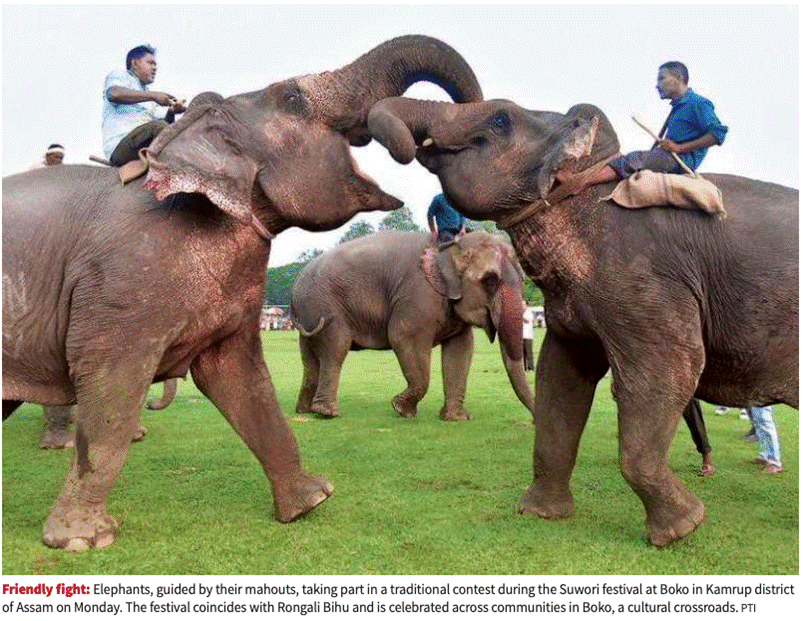
- 21 April 2026 witnessed the celebration of the 114th Suwori Bihu Festival in Boko (Kamrup district), drawing attention to Assam’s rich syncretic tribal culture and continuity of indigenous traditions within the broader Rongali Bihu framework.
- The event gained prominence due to its scale of participation, traditional sports (horse/elephant races), and multi-ethnic representation, making it relevant for culture, society, and regional identity in UPSC.
Relevance
GS I (Art & Culture)
- Intangible Cultural Heritage (ICH)
- Tribal culture, festivals, Northeast diversity
GS I (Society)
- Cultural integration, unity in diversity
- Ethnic coexistence
Practice Question
Q1.Discuss the role of regional festivals in preserving India’s intangible cultural heritage. Illustrate with examples from Northeast India. (250 words)
Static Background
- Suwori Bihu is a century-old regional festival embedded within the larger Bihu cycle of Assam, particularly associated with Rongali (Bohag) Bihu, which marks the Assamese New Year and onset of the agricultural sowing season.
- The broader Bihu system reflects agrarian rhythms and seasonal transitions:
- Rongali (Bohag) → celebration, fertility, new year
- Kongali (Kati) → austerity and crop protection
- Bhogali (Magh) → harvest and feasting
- The festival embodies tribal–non-tribal cultural synthesis, involving communities such as Rabha, Bodo, Garo, Koch-Rajbongshi, and Gorkha, highlighting Assam’s ethnographic diversity.
- Falls under the domain of Intangible Cultural Heritage (ICH), characterised by oral traditions, ritual performances, and community participation, rather than monumental heritage.
Core Issue & Key Features
- Celebrated annually on the 7th day of Rongali Bihu, making it a post-New Year community festival consolidating regional cultural identity.
- The 114th edition (2026) reflects continuity of tradition for over a century, indicating strong intergenerational cultural transmission mechanisms.
- Key attractions include:
- Hana Ghora (traditional horse dance) symbolising martial and agrarian heritage
- Paro Bah ritual performances, rooted in local mythological traditions
- Traditional sports such as horse racing, elephant racing, bamboo climbing, and tug-of-war, reflecting pre-modern livelihood patterns
- Participation cuts across multiple ethnic groups, reinforcing shared cultural ownership rather than exclusive identity.
Overview
- The festival represents a grassroots model of cultural federalism, where local traditions coexist within the broader national cultural framework without homogenisation.
- Acts as a living example of “unity in diversity”, where diverse tribes retain distinct identities while participating in a shared socio-cultural platform, strengthening social cohesion in Northeast India.
- The integration of rituals, dance, and indigenous sports demonstrates the inseparable link between culture, ecology, and economy, especially in agrarian societies dependent on seasonal cycles.
- Traditional practices such as horse and elephant races reflect historical mobility patterns, pastoral traditions, and human-animal relationships, offering insights into ethno-ecological adaptations.
- The festival also serves as an informal institution of knowledge transmission, where oral traditions, folklore, and community values are passed across generations without formal documentation systems.
- Increasing media visibility and tourism potential indicate a shift towards cultural commodification, which can enhance local livelihoods but risks diluting authenticity if not managed sustainably.
- From a governance perspective, such festivals highlight the need for policy support for regional cultures, aligning with cultural preservation mandates under Article 29 (protection of culture).
Challenges & Concerns
- Rapid urbanisation and migration threaten the continuity of traditional knowledge systems and community participation.
- Lack of systematic documentation and institutional archiving risks permanent loss of oral and ritual traditions.
- Commercialisation and tourism pressures may transform authentic practices into performative spectacles detached from original meaning.
- Ethical and environmental concerns related to animal-based events (elephant/horse races) may invite regulatory scrutiny.
- Limited policy prioritisation of regional festivals compared to mainstream national cultural narratives.
Key Takeaways
- Demonstrates link between festivals, agriculture, and ecology, useful for interdisciplinary answers.
- Highlights importance of intangible cultural heritage preservation in nation-building.
- Useful case study for cultural federalism, identity politics, and grassroots social cohesion.
- Can enrich answers on “unity in diversity”, tribal traditions, and regional cultural ecosystems.
Prelims Pointers
- Suwori Bihu Festival celebrated in Boko (Kamrup district, Assam).
- 114th edition held in April 2026.
- Observed on 7th day of Rongali (Bohag) Bihu.
- Famous for Hana Ghora dance and Paro Bah rituals.
- Includes traditional sports like horse and elephant races.
- Represents multi-ethnic participation (Rabha, Bodo, Garo, Koch-Rajbongshi, Gorkha).
India’s forests could nearly double carbon storage by 2100, study finds
Context: Why in News?
- A recent modelling study published in Environmental Research: Climate projects that India’s forests could nearly double their carbon storage by 2100, depending on emission scenarios.
- The findings diverge from official estimates of Forest Survey of India (FSI), raising concerns about methodological gaps and future forest stability under climate change.
Relevance
GS III (Environment & Climate Change)
- Carbon sinks, climate modelling
- Forest policy, Paris Agreement commitments
GS I (Geography)
- Vegetation patterns, climate–ecosystem interaction
Practice Question
Q1.“Increased forest carbon storage does not necessarily indicate ecological health.”Critically examine with reference to recent climate studies. (250 words)
Static Background
- Forests act as carbon sinks, absorbing atmospheric CO₂ through Photosynthesis and storing it as biomass carbon (above-ground + below-ground).
- India’s climate commitments under Paris Agreement include creating an additional 2.5–3 billion tonnes of CO₂ equivalent carbon sink through forests by 2030.
- FSI assessments rely on satellite-based forest cover mapping + inventory methods, focusing on current stock, whereas climate models project future dynamics.
- Key drivers of forest carbon dynamics:
- Precipitation (water availability)
- Atmospheric CO₂ concentration (fertilisation effect)
- Temperature and extreme events
Core Issue / Key Findings / Data
- Forest carbon biomass projected to increase:
- +35% (low emissions)
- +62% (medium emissions)
- +97% (high emissions scenario) by 2100
- Growth divergence becomes significant post-2050, despite similar trends till ~2030.
- Dry regions (Rajasthan, Gujarat, W. MP) show >60% increase, while Western Ghats & Himalayas show limited gains due to ecological saturation.
- Growth driven by increased rainfall + CO₂ fertilisation, with lag effect (2–4 years) in biomass response.
Overview
- The study highlights a paradox where higher emissions → greater carbon sequestration, due to CO₂ fertilisation and increased rainfall, but this does not imply climate benefit.
- Increased biomass in semi-arid regions suggests climate-induced vegetation shifts, potentially altering ecosystem composition and biodiversity patterns.
- Ecological saturation in dense forests (Western Ghats, Himalayas) limits further carbon absorption, indicating finite carrying capacity of ecosystems.
- The divergence from FSI estimates underscores the gap between static measurement (present stock) and dynamic modelling (future projections).
- The projections exclude disturbance factors (deforestation, fires, pests, land-use change), which may reverse gains and convert forests into carbon sources.
- Increased biomass accumulation may also raise forest vulnerability, as heatwaves, droughts, and wildfires can trigger sudden carbon release.
- The findings reinforce the concept that climate change has non-linear and regionally differentiated impacts, challenging simplistic narratives of “greening”.
- Demonstrates importance of integrating climate science, ecology, and policy planning for long-term forest management.
Challenges & Concerns
- Overestimation risk due to exclusion of disturbances like wildfires, deforestation, pest outbreaks.
- Policy mismatch between FSI-based reporting and model-based projections.
- Climate extremes (heatwaves, droughts) may destabilise forest ecosystems despite biomass growth.
- Risk of biodiversity loss due to species composition changes in newly greening dry regions.
- Weak integration of forest carbon modelling into policy frameworks (NAPCC, Green India Mission).
- Uncertainty in long-term rainfall projections and CO₂ fertilisation effects.
Key Takeaways
- Highlights complexity of climate–forest interactions, showing that increased carbon storage ≠ ecological health.
- Demonstrates need for dynamic, forward-looking forest policy rather than static assessments.
- Useful example of scientific modelling vs administrative data gap.
- Reinforces importance of climate-resilient forest management and ecosystem-based adaptation.
Prelims Pointers
- Forest carbon storage depends on biomass accumulation via photosynthesis.
- CO₂ fertilisation effect can enhance plant growth under higher CO₂ levels.
- FSI is India’s official body for forest cover and carbon stock estimation.
- Western Ghats & Himalayas show ecological saturation limiting carbon growth.
- Semi-arid regions may show higher relative increase in vegetation under climate change.
- Climate models often exclude disturbance factors like fire and land-use change
There is a need to prioritise biofuel for aviation: IATA
Context: Why in News?
- Recent remarks by International Air Transport Association (IATA) emphasise that India’s Sustainable Aviation Fuel (SAF) transition must prioritise efficient feedstock allocation, especially ethanol, to aviation over road transport.
- This aligns with India’s SAF blending roadmap and global commitments under International Civil Aviation Organization (ICAO) for net-zero aviation emissions by 2050.
Relevance
GS III (Economy & Environment)
- Energy transition, biofuels, aviation sector
- Climate commitments (net-zero aviation)
Practice Question
Q1.Discuss the challenges in decarbonising the aviation sector. Evaluate the role of Sustainable Aviation Fuel (SAF). (250 words)
Static Background
- Sustainable Aviation Fuel (SAF) refers to non-fossil jet fuels derived from biomass, waste oils, or synthetic processes, capable of reducing lifecycle emissions by up to 80%.
- Key production pathways include:
- Alcohol-to-Jet (AtJ) (ethanol → jet fuel)
- HEFA (Hydroprocessed Esters & Fatty Acids)
- Power-to-Liquid (synthetic fuels)
- Aviation is a hard-to-abate sector due to high energy density requirements, limiting electrification feasibility unlike road transport.
- India’s climate commitments under Paris Agreement and Long-Term Low Emission Development Strategy (LT-LEDS) emphasise low-carbon fuels and energy transition.
Core Issue & Key Findings
- India has set SAF blending targets:
- 1% by 2027
- 2% by 2028
- 5% by 2030 (for international flights)
- India possesses ~10% of global bio-feedstock potential, yet currently utilises only ~2–3%, indicating underutilisation capacity.
- Global SAF feedstock availability projected:
- 105 million tonnes (2030)
- 154 million tonnes (2050) vs 500 mt global demand → significant supply gap.
- SAF currently costs 3–5 times more than conventional jet fuel, posing economic challenges.
Overview
- The core policy challenge is optimal allocation of scarce biomass feedstock, where competing sectors (aviation vs road transport) demand the same resource (ethanol).
- Road transport has viable alternatives (EVs, hydrogen, hybrid systems), whereas aviation remains structurally dependent on liquid fuels, justifying sectoral prioritisation of ethanol for SAF.
- The Alcohol-to-Jet (AtJ) pathway emerges as India’s most viable route due to existing ethanol ecosystem (E20 blending programme), creating policy synergies but also competition.
- Lack of integrated mobility planning leads to sub-optimal outcomes, where sector-specific policies (ethanol for cars vs planes) may conflict, highlighting need for systems approach in energy transition.
- India’s bio-feedstock abundance (10% global share) positions it as a potential global SAF hub, but requires supply chain scaling, logistics, and policy coordination.
- High cost of SAF reflects early-stage technology, limited economies of scale, and feedstock constraints, necessitating state support (subsidies, viability gap funding).
- Without policy clarity, there is a risk of stranded investments, where aviation firms invest in SAF capacity but face ethanol shortages due to competing demand from ethanol blending in petrol.
- The issue underscores broader energy transition dilemma: balancing food security, fuel demand, and environmental sustainability, especially when feedstock is derived from agricultural biomass.
Challenges & Concerns
- Feedstock competition between aviation, road transport, and other biofuel sectors.
- High production cost (3–5x conventional fuel) impacting airline economics and passenger fares.
- Lack of integrated policy framework across ministries (aviation, petroleum, agriculture).
- Risk of food vs fuel conflict if ethanol production expands unsustainably.
- Limited domestic SAF production infrastructure and technology maturity.
- Absence of long-term pricing and demand certainty discourages private investment.
Key Takeaways
- Highlights importance of sectoral prioritisation in energy transition for hard-to-abate sectors.
- Demonstrates need for integrated mobility and energy policy approach rather than silo-based policymaking.
- Illustrates trade-offs between economic feasibility, environmental sustainability, and technological constraints.
- Useful case for policy design, resource allocation, and sustainable development debates.
Prelims Pointers
- SAF (Sustainable Aviation Fuel) can reduce aviation emissions significantly compared to fossil jet fuel.
- Alcohol-to-Jet (AtJ) is a key SAF production pathway using ethanol.
- India’s SAF blending targets: 1% (2027), 2% (2028), 5% (2030).
- IATA is a global airline association; ICAO is a UN specialised agency for aviation.
- Aviation sector is difficult to electrify due to high energy density requirements.
- SAF is currently 3–5 times more expensive than conventional aviation fuel.
Government recognizes more than 55,200 startups during FY 2025-26
Context: Why in News?
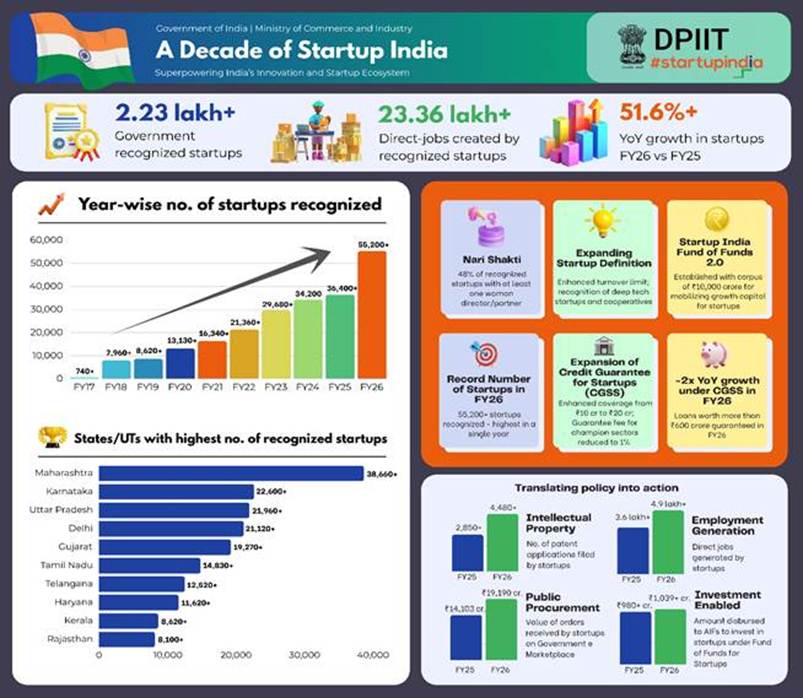
- PIB reported that India recognised 55,200+ startups in FY 2025–26, the highest-ever annual addition since the launch of the Startup India Initiative (2016).
- Total recognised startups crossed 2.23 lakh, generating 23.36 lakh direct jobs, signalling deepening of India’s innovation-led growth model.
Relevance
GS III (Economy)
- Innovation, entrepreneurship, employment generation
- Startup ecosystem, funding mechanisms
GS II (Governance)
- Policy design, ease of doing business
Practice Question
Q1.Evaluate the role of startups in driving India’s economic transformation. Highlight key challenges. (250 words)
Static Background
- Startup India Initiative (2016) aims to build a robust entrepreneurial ecosystem, focusing on innovation, job creation, and ease of doing business.
- Key pillars include:
- Simplification and handholding (regulatory easing, self-certification)
- Funding support and incentives (tax exemptions, capital access)
- Industry-academia partnerships and incubation ecosystem
- Institutional architecture includes schemes like:
- Fund of Funds for Startups (FFS)
- Startup India Seed Fund Scheme (SISFS)
- Credit Guarantee Scheme for Startups (CGSS)
- Linked to Atmanirbhar Bharat, Digital India, and Make in India, positioning startups as drivers of innovation and employment.
Core Issue & Key Findings
- 55,200+ startups recognised in FY 2025–26, marking 51.6% YoY growth, indicating accelerated entrepreneurial activity.
- Total recognised startups: 2.23 lakh+, generating 23.36 lakh direct jobs, reflecting labour-intensive innovation growth.
- Women-led participation strong: 1.07 lakh startups (~48%) have at least one woman director/partner, signalling inclusive entrepreneurship.
- Regional spread pan-India, with Maharashtra, Karnataka, Uttar Pradesh, Delhi, Gujarat emerging as leading hubs.
- Funding ecosystem:
- ₹7,000+ crore disbursed via FFS → ₹26,900+ crore invested in 1,420+ startups
- FFS 2.0 launched with ₹10,000 crore corpus
- Credit expansion:
- CGSS guarantee enhanced from ₹10 crore → ₹20 crore per borrower
- ₹1,250+ crore loans guaranteed (410+ loans)
- Innovation indicators:
- 19,400+ patent applications filed
- Patent filings rose from 2,850 → 4,480 (YoY increase)
- Public procurement integration:
- 38,600+ startups onboarded on Government e-Marketplace
Overview
- The surge in startup recognition reflects structural shift towards innovation-driven growth, complementing India’s transition from factor-driven to knowledge-driven economy.
- Strong YoY growth (51.6%) indicates improved ease of doing business, digital infrastructure, and policy support, especially post-pandemic entrepreneurial expansion.
- High women participation (~48%) signals democratisation of entrepreneurship, contributing to gender-inclusive economic development.
- Expansion of FFS and CGSS reflects government’s role in de-risking private investment, addressing the “valley of death” problem in startup financing.
- Integration with GeM platform creates demand-side support, enabling startups to access government procurement markets, which is critical for scaling and revenue stability.
- Rising patent filings indicate shift from service-based startups to deep-tech and IP-driven innovation ecosystems.
- However, startup concentration in a few states highlights regional innovation imbalance, pointing to uneven ecosystem maturity.
- The policy push shows movement from startup quantity → quality (innovation, patents, scale-ups), but sustainability depends on market viability and global competitiveness.
Challenges & Concerns
- High startup mortality rate due to funding gaps beyond early stages (Series B/C crunch).
- Regional disparities with Tier-2/3 cities lagging in ecosystem maturity.
- Limited deep-tech and manufacturing startups compared to service sector dominance.
- Regulatory compliance burden still persists despite simplification efforts.
- Dependence on government incentives rather than market-driven sustainability.
- Skill gaps and R&D ecosystem limitations constrain high-value innovation.
- Global uncertainties affecting venture capital flows and startup valuations.
Key Takeaways
- Startup ecosystem is a key pillar of India’s economic transformation and employment generation strategy.
- Demonstrates public-private partnership model in innovation financing (FFS, CGSS).
- Highlights importance of inclusive entrepreneurship (women participation, pan-India spread).
- Useful example of state-led ecosystem building with market-oriented outcomes.
Prelims Pointers
- Startup India Initiative launched on 16 January 2016.
- FFS operates via SEBI-registered AIFs, not direct funding to startups.
- CGSS provides credit guarantees, not direct loans.
- SISFS supports early-stage startups through incubators.
- GeM platform enables startups to participate in government procurement.
- Patent filings by startups increased significantly in FY 2025–26.
Cabinet approves proposal for creation of ‘Bharat Maritime Insurance Pool’ (BMI pool)
Why in News?
- 18 April 2026 (PIB): Union Cabinet approved creation of the Bharat Maritime Insurance Pool (BMI Pool) with a sovereign guarantee of ₹12,980 crore, aimed at ensuring continuous, affordable maritime insurance coverage for Indian trade amid rising global volatility and geopolitical disruptions.
- The move is significant in the backdrop of increasing risks in key shipping routes and the withdrawal or cost escalation of insurance by foreign insurers, directly affecting India’s trade security and logistics costs.
Relevance
GS III (Economy & Infrastructure)
- Maritime trade, insurance sector, logistics
- Economic security, global supply chains
GS II (Governance)
- Sovereign guarantee, strategic policy response
Practice Question
Q1.Discuss the significance of the Bharat Maritime Insurance Pool in enhancing India’s trade resilience. (250 words)
Static Background
- Maritime insurance is a critical enabler of global trade, as ships cannot operate without adequate risk coverage; it protects against physical damage, cargo loss, third-party liabilities, and war-related risks.
- India’s trade is heavily dependent on maritime routes, with ~95% of trade by volume and ~70% by value transported via sea, making uninterrupted insurance coverage essential for economic stability and supply chain resilience.
- Traditionally, India has depended on global insurance systems like the International Group of Protection and Indemnity Clubs (IGP&I Clubs), which provide P&I insurance covering liabilities such as oil spills, crew injury, and collision damage.
- However, such dependence exposes India to external risks including sanctions, geopolitical conflicts, and premium volatility, as these global entities may withdraw or restrict coverage during crises.
- The concept of an insurance pool involves multiple insurers combining their financial capacity to spread risk, enhance underwriting capability, and provide coverage for large or high-risk sectors.
Core Issue & Key Features
- The BMI Pool is backed by a sovereign guarantee of ₹12,980 crore, ensuring strong financial backing and credibility to absorb large-scale maritime risks.
- The pool will have a combined underwriting capacity of approximately ₹950 crore, enabling domestic insurers to issue policies collectively rather than individually bearing risk.
- It provides comprehensive coverage across all major maritime risk categories, including Hull & Machinery (ship damage), Cargo (goods in transit), Protection & Indemnity (third-party liabilities), and War risk (conflict-related damages).
- Coverage extends to Indian-flagged vessels as well as ships carrying cargo to and from Indian ports, even when passing through volatile maritime corridors such as conflict-prone sea lanes.
- A dedicated Governing Body will oversee the pool’s functioning, ensuring regulatory coordination, operational efficiency, and adherence to Indian maritime conditions and legal frameworks.
Overview
- The creation of the BMI Pool represents a strategic shift towards financial sovereignty in maritime risk management, reducing India’s reliance on foreign insurers and insulating trade from external shocks such as sanctions or geopolitical tensions.
- By providing a sovereign guarantee, the government effectively de-risks the sector, enabling domestic insurers to expand their coverage capacity and compete with established global insurance pools.
- The initiative ensures continuity of maritime trade, especially during crises when foreign insurers may either withdraw coverage or impose prohibitively high premiums, thereby safeguarding supply chains and export-import flows.
- It contributes to cost stabilisation in logistics, as predictable insurance premiums prevent sudden spikes in shipping costs that could otherwise translate into inflationary pressures in the domestic economy.
- The pool also promotes development of domestic expertise in marine underwriting, claims management, actuarial science, and maritime legal frameworks, strengthening India’s financial and insurance ecosystem.
- Strategically, it complements India’s broader maritime ambitions (Sagarmala, Maritime India Vision 2030) and aligns with Atmanirbhar Bharat, extending self-reliance to financial and risk management domains.
- However, long-term success depends on robust risk assessment, actuarial accuracy, and reinsurance linkages, as sovereign backing alone cannot sustain large-scale catastrophic liabilities.
Challenges & Concerns
- The ₹12,980 crore sovereign guarantee exposes the government to significant fiscal risk, especially in case of large maritime accidents or war-related losses.
- India currently has limited domestic expertise in complex marine underwriting and actuarial risk modelling, compared to established global insurance institutions.
- The pool will require strong reinsurance arrangements, possibly still involving global players, to manage catastrophic risks beyond domestic capacity.
- There is a potential risk of moral hazard, where insurers or shipping entities may rely excessively on sovereign backing and weaken risk discipline.
- Coordination challenges may arise among multiple insurers, regulators, and maritime stakeholders, affecting operational efficiency.
- Ensuring global acceptance and integration with international maritime insurance norms will be crucial for credibility and smooth functioning.
Key Takeaways
- The BMI Pool is a significant example of economic security through financial instruments, linking insurance, trade resilience, and geopolitics.
- It reflects a policy shift from external dependence to domestic capacity building in critical sectors, extending the idea of Atmanirbhar Bharat beyond manufacturing into financial services.
- Demonstrates the role of sovereign guarantees in enabling high-risk sectors and crowding in private participation.
- Serves as a case study of how non-traditional sectors like insurance can influence national security and economic stability.
Prelims Pointers
- The Bharat Maritime Insurance Pool (BMI Pool) was approved by the Union Cabinet in April 2026.
- It is backed by a sovereign guarantee of ₹12,980 crore, ensuring financial stability and risk absorption.
- The pool provides coverage for Hull & Machinery, Cargo, Protection & Indemnity (P&I), and War risks.
- It reduces India’s dependence on International Group of Protection and Indemnity (IGP&I) Clubs, which dominate global marine insurance.
- It applies to Indian-flagged vessels and ships trading to/from India, including those transiting high-risk maritime zones.
- The initiative aims to ensure continuous insurance availability and stability of maritime trade under geopolitical uncertainty.
Tobacco as Poverty Trap
Context: Why in News?
- A recent study in BMJ Global Health (April 2026) shows that 20.49 million Indian households (~10.6%) could move to a higher economic class simply by quitting tobacco, reframing tobacco as a poverty and development issue, not just a health concern.
- The study by ICMR-National Institute of Cancer Prevention and Research and Tata Institute of Social Sciences provides national-scale evidence linking tobacco consumption with economic immobility.
Relevance
GS II (Health & Social Sector)
- Public health policy, tobacco control laws
- Welfare and behavioural change
GS III (Economy)
- Poverty, human capital, inequality
Practice Question
Q1.“Tobacco consumption is not merely a health issue but a development challenge.”Discuss with evidence. (250 words)
Static Background
- Tobacco is a major public health concern in India, with ~267 million users (~25% of adults), making it one of the largest tobacco-consuming countries globally.
- It is the leading preventable cause of death, responsible for ~1.35 million deaths annually, linked to cancers (oral, lung, oesophagus), cardiovascular diseases, and stroke.
- India is also the second-largest producer and consumer of tobacco, with a dominant share (~70%) in smokeless tobacco globally.
- Tobacco control framework includes:
- Cigarettes and Other Tobacco Products Act (COTPA), 2003
- National Tobacco Control Programme (NTCP)
- WHO Framework Convention on Tobacco Control (FCTC) commitments
- Traditionally framed as a health issue, but increasingly recognised as a development and poverty challenge.
Core Issue & Key Findings
- 20.49 million households (10.6%) can move up one income class by reallocating tobacco expenditure.
- Poorest households spend ~6.4% of monthly income on tobacco, compared to ~2% among richest, indicating regressive consumption burden.
- 5.62 million poorest households (12.4%) could escape their income class entirely through cessation.
- Rural households disproportionately affected:
- 17 million rural vs 3.5 million urban households could improve economic status
- Rural spending share: 6.6% vs 5.6% (urban)
- Tobacco blocks economic mobility, diverting income from nutrition, education, and healthcare.
Overview
- Tobacco functions as a “poverty trap”, where recurrent spending on addictive products reduces household savings, investment capacity, and upward mobility.
- The burden is regressive, disproportionately affecting poorer households, thereby widening income inequality and social vulnerability.
- The study introduces a paradigm shift from “health externality” to “development constraint”, linking tobacco consumption directly with multidimensional poverty indicators.
- High rural impact reflects lack of awareness, weaker healthcare access, and limited financial resilience, making tobacco expenditure more damaging.
- Early initiation (before age 18 for ~90% users) creates long-term addiction cycles, locking individuals into lifetime economic and health disadvantages.
- The findings highlight the concept of “opportunity cost of consumption”, where money spent on tobacco directly reduces human capital formation (nutrition, education).
- Integrating tobacco control with poverty alleviation programmes can generate dual dividends: improved health outcomes and enhanced economic mobility.
- The study underscores that no additional fiscal resources are required, as gains come from reallocation of existing household expenditure, making it a high-impact, low-cost policy lever.
Challenges & Concerns
- Addiction and behavioural inertia make quitting difficult despite economic incentives.
- Tobacco industry influence and informal sector production (especially smokeless tobacco) hinder regulation.
- Weak enforcement of COTPA provisions in rural and semi-urban areas.
- Limited integration of tobacco cessation with welfare schemes (PDS, MGNREGA, health missions).
- Social and cultural acceptance of tobacco use in many regions.
- Lack of targeted awareness linking tobacco use to poverty, as messaging is largely health-focused.
Key Takeaways
- Tobacco is not just a public health issue but a structural barrier to poverty reduction and human development.
- Demonstrates importance of behavioural economics in policy design, where consumption choices affect socio-economic outcomes.
- Relevant for GS II (health, welfare policies), GS III (poverty, human capital), and GS IV (ethics: responsibility towards vulnerable groups).
- Provides strong case for policy convergence (health + poverty + nutrition).
- Useful example for essay themes on development traps, inequality, and behavioural change.
Prelims Pointers
- India has ~267 million tobacco users, one of the highest globally.
- Tobacco causes ~1.35 million deaths annually in India.
- COTPA, 2003 regulates tobacco production, sale, and advertisement.
- India accounts for ~70% of global smokeless tobacco consumption.
- Majority of users start before age 18, increasing addiction risk.
- Tobacco expenditure is higher as a share of income among poorer households.


