
Content
- Kendu Leaves & Forest Rights Issue
- Carbon Credits in Rice Farming (Amazon Deal)
- What are safer fireworks alternatives?
- Real equity gap in higher education
- Indian ties with Africa signal stability in a turbulent world’
- Liver disease often goes unnoticed in people with type 2 diabetes
Kendu Leaves & Forest Rights Issue
What is the News?
- Tribal Gram Sabhas in Koraput (Odisha) are unable to exercise their legal rights over kendu leaves for the third consecutive year.
- Despite having Community Forest Rights (CFR) under the Forest Rights Act, 2006, they need a state-issued deregulation letter to actually collect and sell leaves.
- The State continues monopoly control under the Odisha Kendu Leaf (Control of Trade) Act, restricting access to only ~20% households via a card system.
- As a result, most tribal collectors—especially women—are excluded from income opportunities, with past losses like ₹36 lakh worth produce wasted in 2024.
Relevance
GS II (Governance)
- Implementation gaps in Forest Rights Act, 2006
- Conflict between state monopoly laws and community rights
- Tribal governance, decentralisation, administrative bottlenecks
GS III (Environment & Economy)
- Minor Forest Produce (MFP)-based livelihoods
- Forest economy, informal sector (bidi industry)
- Sustainable forest management
Practice Questions
Q1.“Legal recognition of rights does not guarantee their realisation on the ground.”Examine in the context of Community Forest Rights under FRA. (250 words)
What are Kendu Leaves ?
- Kendu (Tendu) leaves (Diospyros melanoxylon) are classified as Minor Forest Produce (MFP) under the Forest Rights Act, 2006.
- Popularly called “Green Gold of Odisha” due to their high economic value for forest-dependent communities.
- Primarily used in bidi (local cigarette) rolling, making them a key raw material in the informal tobacco sector.
- Major producing states include Madhya Pradesh, Chhattisgarh, Odisha, Maharashtra, and Jharkhand.
Key facts about Kendu leaves ?
- It is a nationalised forest product in some states, meaning the government controls procurement and trade.
- Leaves are hygroscopic, allowing them to remain flexible and suitable for bidi rolling without cracking.
- Odisha is unique in producing processed kendu leaves, adding value before sale.
- Collection is seasonal (around 3 weeks) and forms a crucial livelihood source for tribal households, especially women.
Why it matters ?
- Kendu leaves provide critical seasonal income in forest regions where alternative livelihoods are limited.
- FRA gives communities ownership and selling rights, but administrative barriers prevent real benefits.
- The issue highlights the gap between legal rights and ground-level implementation in tribal and forest governance.
Prelims Pointers
- Kendu (Tendu) leaves (Diospyros melanoxylon) are classified as Minor Forest Produce (MFP) under the Forest Rights Act, 2006.
- The Forest Rights Act (FRA), 2006 grants Community Forest Rights (CFR), including rights to collect, use, and sell MFP.
- Kendu leaves are used in bidi-making, making them an important non-timber forest product with high economic value.
- In some states, kendu leaves are nationalised forest produce, meaning the government controls trade and procurement.
- Major kendu-producing states include Madhya Pradesh, Chhattisgarh, Odisha, Maharashtra, and Jharkhand.
Carbon Credits in Rice Farming (Amazon Deal)
What is the News ?
- Amazon has signed a $30 million (₹280 crore) deal with Good Rice Alliance to purchase carbon credits from Indian rice farmers.
- This is India’s largest agricultural carbon credit deal and among the biggest globally in the agriculture sector.
- The project will generate over 685,000 tonnes of CO₂-equivalent credits, helping Amazon offset emissions and move towards net-zero targets.
- The initiative covers 13,000+ farmers across 35,000 hectares, promoting sustainable rice cultivation practices.
Relevance
GS III (Environment & Economy)
- Carbon markets under Paris Agreement
- Nature-based solutions, agriculture emissions
- Methane mitigation in paddy cultivation
GS III (Agriculture)
- Sustainable practices: AWD, DSR
- Climate-smart agriculture
Practice Questions
Q1.Evaluate the potential of carbon markets in transforming Indian agriculture towards sustainability. Highlight associated challenges. (250 words)
What are carbon credits ?
- Carbon credits are tradable permits representing 1 tonne of CO₂ (or equivalent) reduced, avoided, or removed from the atmosphere.
- Companies purchase them to offset their emissions, especially when direct emission reduction is difficult.
- They are part of market-based climate mechanisms under global climate frameworks like the Paris Agreement.
Why rice farming is important for carbon credits ?
- Conventional rice cultivation involves flooded fields, which produce methane due to anaerobic decomposition.
- Rice cultivation contributes 8–10% of global methane emissions, making it a major agricultural emission source.
- India, as the largest paddy producer, is also among the top methane emitters globally.
Sustainable rice practices involved
- Farmers adopt Alternate Wetting and Drying (AWD) instead of continuous flooding, reducing methane emissions significantly.
- Direct Seeded Rice (DSR) reduces water use and emissions compared to traditional transplantation methods.
- These practices improve water efficiency, soil health, and climate resilience along with emission reduction.
Key facts about methane and impact
- Methane has ~27 times higher global warming potential than CO₂, making it a critical short-term climate pollutant.
- Reducing methane emissions can deliver rapid climate benefits within a decade, unlike CO₂ which has long-term persistence.
Why it matters ?
- The deal shows growing role of carbon markets in agriculture, expanding beyond renewable energy projects.
- Provides additional income to small farmers, linking climate action with livelihoods.
- Helps corporates like Amazon achieve net-zero commitments, though debates remain on over-reliance on offsets.
- Signals India’s potential as a major player in nature-based carbon credit markets.
Prelims Pointers
- Amazon signed a $30 million deal to purchase carbon credits from Indian rice farmers, marking a major agricultural carbon market initiative.
- Carbon credits represent 1 tonne of CO₂ (or equivalent) reduced or removed, and are traded to help entities meet emission reduction or net-zero targets.
- Rice cultivation contributes 8–10% of global methane emissions, due to anaerobic decomposition in flooded paddy fields.
- Methane has ~27 times higher global warming potential than CO₂, making it a key target for short-term climate mitigation.
- Sustainable methods like Alternate Wetting and Drying (AWD) and Direct Seeded Rice (DSR) help reduce emissions and improve water efficiency.
What are safer fireworks alternatives?
What is the News ?
- Fireworks at Thrissur Pooram reached 122.4 decibels, close to the legal limit, raising concerns over safety and health impacts.
- Incidents like elephants running amok and recent firecracker factory explosions have intensified debate on high-decibel fireworks.
- Experts are pushing for a shift towards noiseless alternatives like cold spark technology due to risks to humans, animals, and hospitals.
Relevance
GS III (Environment & Health)
- Noise pollution norms by Central Pollution Control Board
- Public health impacts (WHO: 3rd biggest environmental threat)
GS III (Science & Tech)
- Cold spark technology (low temperature, metal powder-based combustion)
Practice Questions
Q1.“Balancing cultural traditions with environmental sustainability is a governance challenge.”Discuss with reference to firecracker regulations in India. (250 words)
How loud are fireworks & what rules permit ?
- Firecracker noise in India is capped at 125 decibels at 4 metres, as per Central Pollution Control Board norms.
- At Thrissur Pooram, recorded levels of 122.4 dB are extremely high compared to safe ambient levels.
- Recommended ambient noise is 45–55 dB in residential areas and 40–50 dB in silence zones like hospitals.
Risks to hospitals and people
- Fireworks noise far exceeds safe limits near hospitals, especially affecting neonatal intensive care units (NICUs).
- High decibel exposure can impact infant brain development, disturb critical patients, and delay recovery.
- According to World Health Organization, noise pollution is the third most harmful environmental threat after air and water pollution.
What is cold spark technology ?
- Cold spark technology uses fine metal powders like titanium and zirconium, not explosive chemicals, to create spark effects.
- Devices heat and eject these particles, which react with oxygen to produce bright sparkler-like visuals without loud noise.
Are they safer than traditional fireworks
- Traditional fireworks operate at around 1,200°C, while cold spark systems work at only 60–100°C, reducing burn and fire risks.
- They produce minimal noise, less smoke, and controlled effects, making them safer for humans, animals, and sensitive areas.
Why noiseless alternatives are not widely used ?
- Higher cost (e.g., ~₹400 per unit) compared to traditional fireworks limits adoption.
- Lack of large-scale domestic manufacturing, with many products currently imported.
- Cultural preference for loud, explosive displays and limited policy push slow transition.
What transition is being proposed ?
- Experts suggest a phased shift from traditional fireworks to cold spark-based displays, starting with major festivals like Thrissur Pooram.
- Proposal includes large-scale coordinated spark systems that replicate visual grandeur without noise and pollution.
- Local authorities are urged to pilot and gradually replace high-decibel fireworks, balancing tradition with safety and sustainability.
Prelims Pointers
- Firecracker noise in India is regulated by Central Pollution Control Board, with a maximum limit of 125 decibels at 4 metres distance.
- Recommended ambient noise levels are 40–50 dB in silence zones (hospitals, schools) and 45–55 dB in residential areas, far lower than firecracker limits.
- Cold spark technology uses metal powders like titanium and zirconium to create light effects without explosive combustion or loud noise.
- Traditional fireworks operate at around 1,200°C, whereas cold spark systems function at only 60–100°C, significantly reducing burn and fire hazards.
- According to World Health Organization, noise pollution is the third most harmful environmental risk after air and water pollution.
Real equity gap in higher education
What is the news ?
- The UGC (Promotion of Equity in Higher Education Institutions) Regulations, 2026 have triggered debate and protests over their scope and intent.
- The Supreme Court has stayed their implementation, calling them vague and open to misuse.
- The issue has raised concerns about equity, discrimination, and representation in higher education institutions (HEIs).
Relevance
GS II (Polity & Governance)
- Role of University Grants Commission
- Equity vs over-regulation debate
- Judicial review by Supreme Court of India
GS I (Society)
- Social justice, caste-based inequality
- Representation vs discrimination debate
Practice Questions
Q1.“Equity in higher education goes beyond access to representation in decision-making roles.”Critically examine. (250 words)
What the regulations are about ?
- Proposed by University Grants Commission to promote equity and address discrimination in universities and colleges.
- Include provisions like Equity Helplines, complaint mechanisms, and institutional responsibilities to prevent discrimination.
- Aim to create a more inclusive academic environment across caste and social groups.
Key findings from data
- Representation of SC (15%), ST (7.5%), and OBC (27%) in HEI employment is below mandated reservation levels, especially at higher positions.
- In contrast, student admissions are broadly aligned with reservation quotas, with ST representation even exceeding quotas in some levels.
- This suggests inequality is more serious in employment than in admissions.
Data on discrimination
- Around 378 complaints reported in 2023–24 across 704 universities and 1,553 colleges.
- This translates to roughly 3.7 complaints per 1 lakh students and 0.16 cases per institution, indicating relatively low reported incidence.
- Disposal rate of SC/ST complaints is ~90%, showing strong procedural follow-up.
NCRB data context
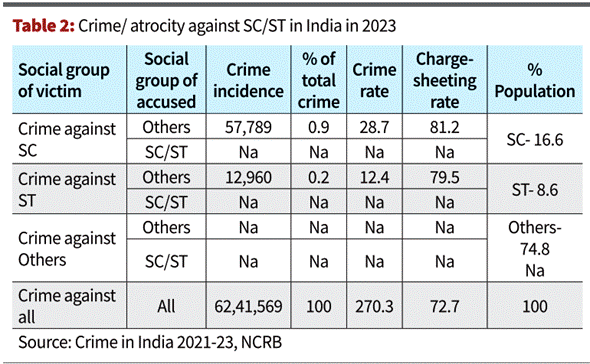
- Crimes against SCs and STs constitute about 0.9% and 0.2% of total crimes, respectively.
- Data is limited as it only records crimes by “others”, not within communities or across all groups.
- Crime patterns often reflect social proximity rather than purely caste-based targeting.
Why controversy arose ?
- Regulations are criticised for focusing more on complaint mechanisms (anti-discrimination) rather than structural equity (representation in jobs).
- Lack of clarity in provisions raises fears of misuse and over-regulation in academic spaces.
- Critics argue they assume complete elimination of identity-based discrimination, which may be unrealistic.
Why it matters ?
- Highlights gap between formal reservation policies and actual representation, especially in faculty and leadership roles.
- Raises broader questions on how to measure equity vs discrimination in HEIs.
- Brings attention to need for balanced approach combining representation, inclusion, and social cohesion in higher education.
Prelims Pointers
- The UGC (Promotion of Equity in HEIs) Regulations, 2026 aim to address equity and discrimination in higher education institutions.
- The Supreme Court has stayed the regulations, citing concerns of vagueness and potential misuse.
- Reservation norms: SC – 15%, ST – 7.5%, OBC – 27% in public employment and education.
- Data shows representation gaps are higher in faculty/employment than in student admissions in HEIs.
- Equal Opportunity Cells (EOCs) and SC/ST Cells in universities handle discrimination complaints and grievance redressal.
‘Indian ties with Africa signal stability in a turbulent world’
What is the News ?
- External MinisterS. Jaishankar stated that India–Africa relations represent “stability in a turbulent world”, at the launch of India-Africa Forum Summit (IAFS-IV) in New Delhi.
- The summit (May 28–31) is themed “Enduring partnership – shared vision”, signalling renewed focus on strategic, developmental, and geopolitical cooperation.
- India is strengthening ties with Africa amid global disruptions in energy, fertiliser, and supply chains, especially due to West Asian instability.
Relevance
- GS II (International Relations)
- India–Africa strategic partnership
- Global South diplomacy
- Multilateral support (UNSC reform, 54 African votes)
- GS III (Economy)
- Trade (~$100 billion)
- Resource security (oil, fertilisers, critical minerals)
- GS III (Security)
- Maritime security (Western Indian Ocean)
- Counter-terrorism cooperation
Practice Question
- “India’s engagement with Africa is shifting from historical solidarity to strategic partnership.” Examine in the context of current global geopolitics.(250 Words)
Key aspects of India–Africa partnership
- Relationship is rooted in shared anti-colonial struggle and Global South solidarity, with India supporting African liberation movements historically.
- Strong emphasis on development cooperation and capacity building, including training under ITEC (Indian Technical and Economic Cooperation) and Pan-African e-network initiatives.
- Africa is the largest recipient of India’s concessional Lines of Credit (LoCs), accounting for nearly $12+ billion across 40+ countries.
Strategic and economic significance
- Africa accounts for about $100+ billion bilateral trade (2023-24 approx.), making it a key economic partner for India’s growth and diversification strategy.
- India sources critical resources like oil (Nigeria, Angola), gold, phosphates (Morocco), and rare minerals, vital for energy and food security.
- Fertiliser supply diversification towards North African countries is crucial amid disruptions from Gulf and Russia-Ukraine conflict.
Geopolitical and security dimension
- Africa is central to India’s maritime strategy, especially along the Western Indian Ocean and Red Sea shipping lanes, critical for global trade.
- Cooperation in counter-terrorism, UN peacekeeping, and maritime security strengthens India’s role as a net security provider in the region.
- Africa holds 54 UN votes, making it crucial for India’s ambitions like UNSC reform and Global South leadership.
People-to-people and institutional linkages
- Around 3 million Indian diaspora in Africa acts as a “living bridge”, facilitating trade, investment, and cultural exchange.
- India has established institutions like IIT Zanzibar, National Forensic Science University (Uganda), and multiple IT and vocational training centres.
- Over 50,000 African students study in India annually, strengthening long-term human capital and diplomatic goodwill.
Development partnership model (value addition)
- India follows a demand-driven, non-conditional development model, contrasting with extractive or debt-heavy approaches of some global powers.
- Key initiatives include Pan-African e-Network (telemedicine + tele-education) and Solar electrification under International Solar Alliance (ISA).
- Focus on capacity building rather than resource extraction enhances trust and sustainability of partnerships.
Challenges in India–Africa relations
- Competition from China’s Belt and Road Initiative (BRI), which offers larger financing and infrastructure investments.
- Implementation delays in Line of Credit projects and bureaucratic hurdles reduce effectiveness of Indian assistance.
- Trade imbalance and limited private sector engagement constrain full economic potential of the partnership.
Way forward
- Accelerate IAFS process (last held in 2015) to institutionalise high-level engagement and strategic dialogue.
- Enhance private sector participation, digital partnerships, and startup ecosystems for deeper economic integration.
- Focus on critical minerals, green energy, and healthcare cooperation to align with future global priorities.
- Strengthen maritime cooperation under frameworks like SAGAR (Security and Growth for All in the Region).
Prelims pointers
- IAFS (India-Africa Forum Summit) is the flagship platform for India–Africa engagement; last held in 2015 (3rd edition).
- ITEC programme provides training and capacity building to developing countries, especially in Africa.
- Africa has 54 countries and 54 votes in UN General Assembly, making it geopolitically significant.
Liver disease often goes unnoticed in people with type 2 diabetes
What is the News ?
- A large study in The Lancet shows many people with type 2 diabetes have silent liver fibrosis, with 4.6% showing stiffness and 1.6% confirmed cases.
- Evidence suggests up to one-third of diabetics may have undiagnosed fibrosis, highlighting the urgent need to integrate routine liver screening into diabetes management protocols.
Relevance
- GS II (Health)
- Non-communicable diseases (NCDs) burden
- Need for integrated healthcare screening policies
- GS III (Science & Tech)
- Diagnostic technologies (FibroScan, biomarkers)
- Preventive healthcare systems
Practice Question
- “India’s healthcare system remains reactive rather than preventive.” Discuss in the context of silent diseases like liver fibrosis among diabetics.(250 Words)
Basics – liver and its functions
- The liver is a key metabolic organ responsible for processing nutrients, detoxifying harmful substances, producing bile, and maintaining glucose, fat, and protein balance in the body.
- It has a high regenerative and functional reserve capacity, allowing it to compensate for damage, which often delays symptom onset even in progressive liver disease.
What is fatty liver ?
- Fatty liver (hepatic steatosis) refers to accumulation of excess fat within liver cells, commonly associated with obesity, insulin resistance, and metabolic disorders like type 2 diabetes.
- In early stages, fatty liver is largely reversible through lifestyle modifications, including improved diet, weight loss, and better control of blood sugar levels.
What is liver fibrosis ?
- Liver fibrosis is a condition where repeated liver injury leads to formation of scar tissue, gradually replacing healthy liver cells and impairing normal liver function over time.
- Advanced fibrosis can progress to cirrhosis, liver failure, and hepatocellular carcinoma, making it a critical stage determining long-term health outcomes in liver disease.
How diabetes leads to liver disease ?
- In type 2 diabetes, insulin resistance disrupts fat metabolism, leading to increased fat deposition in the liver and triggering inflammation and cellular damage.
- Additional factors like obesity, dyslipidaemia, alcohol use, and gut microbiota imbalance further accelerate progression from fatty liver to fibrosis and advanced liver disease.
Symptoms and detection
- Liver disease often remains asymptomatic for years, as the organ lacks pain receptors and can maintain function despite ongoing damage and fibrosis.
- Symptoms such as fatigue, jaundice, abdominal swelling, and fluid accumulation usually appear only at advanced stages, when significant liver injury has already occurred.
- Early detection relies on screening tools like liver function tests, ultrasound, FibroScan, and fibrosis scoring systems such as FIB-4, which identify damage before symptoms appear.
Why it matters ?
- Fibrosis, rather than simple fat accumulation, is the key determinant of disease progression and complications, including cirrhosis, liver failure, and liver cancer.
- Early identification enables timely interventions like weight management, improved glycaemic control, and medications, significantly reducing the risk of severe long-term complications.
Key takeaway
- Fatty liver is common and reversible in early stages, but progression to fibrosis is often silent and dangerous, making routine screening essential in all patients with type 2 diabetes.
Prelims Pointers
- Liver fibrosis is scarring due to chronic liver injury, which can progress to cirrhosis and liver failure if untreated.
- Fatty liver (hepatic steatosis) is an early stage of liver disease and is reversible, unlike advanced fibrosis.
- Type 2 diabetes causes insulin resistance, leading to fat accumulation in liver cells and increasing risk of liver disease.
- FibroScan is a non-invasive technique to measure liver stiffness, commonly used to detect fibrosis.
- Liver diseases often remain asymptomatic in early stages due to the organ’s high regenerative capacity and absence of pain receptors.


