Source : The Hindu
A. Issue in Brief
- As of 31 Dec 2025, 574 prisoners (550 men, 24 women) on death row — 43.5% rise since 2016, indicating growing imposition at trial stage despite low final confirmation.
- ~45% death row prisoners for murder; ~37% for murder with sexual offences, showing concentration in aggravated violent crimes.
- NALSAR Death Penalty Report (2025) notes rising removal from death row since 2020 due to appellate courts’ reluctance to confirm capital punishment.
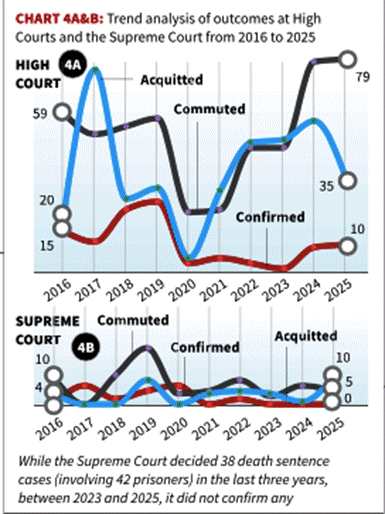
- Only 8.31% death sentences upheld by High Courts; Supreme Court confirmed none in last 3 years, showing systemic dilution at higher judiciary.
- Signals concerns on evidence quality, procedural fairness, and rights protection at trial level.
Relevance
- GS-II (Polity & Governance)
- Judiciary, criminal justice system, due process
- Role of higher judiciary in protecting fundamental rights
- Legal aid and access to justice
B. Static Background
Constitutional & Legal Basis
- Article 21 permits deprivation of life by “procedure established by law” → constitutional basis for death penalty.
- Bachan Singh vs State of Punjab (1980): Introduced “rarest of rare” doctrine, making death penalty an exception.
- Machhi Singh vs State of Punjab (1983): Elaborated aggravating vs mitigating factors framework.
- Death penalty provided under IPC/BNSS for offences like terrorism, waging war, rape-murder, etc.
C. Key Dimensions
Judicial Trends
- 1,310 death sentences (last decade) by Sessions Courts → high trial-level imposition.
- Out of 842 cases reviewed, only 70 confirmed by HCs → strong appellate correction.
- 34.65% HC decisions led to acquittals, indicating serious trial-stage errors.
- Highest acquittal rates:
- Patna HC – 78.31%
- Karnataka HC – 50.46%
- Jharkhand HC – 46.97%
Criminal Justice System Insight
- Pattern suggests over-reliance on capital punishment at trial stage, followed by appellate reversals.
- Reflects investigation gaps, weak legal aid, coerced confessions, and forensic limitations.
D. Critical Analysis
Structural Concerns
- High acquittal rates imply possible wrongful convictions, undermining fairness in irreversible punishment.
- Trial courts may award death penalty under public pressure in heinous crimes, later corrected by higher courts.
- Long death row incarceration creates “death row phenomenon” — psychological torture recognised in jurisprudence.
Rights Perspective
- Global human rights discourse increasingly views death penalty as violative of right to life and dignity.
- Law Commission 262nd Report (2015) recommended abolition except for terrorism-related offences.
Deterrence Debate
- Empirical studies globally show no conclusive proof that death penalty deters crime more than life imprisonment.
- NCRB data show crime trends not directly correlated with capital punishment frequency.
E. Way Forward
- Strengthen forensic infrastructure and investigation quality to reduce wrongful convictions.
- Mandatory mitigation investigation reports before awarding death penalty (as SC suggested in recent rulings).
- Improve legal aid quality at trial stage; many death row prisoners are socio-economically vulnerable.
- Consider legislative re-evaluation of death penalty scope in line with Law Commission suggestions.
- Promote victim-centric justice models focusing on restitution and speedy trials rather than symbolic severity.
F. Exam Orientation
Prelims Pointers
- Death penalty constitutional under Article 21.
- “Rarest of rare” doctrine – Bachan Singh (1980).
- Law Commission 262nd Report recommended partial abolition.
- Supreme Court confirmation required for execution.
Mains Practice Question (15M)
- “The declining confirmation of death sentences by higher courts indicates deeper structural issues in India’s criminal justice system.”Critically examine in light of recent death penalty statistics.