
Content
- Social Media Bans and Child Safety: Limits of Prohibition, Need for Digital Governance
- Myanmar’s Military-Scripted Elections and India’s Strategic Dilemma
Social Media Bans and Child Safety: Limits of Prohibition, Need for Digital Governance
Why in News?
Renewed debate globally on banning or restricting minors’ access to social media amid rising concerns over adolescent mental health, cyberbullying, and online grooming, triggered by recent policy moves and public discourse.
- Countries like Australia and Spain have proposed or advanced age-based restrictions and stricter platform liability, bringing the question of prohibition vs regulation to the forefront of digital governance debates.
- Growing body of research linking excessive social media use with anxiety, depression, and body-image issues among teenagers has pushed governments to consider stronger child online safety frameworks.
- Simultaneously, experts and civil society argue that blanket bans are ineffective, shifting focus toward platform accountability, algorithm regulation, and digital literacy, making it a live governance and ethics issue.
Relevance
GS 1 (Society)
- Impact of social media on youth, mental health, and socialisation.
- Issues of vulnerable sections (children & adolescents).
GS 2 (Polity & Governance)
- Digital governance, regulation of online platforms.
- Fundamental Rights — Speech (Art 19) & Privacy (Art 21).
- Role of State in protecting minors (parens patriae).
Practice Questions
- “Blanket social media bans on minors are neither practical nor sufficient to ensure child safety.” Discuss. (150 Words)
Core Concepts
What is a Social Media Ban?
- Social media ban refers to legal or regulatory prohibition restricting minors’ access to platforms, typically through age-verification, parental consent mandates, or blanket denial to reduce online harms and exposure risks.
Child Online Safety
- Child online safety involves protecting minors from cyberbullying, grooming, harmful content, addiction, and data exploitation while preserving developmental benefits of digital participation, learning opportunities, and social connectivity.
Digital Ecosystem
- Digital ecosystem includes platforms, algorithms, advertisers, data brokers, and users interacting within regulatory frameworks, where design choices, incentives, and governance determine user safety and accountability outcomes.
Constitutional & Legal Dimensions
Freedom vs Protection
- Article 19(1)(a) guarantees speech and expression, including online participation; restrictions must satisfy reasonableness and proportionality, ensuring child protection does not become excessive censorship or rights dilution.
Right to Privacy
- Article 21 privacy (Puttaswamy judgment) requires data minimisation, informed consent, and purpose limitation, especially for minors whose cognitive maturity limits meaningful consent in digital environments.
State’s Parens Patriae Role
- Doctrine of parens patriae empowers the State to protect minors’ welfare, yet mandates balanced intervention respecting autonomy, developmental needs, and constitutional liberties rather than moralistic or populist overreach.
Governance & Regulatory Dimension
Platform Regulation
- Effective governance targets platform design, algorithms, and monetisation models, not merely users, addressing recommender systems that amplify harmful content and engagement-maximising features driving compulsive usage among minors.
Age Verification Limits
- Age-verification systems face privacy risks, circumvention, exclusion errors, and surveillance concerns, often pushing children toward unsafe digital spaces rather than ensuring meaningful protection and guided participation.
Institutional Capacity
- Regulatory success depends on independent regulators, technical expertise, and enforcement capacity, without which laws remain symbolic, inconsistently applied, and vulnerable to industry capture or bureaucratic inertia.
Social Dimension
Adolescent Development
- Adolescence involves identity formation and peer validation; social media intensifies comparison, validation-seeking, and exposure to unrealistic standards, affecting self-esteem, body image, and emotional regulation.
Digital Divide
- Blanket bans risk widening digital divides, disproportionately affecting marginalized children who rely on digital platforms for learning, opportunities, and social mobility in resource-constrained environments.
Family & Community Role
- Parental guidance, digital literacy, and open communication often prove more sustainable than prohibition, fostering responsible use and resilience rather than secrecy-driven or rebellious digital behaviour.
Economic & Political Economy Dimension
Attention Economy
- Platforms operate on attention economy models, monetising user engagement through targeted advertising, incentivising addictive design, infinite scrolling, and emotional triggers that disproportionately affect young users’ self-control capacities.
Corporate Accountability
- Without liability frameworks, companies externalise social harms while privatising profits; regulatory focus must include duty of care, risk audits, and transparency obligations for child-impact assessments.
Technology Dimension
Algorithmic Amplification
- Algorithms prioritise engagement-heavy content, often sensational or harmful, creating echo chambers and accelerating exposure to risky material for impressionable users lacking critical evaluation skills.
Design Ethics
- Safety-by-design principles include default privacy settings, time-use nudges, content moderation, and age-appropriate interfaces, embedding child protection within technological architecture rather than after-the-fact regulation.
Challenges in Ban-Centric Approach
Circumvention Reality
- Tech-savvy youth bypass bans using VPNs, fake credentials, or shared accounts, rendering prohibition partially ineffective while reducing scope for supervised and safer engagement.
Democratic Deficit
- Moral panic-driven bans may substitute evidence-based policymaking, enabling symbolic politics that avoid deeper reforms in platform governance, digital education, and corporate regulation.
Way Forward
Regulate Systems, Not Just Users
- Shift from user-restriction to platform accountability, mandating algorithm audits, risk disclosures, and child-impact assessments, aligning regulation with systemic sources of harm rather than individual blame.
Digital Literacy First
- Institutionalise digital literacy curricula covering critical thinking, online safety, consent, and cyber-ethics, equipping children to navigate digital risks responsibly in an inevitable online future.
Co-Regulation Model
- Adopt co-regulation combining state oversight, industry standards, and civil society input, ensuring flexibility, expertise, and legitimacy in rapidly evolving technological contexts.
Data and Facts
- ~80% of adolescents use social media daily, many exceeding 3 hours, increasing exposure to online risks and addictive design. (Source: UNICEF global adolescent digital use estimates)
- 1 in 3 adolescents (≈33%) experience cyberbullying, making online harassment a mainstream child-safety concern beyond anecdotal cases. (Source: UNICEF, Global Kids Online report)
- 59% of teens say social media harms peers’ mental health, linking platforms with anxiety, comparison pressure, and self-esteem issues. (Source: Pew Research Center, Teen Mental Health Survey)
- ~70% of teens feel “addicted” to social media; about half report sleep disruption due to late-night use. (Source: Common Sense Media, US teen survey)
- India has ~830 million internet users, with a youth-heavy user base, magnifying scale of child online safety challenges. (Source: IAMAI Internet in India Report)
- 10–20% of Indian adolescents face mental health conditions, where excessive digital exposure can act as a risk amplifier. (Source: Lancet Child & Adolescent Health)
- Algorithmic recommender systems can raise engagement 30–40%, often amplifying sensational or harmful content for minors. (Source: Academic studies on recommender systems, MIT/Stanford reviews)
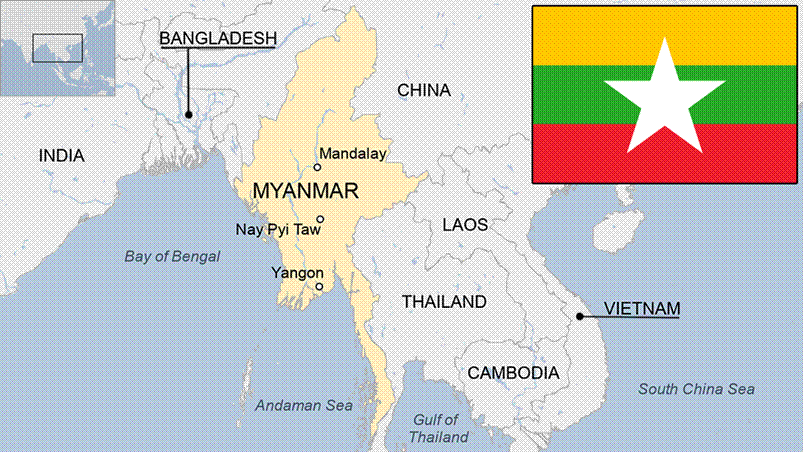
Myanmar’s Military-Scripted Elections and India’s Strategic Dilemma
Context : Myanmar Elections 2025–26
- Myanmar junta conducted military-managed elections (Dec 2025–Jan 2026) claiming transition to civilian rule, but opposition boycotts and conflict conditions question legitimacy and democratic credibility internationally.
Relevance
GS 2 (IR)
- India–Myanmar relations.
- Democracy vs realism in foreign policy.
- ASEAN, neighbourhood diplomacy.
Practice Question
- India’s Myanmar policy reflects a balance between democratic values and strategic interests. Critically analyse.(250 Words)
Basics & Core Keywords
Military Junta
- Military junta refers to armed forces controlling state power after a coup, suspending democratic institutions, centralising authority, and governing through emergency laws and coercive apparatus.
Coup d’état
- Coup d’état is unconstitutional seizure of power by military or elites, displacing elected government, as seen in Myanmar February 2021 coup removing the National League for Democracy.
Proxy Elections
- Military-scripted or proxy elections are polls organised to legitimise regime control, often excluding opposition, restricting media, and operating in conflict-affected environments lacking free political competition.
Political Situation in Myanmar
Post-Coup Conflict
- Since 2021 coup, Myanmar faces civil conflict between junta and Ethnic Armed Organisations (EAOs) + People’s Defence Forces, causing territorial fragmentation and weakening central authority.
Opposition Suppression
- Major parties like NLD sidelined; leaders jailed; electoral participation restricted, undermining pluralism and representative democracy.
Territorial Control
- Junta reportedly lacks full control over significant areas, limiting election conduct and administrative reach, reducing credibility of nationwide mandate claims.
India’s Strategic Interests
Geopolitical Location
- Myanmar is India’s gateway to Southeast Asia and crucial for Act East Policy, linking Northeast India to ASEAN markets and connectivity corridors.
China Factor
- China’s deep presence through infrastructure and arms supplies increases India’s concern about strategic encirclement and loss of regional influence.
Border Security
- India shares 1,643 km border with Myanmar; instability fuels insurgent movement, arms trafficking, and safe havens for Northeast militant groups.
Security & Internal Implications for India
Refugee Inflows
- Violence has driven refugee flows into Mizoram and Manipur, straining local administration and raising humanitarian and political sensitivities.
Transnational Crime
- Conflict zones enable drug trafficking, arms smuggling, and cyber-scam centres, affecting India’s internal security and regional crime networks.
Insurgent Linkages
- Northeast insurgent groups historically used Myanmar sanctuaries, making stable bilateral security cooperation vital for counter-insurgency.
Diplomatic Balancing
Principle vs Pragmatism
- India avoids outright endorsement of junta yet maintains engagement to protect security and connectivity interests, reflecting realist foreign policy balancing.
ASEAN Dynamics
- ASEAN’s divided stance and limited enforcement capacity constrain collective regional response, complicating India’s diplomatic alignment.
Humanitarian Engagement
- India provides relief assistance and disaster aid, maintaining people-centric engagement without fully legitimising the regime.
Economic & Connectivity Stakes
Infrastructure Projects
- Projects like Kaladan Multi-Modal Transit and Trilateral Highway depend on stability in Myanmar for India’s Northeast integration and trade expansion.
Northeast Development
- Myanmar stability directly influences India’s Northeast economic growth, border trade, and regional connectivity vision.
Challenges for India
Policy Dilemma
- Supporting democracy risks losing strategic access; engaging junta risks reputational costs and democratic credibility.
Security Spillovers
- Prolonged instability increases cross-border crime and refugee pressures.
Limited Leverage
- India’s influence is constrained by Myanmar’s internal dynamics and China’s stronger economic footprint.
Way Forward
Calibrated Engagement
- Continue multi-channel diplomacy engaging military, ethnic groups, and civil actors to retain influence without legitimising authoritarianism.
Border Management
- Strengthen smart fencing, coordinated patrols, and intelligence sharing to manage spillovers.
Regional Cooperation
- Work with ASEAN and BIMSTEC for humanitarian corridors and conflict de-escalation.
People-Centric Approach
- Expand humanitarian aid and development partnerships supporting local communities.
Data and Facts
- >3 million internally displaced persons (IDPs) in Myanmar due to post-coup conflict, reflecting scale of humanitarian and governance collapse. (Source: UN OCHA, 2024–25 estimates)
- Over 1.3 million refugees from Myanmar hosted abroad, mainly in Thailand, Bangladesh, and India, indicating regional spillover of instability. (Source: UNHCR Global Trends)
- ~90,000 Myanmar nationals in Mizoram alone since 2021 coup, creating humanitarian and administrative pressures on a small border state. (Source: Mizoram Govt statements, 2024)
- Illicit drug production in Golden Triangle region rising, with Myanmar a major source of methamphetamine in Southeast Asia, affecting India’s Northeast. (Source: UNODC)
- China remains Myanmar’s largest investor and arms supplier, strengthening its leverage and complicating India’s strategic space. (Source: SIPRI Arms Transfers Database)


