
Why is it in News?
- The Food Safety and Standards Authority of India (FSSAI) is proposing stricter labelling and disclosure norms to curb the sale of fake or non-dairy paneer substitutes in markets.
- Many loose / unpackaged paneer products sold locally are made using:
- Vegetable oils
- Skimmed milk powder
- Starches & emulsifiers
- These products imitate the look and texture of real paneer but lack its nutritional profile and may pose health risks.
- FSSAI proposes that such products must be:
- Labelled as “Paneer Analogue”
- Prohibited from using dairy-related terminology
- Sold only in sealed packages
- Carry clear consumer warnings
- The issue is significant because paneer forms an important protein source for a large vegetarian population and the market is ₹65,000-crore+, largely unorganised.
Relevance
- GS-II | Governance & Regulatory Institutions
- Role of FSSAI, consumer protection, labelling norms
- GS-III | Public Health & Food Security
- Adulteration risks, nutrition quality, public health burden
What is Food Adulteration?
Food adulteration refers to:
- Addition, substitution or removal of ingredients
- With the intent to increase profit, reduce quality or mislead consumers
- Leading to health risks, fraud, or nutritional loss
Types
- Intentional — dilution, substitution, artificial colouring, synthetic fat use
- Unintentional — contamination during storage, processing, transport
Relevant Law
- Food Safety and Standards Act, 2006
- Establishes FSSAI as the national regulator
- Provides for:
- Standards & labelling
- Licensing & inspections
- Penalties for adulteration & misbranding
What is the Issue in This Case?
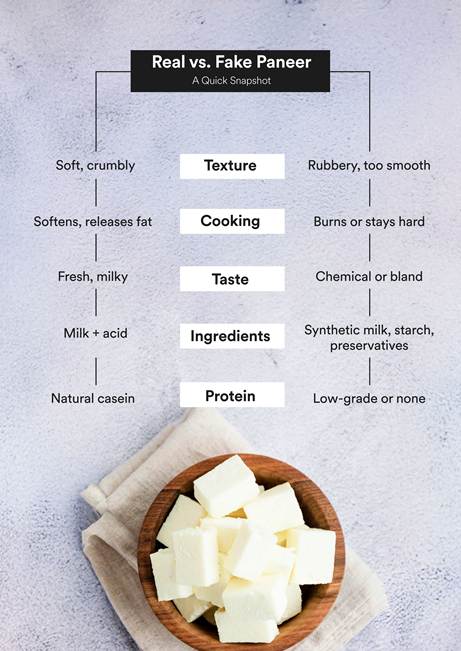
Real Paneer
- Made by curdling milk
- Rich in milk fats, protein, calcium
Fake / Substitute Paneer
- Uses vegetable oils + starch + emulsifiers
- Designed to look identical
- Cheaper, widely sold in loose unpackaged form
- Often not disclosed to consumers
Market Dynamics
- Organised brands = ~10% market
- Majority sold in unorganised informal sector
- Loose paneer ~₹300–340/kg
Branded paneer ~₹450–500/kg
→ Price arbitrage drives adulteration
Public Health & Governance Concerns
- Consumers unknowingly consume:
- Trans fats
- Low-protein substitutes
- Poor-quality oils
- Risk of:
- Obesity & heart disease
- Nutrient deficiency
- Food safety violations
- Violates:
- Right to informed choice
- Food-labelling ethics
- Consumer protection norms
Why Enforcement is Weak ?
- Large, fragmented unorganised dairy markets
- Lack of routine inspections in local mandis
- Low consumer awareness
- Weak supply-chain traceability
- Seasonal festival demand → adulteration spikes
- Incentives for traders are high, penalties limited
FSSAI’s Proposed Measures
- Mandatory Labelling
- Non-dairy substitutes to be marked “Paneer Analogue”
- Ban on Dairy Terminology
- Cannot be sold as paneer / dairy product
- Colour Marking
- Visual differentiation from natural paneer
- Sealed Packaging Only
- Loose sale to be restricted
- Disclosure of Ingredients & Nutrition
- To prevent consumer deception
Regulatory Rationale:
Shift from post-facto enforcement → preventive labelling + traceability.
Way Forward — Policy Recommendations
Regulation & Enforcement
- Strengthen supply-chain audits & random sampling
- Expand food testing infra at district level
- Strict penalties for repeat offenders
- Introduce QR-code traceability for dairy chains
Consumer Protection
- Public campaigns on how to identify real paneer
- Labelling literacy programs
- Encourage certified dairy cooperatives
Market Reform
- Support formalisation of local dairy value chains
- Incentivise quality-assured small producers
- Promote self-regulation & cooperative branding


