
WHY IN NEWS ?
- On December 3, researchers from the University of Oxford reported:
- Discovery of a ~50 million light-year-long galaxy filament.
- The filament shows aligned galaxy spins, suggesting that the entire filament itself is rotating.
- The team claims it may be:
- “One of the largest spinning structures ever observed in the universe.”
- This provides direct observational support to predictions made by cosmological simulations.
Relevance :
GS Paper III – Science & Technology
- Astrophysics and cosmology
- Dark matter and large-scale structure of the universe
- Observational astronomy and simulation-based science
GS Paper I – Physical Geography (World Geography Interface)
- Large-scale structure of the universe
- Formation of galaxies and cosmic web
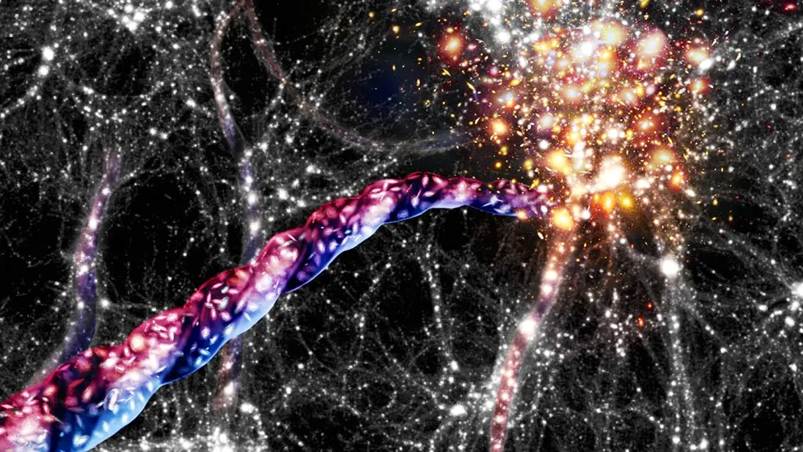
WHAT ARE COSMIC / GALAXY FILAMENTS?
- Cosmic filaments are:
- The largest known structures in the universe.
- Thread-like formations forming the Cosmic Web.
- They are composed of:
- Dark matter
- Intergalactic gas
- Galaxies
- Typical scale:
- Tens to hundreds of millions of light-years
- They:
- Connect massive galaxy clusters
- Surround vast empty regions called voids
STRUCTURE OF THE COSMIC WEB
The large-scale universe is arranged into:
- Filaments → long, thread-like galaxy highways
- Walls/Sheets → flat, dense galaxy regions
- Nodes (Clusters) → intersections of filaments
- Voids → enormous empty regions
- Together, these form the Cosmic Web, the universe’s fundamental large-scale architecture.
HOW DO COSMIC FILAMENTS FORM?
- Originates from:
- Tiny density fluctuations just after the Big Bang
- Under the influence of gravity:
- Matter collapses into sheets
- Sheets intersect → filaments
- Filaments intersect → clusters
- Dominant driver:
- Dark Matter, which provides gravitational scaffolding
- Ordinary matter (gas + galaxies) follows dark matter distribution.
WHY ARE FILAMENTS CALLED “COSMIC HIGHWAYS”?
- Gas and small galaxies:
- Flow along filaments toward massive galaxy clusters.
- This inflow:
- Feeds galaxy growth
- Triggers star formation
- Shapes galactic evolution over billions of years
- Hence, filaments decide:
- Where galaxies form
- How fast they grow
- How much fresh gas they receive
HOW DO ASTRONOMERS DETECT FILAMENTS?
- By:
- Mapping positions and distances of thousands of galaxies
- Using redshift surveys
- Then:
- Tracing spatial clustering patterns
- Supported by:
- Large-scale computer simulations based on:
- Lambda-CDM Model of cosmology
- Large-scale computer simulations based on:
- These simulations reproduce:
- Filaments, walls, voids, and clusters almost exactly as observed.
WHAT EXACTLY DID THE OXFORD TEAM DISCOVER?
- A ~50 million light-year galaxy filament
- Traced by:
- At least 14 galaxies
- Unique feature:
- The galaxies’ axes of rotation are aligned with the filament’s direction
- Interpretation:
- The entire filament is slowly rotating as a coherent structure
WHY IS ROTATION OF A FILAMENT IMPORTANT?
- Earlier belief:
- Filaments are static gravitational channels
- New result shows:
- Filaments can have large-scale angular momentum
- This supports:
- The theory that gravitational infall and tidal forces can spin up even gigantic cosmic structures
- It links:
- Galaxy-scale rotation → filament-scale rotation → cosmic-scale dynamics
SCIENTIFIC SIGNIFICANCE
- Confirms that:
- Angular momentum exists at the largest observable scales
- Strengthens:
- Theoretical predictions from cosmological simulations
- Helps explain:
- Why galaxies in the same filament often show spin alignment
- Improves understanding of:
- Structure formation
- Galaxy evolution
- Dark matter dynamics
IMPLICATIONS FOR COSMOLOGY
- Validates:
- The gravitational instability model of structure formation
- Improves:
- Precision in large-scale universe mapping
- Supports:
- The idea that:
- The universe evolved from tiny early ripples into a connected cosmic network
- The idea that:


