
Why is it in News?
- India and the European Union have finalised the India–EU Free Trade Agreement, described as the “mother of all deals”, marking India’s most comprehensive trade pact with a major developed bloc.
- The agreement delivers deep tariff liberalisation in goods and services, covering economies that together account for ~25% of global GDP, with major implications for exports, jobs, and value chains.
Relevance
GS Paper 2 (International Relations)
- India–EU strategic partnership, trade diplomacy, economic agreements
- Role of FTAs in India’s foreign policy and multipolar global order
- India–EU relations in a protectionist and fragmented global trade system
GS Paper 3 (Indian Economy)
- External sector, exports–imports, trade balance
- Impact of FTAs on MSMEs, employment, and value chains
- Manufacturing, services trade, Make in India, export competitiveness
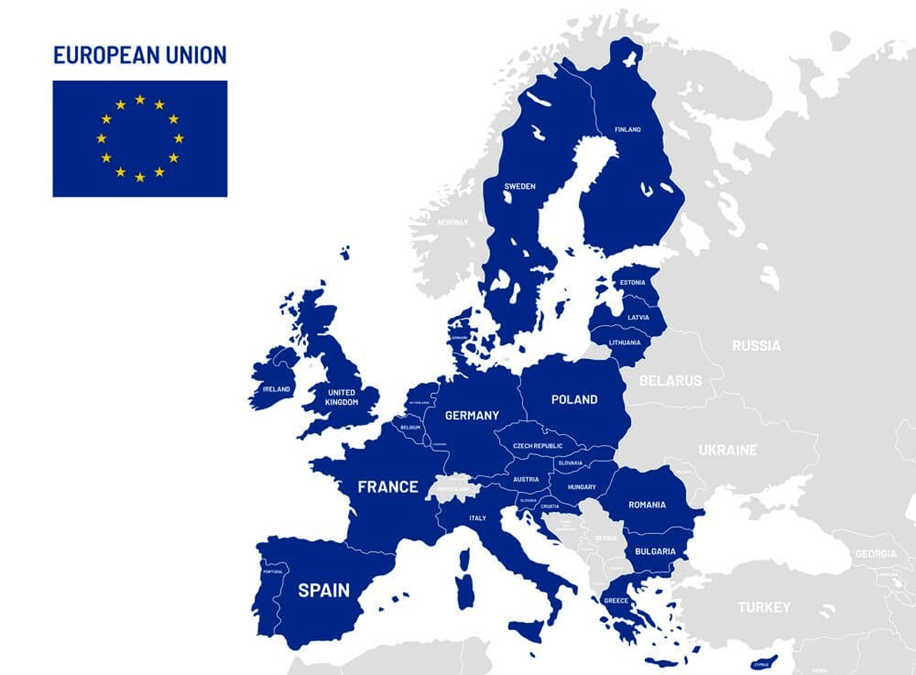
Scale and Coverage of the Agreement
Overall Trade Architecture
- The FTA covers trade in goods, services, and investments, with unprecedented depth compared to India’s earlier FTAs, especially with developed economies.
- It aims to structurally integrate Indian producers into European and global value chains, beyond short-term export gains.
Market Access for Indian Exports
Zero-Duty Access for Labour-Intensive Sectors
- Labour-intensive sectors worth ₹2.87 lakh crore (~$33 billion) in exports, currently facing EU duties of 4%–26%, will enter zero duty from entry into force.
- These sectors are critical for employment generation, particularly for MSMEs, women workers, and export clusters.
Sectors with Complete Duty Elimination
- Marine products face duties up to 26%, chemicals 12.8%, plastic and rubber 6.5%, and leather footwear 17%, all eliminated fully.
- Textiles and apparel (12%), base metals (10%), gems and jewellery (4%), furniture (10.5%), and toys and sports goods (4.7%) gain full duty-free access.
Partial Tariff Reductions
- An additional 6% of India’s exports will see tariff reductions, including poultry products, preserved vegetables, bakery items, and processed foods.
- Select marine and processed food products gain incremental access beyond zero-duty categories.
Services Market Access for India
EU Commitments
- The EU has committed market access across 144 services sub-sectors, covering IT/ITeS, professional services, education, and other business services.
- This strengthens India’s position as a global services hub, complementing goods exports with high-value services trade.
What India Has Conceded to the EU ?
Tariff Line Liberalisation
- India will eliminate or reduce duties on 92.1% of tariff lines, covering 97.5% of EU exports to India.
- 49.6% of tariff lines will see immediate duty elimination once the agreement comes into force.
Phased Liberalisation
- 39.5% of tariff lines will undergo phased tariff elimination over 5, 7, and 10 years, allowing domestic industry adjustment.
- An additional 3% of products will see gradual tariff reductions, not full elimination.
EU Export Gains in Indian Market
High-Technology and Capital Goods
- EU exporters gain duty-free access for machinery, electrical equipment, aircraft, spacecraft, optical and medical devices.
- Imports of high-tech EU goods are expected to reduce input costs, improve productivity, and support Indian manufacturing competitiveness.
Core Industrial and Consumer Sectors
- Chemicals, plastics, pharmaceuticals, motor vehicles, iron and steel, precious metals, and select agricultural products gain improved access.
- These imports are expected to diversify India’s sourcing, lowering dependency on limited supplier geographies.
Services Access for the EU in India
Indian Commitments
- India has opened 102 services sub-sectors aligned with EU priorities, including professional, business, telecom, maritime, financial, and environmental services.
- This is expected to attract investment, technology transfer, and best practices into India’s services ecosystem.
Sensitive Sectors and Negotiated Compromises
Automobiles and Wine
- Negotiations on automobiles and wine were contentious due to domestic sensitivities and political economy concerns.
- Both sides agreed on quota-based access systems, balancing market opening with protection of domestic producers.
Economic and Strategic Implications
Manufacturing and GVC Integration
- Zero-duty access for key export sectors anchors Indian manufacturers into European supply chains, supporting Make in India and export-led growth.
- Lower-cost imports of high-end machinery improve industrial upgrading and competitiveness.
Employment and MSMEs
- Labour-intensive export expansion supports job creation, especially in textiles, leather, marine products, gems, and furniture sectors.
- MSMEs gain stable access to a large, high-income consumer market.
Challenges and Caveats
- Compliance with EU standards on environment, labour, SPS, and technical regulations may strain MSMEs without adequate domestic capacity-building.
- Phased tariff elimination requires active industrial policy support to prevent import surges from harming vulnerable sectors.
Way Forward
Domestic Readiness
- Strengthen standards infrastructure, export finance, skilling, and logistics to fully leverage FTA gains.
- Align the FTA with PLI schemes, MSME support, and trade facilitation reforms.
Strategic Trade Positioning
- Use the India–EU FTA as a platform to reposition India as a reliable manufacturing and services partner in a fragmented global trade order.
Conclusion
- The India–EU FTA represents a structural shift in India’s trade strategy, combining deep market access, services liberalisation, and value-chain integration.
- Its success will depend on domestic preparedness, regulatory capacity, and the ability to translate tariff preferences into sustained competitiveness.


