
Why in News?
- Days before a U.S. trade delegation led by Rick Switzer arrived in New Delhi (Dec 10–12), Donald Trump hinted at fresh tariffs on Indian rice.
- The claim: India is “dumping” rice in the U.S. market.
- Statement made during a White House meeting while announcing a $12 billion farm support package.
- Question raised to U.S. Treasury Secretary Scott Bessent regarding India’s “exemption” on rice.
- This comes when the U.S. has already imposed 50% tariffs on Indian exports in multiple sectors.
Relevance
GS II – International Relations
- India–U.S. trade relations under stress.
- Impact of protectionism under Donald Trump-style economic nationalism.
- Trade diplomacy amidst strategic partnership narrative (QUAD vs tariffs contradiction).
- Use of tariffs as coercive foreign policy tools.
GS III – Economy & Agriculture
- MSP-based procurement and export competitiveness.
- Agricultural exports vs global protectionism.
- WTO Agreement on Agriculture – public stockholding & dumping dispute.
- Impact on:
- Farmer income stability
- Food inflation abroad
- Export market diversification
Core Economic Facts
1. Trade Asymmetry in Rice
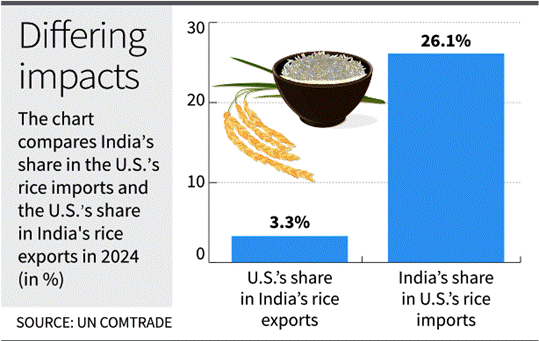
- Only ~3% of India’s total rice exports go to the U.S.
- Over 25% of total U.S. rice imports come from India
- Conclusion:
- India is not dependent on U.S.
- U.S. is highly dependent on India
Inference: Any tariff shock hurts U.S. consumers more than Indian exporters.
Dumping: Is the allegation valid?
Dumping (WTO definition):
- Exporting goods below domestic cost/price to capture foreign markets.
Indian rice exports:
- Backed by:
- Low cost of production
- Economies of scale
- MSP-based procurement
- Not proven as:
- Below production cost
- Below domestic wholesale price
Conclusion:
- U.S. claim is political, not legally established under WTO rules.
Strategic Context
1. Domestic U.S. Politics
- Trump’s statement made alongside:
- $12 billion farm bailout
- Pressure from American farmer lobbies
- Objective:
- Signal protectionism
- Externalise domestic agrarian stress
2. Trade Negotiation Pressure Tactic
- Timed just before:
- India–U.S. tariff negotiations
- Classic U.S. strategy:
- Create pre-negotiation pressure
- Use sector-specific threats (rice) as leverage
Who Loses If Rice Tariff Is Imposed?
Impact on the U.S.
- Sharp rise in:
- Retail rice prices
- Food inflation
- Disproportionately affects:
- Low-income and immigrant consumers
- No quick alternative suppliers at Indian scale + price
Impact on India
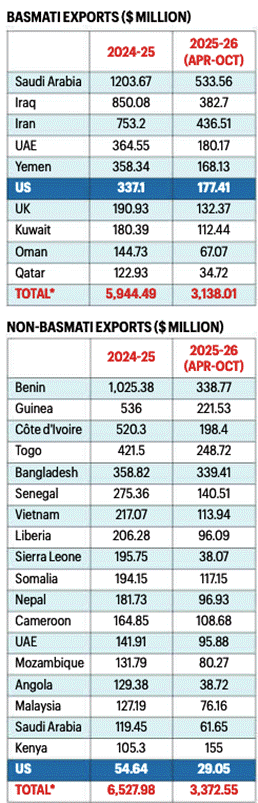
- Minimal export loss due to:
- Market diversification:
- West Asia
- Africa
- Southeast Asia
- Market diversification:
- U.S. market is non-critical for Indian rice
WTO & Legal Angle
- Anti-Dumping duties require:
- Cost-price investigation
- Injury to domestic industry
- Unilateral tariff announcement:
- Violates spirit of multilateral trade rules
- Reflects weaponisation of tariffs
Strategic Implications for India
- Reinforces need for:
- Export market diversification
- Reduced dependence on U.S. trade leverage
- Strengthens India’s case for:
- South–South trade
- Agro-export diplomacy
- Shows limits of:
- “Strategic partnership” under transactional protectionism
Link with MSP, Food Security & Global Image
- India’s rice dominance stems from:
- MSP-backed procurement
- High buffer stocks
- Green Revolution legacy
- U.S. attack indirectly targets:
- India’s food security architecture
- Public stockholding system (WTO AoA debate)
Broader Trend: Return of Trump-era Protectionism
- Sectoral targeting:
- Steel, auto, pharma earlier
- Rice now
- Tools used:
- National interest
- Dumping allegations
- Farm lobby pressure
Conclusion
- The proposed U.S. tariff on Indian rice is economically irrational, politically motivated, and strategically self-damaging.
- It exposes:
- Fragility of U.S. commitment to free trade
- Weaponisation of tariffs for electoral optics
- India remains structurally resilient due to:
- Market diversification
- Cost leadership
- Global rice dominance


