Context & Why in News ?
- India to be invited to join “Pax Silica”, a U.S.-led 8-nation initiative on:
- Semiconductors
- Critical minerals
- Artificial Intelligence
- Signals reset in India–U.S. strategic-tech cooperation after months of trade frictions.
- India was excluded in the initial launch (Dec, Washington) despite Quad membership.
Relevance
GS II – International Relations
- India–U.S. strategic partnership
- Minilateralism (Quad, I2U2)
- Strategic autonomy vs alignment
GS III – Economy & S&T
- Semiconductors, AI, critical minerals
- Supply chain security
- Industrial policy (PLI, Semicon India)
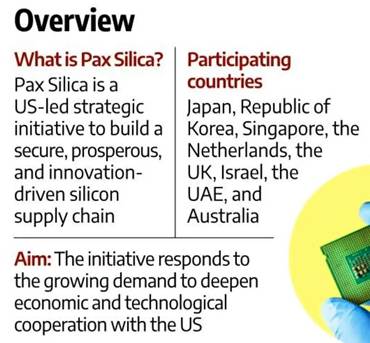
What is Pax Silica?
- Strategic techno-economic bloc, not a formal treaty.
- Aims to:
- Secure trusted semiconductor supply chains.
- Reduce dependence on China-centric manufacturing & minerals.
- Coordinate on AI governance, standards, and innovation.
- Part of broader U.S. vision of “friend-shoring” and tech alliances.
Strategic Context: Why Pax Silica Matters Now ?
- Semiconductors as geopolitics:
- Chips = core of defence, AI, telecom, EVs.
- Critical minerals:
- Lithium, cobalt, rare earths → energy transition & defence.
- AI race:
- Economic productivity + military applications.
- Pax Silica complements:
- Quad tech agenda
- I2U2 economic corridor
- U.S. CHIPS & Science Act ecosystem.
Why India’s Participation is Significant ?
Strategic Dimension
- Indo-Pacific balancing:
- Strengthens India’s role in shaping rules-based tech order.
- Trust-based alignment:
- Without formal alliance → preserves strategic autonomy.
- Enhances India’s leverage in:
- Quad
- G20
- Global tech governance forums.
Economic & Industrial Dimension
- Aligns with India’s:
- Semicon India Programme
- PLI schemes
- Access to:
- Advanced chip design ecosystems.
- Global value chains (fab, packaging, testing).
- Helps India move up from:
- Assembly → design, materials, and equipment.
Supply Chain Security
- Reduces vulnerability to:
- China-dominated rare earth processing.
- Diversification of:
- Mineral sourcing
- Manufacturing nodes.
Why India Was Initially Excluded ?
- Trade tensions:
- U.S. imposed 50% tariffs on Indian goods.
- Friction over:
- India’s Russian oil imports.
- Policy divergence:
- Data localisation
- Market access issues.
- Current invitation reflects:
- Pragmatic reset rather than ideological convergence.
Challenges & Risks for India
Strategic Risks
- Over-alignment risks perception of bloc politics.
- China factor:
- Possible retaliation in trade or border diplomacy.
Economic Risks
- High entry barriers:
- Capital-intensive fabs.
- Technology export controls (U.S. ITAR-like regimes).
Policy Risks
- AI governance:
- U.S. model vs India’s development-first approach.
- Critical minerals:
- India weak in domestic reserves → dependency persists.
Linkages with Other Groupings
- Quad:
- Security + tech norms.
- I2U2:
- Economic innovation corridor.
- BRICS:
- India must balance tech alignment with Global South leadership.
Way Forward for India
- Selective participation:
- Focus on semicon design, OSAT, minerals processing.
- Insist on technology access, not just market integration.
- Leverage Pax Silica for Global South:
- Act as bridge between advanced tech & developing world.
- Domestic reforms:
- Ease land, power, water bottlenecks for fabs.
- Parallel diversification:
- Continue cooperation with EU, Japan, South Korea.
Pax Silica – Members
- United States (Lead country)
- Japan
- Australia
- South Korea
- Singapore
- United Kingdom
- Netherlands
- Israel
- United Arab Emirates