
Why is it in news?
- On the 2nd anniversary of India’s Aditya-L1 solar mission, ISRO has issued an Announcement of Opportunity (AO) inviting Indian scientists and researchers to analyse the mission’s first AO-cycle data for solar science research.
- The Aditya-L1 spacecraft reached Lagrange Point-1 (L1) on 6 January 2024 (127 days after launch on 2 September 2023) and has since been carrying out continuous observations of the Sun; ISRO has now placed >23 TB of mission data in the public domain for global scientific utilisation.
Relevance
- GS-3 | Science & Technology — Space Research, Heliophysics, Space-based Observations
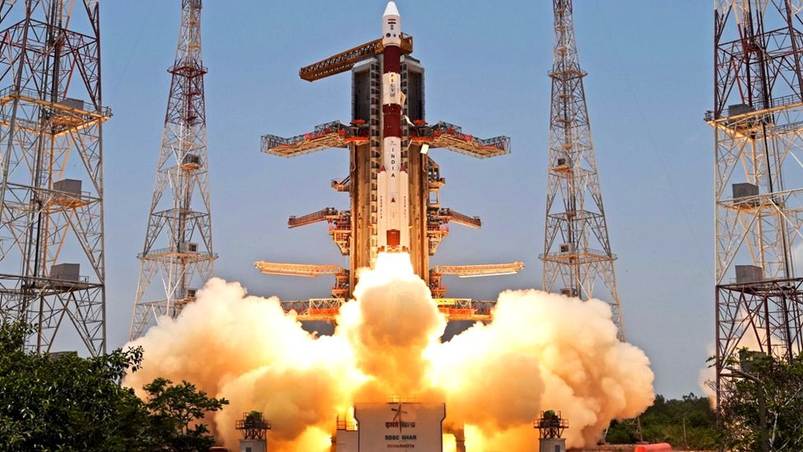
Facts & Data — Mission Status and Scientific Output
- Mission Objective: First Indian dedicated mission to study the Sun from L1 (≈1.5 million km from Earth) enabling continuous, eclipse-free observations.
- Orbit Position: Halo orbit around L1 → uninterrupted monitoring of solar corona, solar wind, CMEs, magnetic fields, and solar radiation.
- Data Generated:
- >23 terabytes (TB) of solar observation data already released
- Multiple peer-reviewed scientific papers published using mission data
- Instruments Studied (examples):
- VELC, SUIT, ASPEX, PAPA, SoLEXS, HEL1OS, MAG → spectrometry, coronagraphy, particle and magnetic-field measurements.
What ISRO’s AO Call Involves ?
- Open to: Indian scientists/researchers in universities, institutes, and colleges working in solar & space sciences.
- Role Invited: Apply as Principal Investigators (PIs) with proposals for
- scientific justification,
- data-analysis methodology, and
- clear research outcomes.
- Goal: Maximise scientific return from mission data through wider community participation and collaborative research.
Why this matters ?
- Strengthens India’s solar physics ecosystem by democratising access to high-value space-science data.
- Enhances space-weather forecasting capability (impact on satellites, power grids, communications, aviation).
- Positions India as a front-line contributor to heliophysics research alongside global missions (SOHO, Parker Solar Probe, Solar Orbiter).
- Encourages domestic research capacity, publications, and innovation in astrophysics and instrumentation science.


