
Why is it in News?
- December 2025: Union Railway Minister Ashwini Vaishnaw informed Lok Sabha that:
- KAVACH has been fully commissioned on over 2,000 km of the Indian Rail network.
- Consequential train accidents reduced by ~90% (from 135 in 2014 to 11 now).
- Comes amid:
- Recurrent concerns on rail safety.
- Push for indigenous, tech-driven accident prevention.
- Expansion under Atmanirbhar Bharat and Viksit Bharat vision.
Relevance
- GS III:
- Infrastructure: railways, public safety systems.
- Science & technology: indigenous innovation, ATP systems.
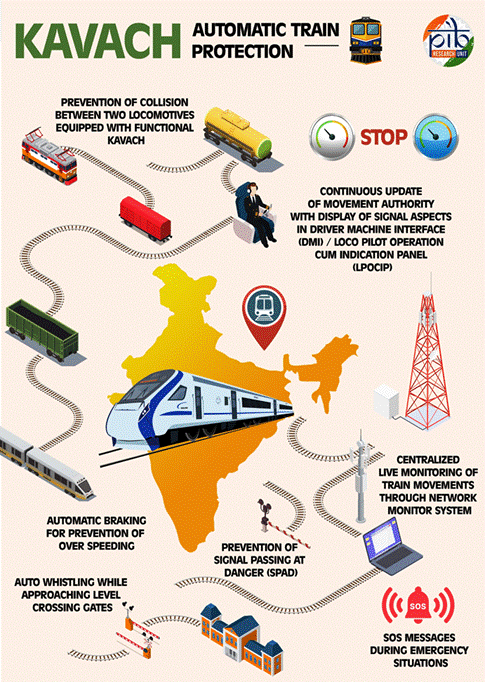
What is KAVACH?
- KAVACH is India’s indigenous Automatic Train Protection (ATP) system.
- Objective:
- Prevent train collisions due to human error.
- Developed by:
- Research Designs & Standards Organisation (RDSO).
- In collaboration with Indian industry.
- Comparable to:
- ETCS (Europe), PTC (USA) — but much cheaper.
What Problems Does KAVACH Address?
- Human errors by:
- Loco pilots.
- Station masters.
- Signal misinterpretation.
- High-risk scenarios:
- Signal Passed At Danger (SPAD).
- Head-on collisions.
- Rear-end collisions.
- Overspeeding.
- Limitation of legacy signalling systems.
How Does KAVACH Work? (Core Architecture)
KAVACH is a real-time, fail-safe system built on continuous communication.
Five Major Components
- On-board unit (Loco KAVACH):
- Installed on locomotives.
- Applies automatic braking if danger detected.
- Track-side equipment:
- Along tracks to relay movement authority.
- Station KAVACH:
- Integrated with interlocking & signalling.
- Telecom network:
- Optical Fibre Cable (OFC).
- Telecom towers.
- Central data systems:
- Real-time monitoring & diagnostics.
Operational Features
- Automatic braking when:
- Train overshoots signal.
- Collision risk detected.
- Speed exceeds permissible limit.
- Continuous loco-to-loco & loco-to-station communication.
- Works even in:
- Fog.
- Low visibility.
- Designed for:
- High-density mixed traffic (passenger + freight).
Current Implementation Status (as per Govt)
- >2,000 km fully commissioned.
- 7,129 km OFC laid.
- 860 telecom towers installed.
- 767 stations connected to data centres.
- 3,413 km trackside equipment deployed.
- 4,154 locomotives equipped.
- ~40,000 staff trained.
- Expansion pace described as “very fast”.
Why is KAVACH Considered Strategic?
- Safety dividend:
- Sharp fall in consequential accidents.
- Indigenous technology:
- Reduces import dependence.
- Cost-effective:
- ~₹50 lakh per km (far cheaper than global ATP systems).
- Scalable:
- Designed for India’s vast and diverse rail network.
- Employment & skilling:
- Large-scale technician training.
Challenges & Limitations
- High upfront capital cost for pan-India rollout.
- Requires:
- Dense telecom infrastructure.
- Precision mapping & calibration.
- Integration with:
- Multiple signalling systems across zones.
- Not yet universal across:
- All routes.
- All locomotives.
Policy & Governance Angle
- Linked schemes:
- Amrit Bharat Station Scheme (station modernisation).
- Governance challenge:
- Upgrading safety without suspending rail operations.
- India handles ~7.5 crore passengers daily.
- Minister highlighted:
- Unlike other countries, India cannot shut rail services for years.
Conclusion
KAVACH is India’s indigenous Automatic Train Protection system that uses real-time communication to automatically prevent train collisions, significantly improving rail safety while reinforcing technological self-reliance.


