
Content
- Mandatory Biometric Updates (MBUs) for Schoolchildren under Aadhaar
- Seven Chakras of the India–AI Impact Summit 2026
Mandatory Biometric Updates (MBUs) for Schoolchildren under Aadhaar
Why in News?
- UIDAI announced completion of over 1 crore Mandatory Biometric Updates (MBUs) for schoolchildren through a nationwide mission-mode campaign, marking a major milestone in child-focused digital identity strengthening and lifecycle Aadhaar management.
- The update drive gained attention due to coverage of 83,000 schools in about 5 months, reflecting unprecedented administrative scale, cooperative federalism, and integration of identity services with the education ecosystem.
- Article relevance also arises from integration of Aadhaar with UDISE+ database, enabling real-time identification of children pending biometric updates and showcasing data-driven governance in the school education sector.
- Fee waiver for MBUs for children aged 7–15 from 1 October 2025 for one year highlighted government efforts to remove financial barriers and prevent exclusion from exams and welfare schemes.
Relevance
GS 2 (Polity & Governance)
- DBT efficiency and targeted welfare delivery.
- Cooperative federalism (UIDAI–States–Schools).
- Privacy, data protection, child rights.
- Data-driven education governance (UDISE+).
Basics & Core Keywords
Meaning and Concept
- Mandatory Biometric Update (MBU) is compulsory capture and refresh of fingerprints and iris in Aadhaar after biological maturation at ages 5 and 15, ensuring reliable lifelong biometric authentication and identity continuity.
- UIDAI is a statutory authority under Aadhaar Act 2016 responsible for enrolment, authentication, and updates, managing demographic and biometric database and ensuring secure digital identity infrastructure across India.
- UDISE+ is a national digital school database of Ministry of Education capturing enrolment, infrastructure, and student data, enabling data-driven governance and integration with Aadhaar update status monitoring for children.
Constitutional / Legal Dimension
- Aadhaar Act 2016 provides statutory basis; Supreme Court (Puttaswamy, 2018 Aadhaar judgment) allowed welfare-linked use but restricted private mandatory usage, embedding proportionality and legality in identity-based service delivery frameworks.
- Right to Privacy (Article 21) mandates lawful, necessary, and proportionate data collection, requiring purpose limitation, data minimisation, and safeguards, especially critical when collecting and storing children’s biometric information.
- Best-interest-of-child principle from constitutional jurisprudence and UNCRC obligations requires secure storage, limited retention, and grievance redressal, ensuring minors’ identity data is not misused or excessively processed by state systems.
Governance / Administrative Dimension
- Campaign shows cooperative federalism, where UIDAI, State Education Departments, and district administrations align databases and logistics, improving last-mile identity service delivery through coordinated institutional efforts across states.
- School-based MBU camps reduce transaction costs, parental burden, and opportunity loss, bringing services to beneficiaries and improving inclusion in welfare, examination, and scholarship-linked identity requirements for students nationwide.
- UDISE+–Aadhaar integration enables real-time visibility of pending MBUs, supporting evidence-based targeting, dashboards, and monitoring, strengthening accountability and digital governance capacities in public education administration systems.
Economic Dimension
- Updated biometrics strengthen Direct Benefit Transfer (DBT) by preventing ghost and duplicate beneficiaries, improving fiscal efficiency of scholarships, nutrition schemes, and subsidies targeted at school-going children nationwide.
- Reliable Aadhaar enables smoother access to examinations, banking, and skilling, supporting human capital formation and future productivity, aligning with India’s demographic dividend and formalisation of the economy goals.
Social / Ethical Dimension
- Free MBU for 7–15 years from 1 Oct 2025 for one year lowers financial barriers, promoting equity for poor, migrants, and marginalised groups, reducing risk of exclusion from welfare and education-linked services.
- Ethical governance demands informed parental consent, awareness on data usage, and child-friendly enrolment, ensuring identity systems empower rather than surveil, and preserve dignity and autonomy of minors.
Technology / Security Dimension
- Fingerprints and iris biometrics rely on uniqueness and permanence; capturing after maturation improves matching accuracy, reducing false rejections in authentication for welfare, exams, and service delivery systems.
- Centralised identity databases require encryption, access controls, audit trails, and breach-response protocols to prevent identity theft, profiling, or unauthorised surveillance, especially given scale and sensitivity of children’s data.
Data & Evidence
- Over 1 crore MBUs completed, covering 83,000 schools in 5 months, indicating strong administrative capacity, prioritisation of child identity updates, and scalability of mission-mode digital governance initiatives.
- About 1.3 crore MBU transactions at Aadhaar Seva Kendras and enrolment centres show high citizen demand and responsiveness when services are accessible, predictable, and free for children.
Challenges
- Large biometric databases pose risks of data breaches, function creep, and profiling, particularly concerning for minors with limited consent capacity, necessitating strict oversight and enforcement of data protection norms.
- Device shortages, connectivity gaps, and operator deficits in remote areas may cause uneven coverage, creating regional disparities in update completion and risking exclusion of vulnerable populations.
- Low parental awareness on timelines and consequences leads to delays; sustained IEC campaigns through schools, anganwadis, and local governments are required for behavioural compliance and inclusion.
Way Forward
- Implement Digital Personal Data Protection framework with child-specific protocols, shorter retention, and independent audits, building trust and legal robustness in children’s biometric identity ecosystem.
- Institutionalise lifecycle-based updates by linking MBUs to school admissions and health check-ups, creating automatic reminders and on-site facilities for universal compliance among children.
- Invest in secure devices, operator training, and grievance redressal, ensuring that scale does not dilute accuracy, dignity, or data security while maintaining inclusive and reliable service delivery.
Aadhaar
What is Aadhaar?
- Aadhaar is a unique digital identity number issued to residents of India, based on demographic + biometric data, designed to enable unique identification and authentication for service delivery.
- It is proof of identity, not citizenship, and is available to residents (person living in India ≥ 182 days in preceding 12 months).
Legal & Institutional Basis
- Aadhaar has statutory backing under the Aadhaar (Targeted Delivery of Financial and Other Subsidies, Benefits and Services) Act, 2016.
- It aims at targeted delivery of subsidies, benefits, and services funded from the Consolidated Fund of India, reducing leakages and duplication.
Implementation Agency
- Implemented by Unique Identification Authority of India (UIDAI), a statutory authority.
- UIDAI functions under Ministry of Electronics and Information Technology (MeitY).
- UIDAI responsibilities:
- Aadhaar enrolment and updates
- Authentication ecosystem
- Data security and storage
- Policy and regulation of Aadhaar usage
Aadhaar Number – Structure
- Aadhaar is a 12-digit random number (not intelligence-based, no profile coding).
- Designed to be unique, portable, and lifelong.
Data Collected
Demographic Data
- Name
- Date of Birth/Age
- Gender
- Address
- Mobile number (optional but important)
- Email (optional)
Biometric Data
- 10 fingerprints
- Both iris scans
- Photograph
- For children below 5 years: only demographics + photo; biometrics updated later at 5 and 15 years.
Seven Chakras of the India–AI Impact Summit 2026
Context
Global AI Diplomacy Moment
- India–AI Impact Summit 2026 announced as first global AI summit in the Global South, projecting India as agenda-setter in responsible AI governance and development-oriented technology diplomacy.
- Summit highlighted due to 100+ countries, 15–20 Heads of Government, 50+ ministers, 40+ CEOs, signalling broad multilateral consensus-building on inclusive, safe, and accountable AI ecosystems.
Relevance
GS 2 (IR & Governance)
- AI diplomacy and global norm-setting.
- International tech governance.
- AI regulatory frameworks.
GS 3 (S&T / Economy / Environment)
- AI as emerging technology.
- AI-led economic growth & startups.
- R&D and innovation ecosystem.
- Green AI and energy-efficient data centres.
- Digital sovereignty & compute infrastructure.
Core Keywords
Artificial Intelligence (AI)
- Artificial Intelligence refers to machine-based systems performing cognitive tasks like learning and decision-making using machine learning, neural networks, and big data, enabling predictive, adaptive, and autonomous functionalities.
Global South
- Global South includes developing nations in Asia, Africa, Latin America facing developmental constraints; summit hosting signals geographical diversification of tech governance beyond traditional Western dominance.
AI Governance
- AI governance comprises laws, ethical norms, standards, and institutions regulating AI lifecycle to ensure fairness, safety, accountability, and alignment with societal and developmental priorities.
Chakras / Working Groups
- Seven Chakras are thematic working groups translating principles into policy and practice, enabling structured multilateral cooperation, norm-setting, and implementation pathways across AI domains.
Philosophical Foundation: Three Sutras
People
- Human-centric AI safeguards rights, dignity, and accessibility, ensuring equitable benefit distribution, trust-building, and augmentation of human capabilities rather than replacement across socio-economic segments.
Planet
- Sustainable AI promotes energy-efficient algorithms, green data centres, and climate-focused AI applications, reducing ecological footprint of compute-heavy AI and supporting environmental resilience strategies.
Progress
- Inclusive progress stresses innovation, productivity, and skilling, ensuring AI-driven growth generates employment, competitiveness, and SDG-aligned development without widening digital inequality.
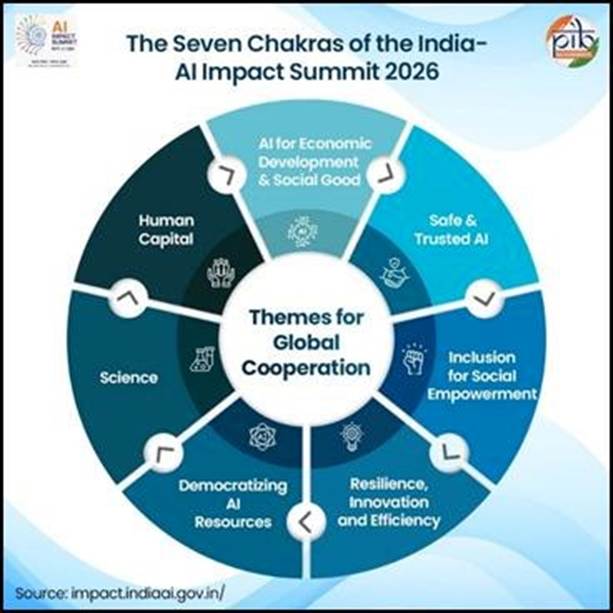
Chakra 1: Human Capital
AI Skilling Ecosystem
- Focuses on reskilling, future-ready education, and workforce transition, minimizing technological unemployment and leveraging demographic dividend for knowledge-driven AI economy.
Talent Indicators
- India shows 3× AI talent growth since 2016, 33% annual hiring growth, and targeted support for 500 PhDs, 5,000 PGs, 8,000 UGs, strengthening research pipelines.
Chakra 2: Inclusion for Social Empowerment
Inclusive-by-Design AI
- Encourages representative datasets, multilingual interfaces, and accessibility tools, reducing algorithmic bias and ensuring AI reflects India’s linguistic and social diversity.
DPI Linkage
- Uses Digital Public Infrastructure (DPI) for scalable AI deployment in welfare, agriculture, and governance, ensuring affordability and last-mile access.
Chakra 3: Safe and Trusted AI
Responsible AI
- Promotes transparency, explainability, and auditability, making AI decisions interpretable and legally defensible, strengthening public trust.
Governance Architecture
- Proposes AI Governance Group, Technology Policy Expert Committee, IndiaAI Safety Institute, creating layered oversight combining policy, expertise, and technical risk testing.
Chakra 4: Resilience, Innovation & Efficiency
Efficient AI Design
- Encourages low-energy, resource-optimized AI models, ensuring climate-conscious and scalable AI suitable for developing economies.
Infrastructure Scale
- Data-centre capacity projected from 960 MW to 9.2 GW by 2030, backed by large private investments enhancing digital sovereignty.
Chakra 5: Science
AI in Research
- AI accelerates discovery in climate science, genomics, and health, improving modelling accuracy and collaborative research.
R&D Push
- India’s R&D spending rose from ₹60,196 crore to ₹1.27 lakh crore; ANRF targets ₹50,000 crore, strengthening research ecosystem.
Chakra 6: Democratising AI Resources
Compute Sovereignty
- Promotes domestic access to GPUs, cloud, and supercomputers, reducing foreign dependence and ensuring strategic autonomy.
Shared Infrastructure
- IndiaAI Kosh: 7,400 datasets, 570 AI Data Labs, and compute below ₹100/hour enable equitable innovation.
Chakra 7: AI for Economic Growth & Social Good
Sectoral Transformation
- AI improves productivity in agriculture, healthcare, education, and judiciary via analytics, diagnostics, and automation.
Economic Impact
- AI sector projected at US$280 billion (2025); 1.8 lakh startups show widespread adoption and employment potential.
Governance Significance
Digital Diplomacy
- Summit enhances India’s soft power by shaping ethical AI norms and strengthening its global technology leadership.
Development Model Export
- India promotes DPI + AI model, offering scalable governance solutions for developing nations.
Challenges
Global Inequality
- Unequal access to compute, data, and talent risks new digital divides and technological dependency.
Regulatory Lag
- Fast AI evolution outpaces regulation, creating risks of misuse and accountability gaps.
Way Forward
Balanced AI Statecraft
- Align AI growth with constitutional values, human rights, and SDGs.
South–South Cooperation
- Expand AI skilling and infrastructure collaboration among developing nations.


