
Content
- FROM QUEUES TO QR CODES: INDIA’S PAYMENT REVOLUTION
- SAGARMALA: TRANSFORMING INDIA’S MARITIME LANDSCAPE
FROM QUEUES TO QR CODES: INDIA’S PAYMENT REVOLUTION
Why in News?
- Ministry of Information & Broadcasting (PIB) released article highlighting India’s digital payments transformation, especially UPI achieving global scale leadership.
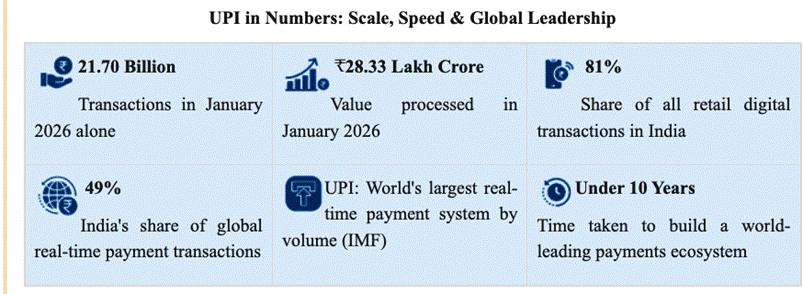
- UPI recorded 21.7 billion transactions (Jan 2026) worth ₹28.33 lakh crore, reinforcing India’s dominance in real-time payments ecosystem.
- RBI’s new mandate (effective April 1, 2026) on enhanced Two-Factor Authentication (2FA) for digital payments strengthens security architecture.
- Growing internationalisation of UPI (France, UAE, Singapore etc.) positions India as a global fintech leader and DPI exporter.
Relevance
- GS Paper II: Governance, Financial Inclusion, Digital Public Infrastructure (DPI), RBI regulation
- GS Paper III: Economy (Fintech, Digital Economy), Cyber Security, Inclusive Growth
Practice Question
- “India’s Unified Payments Interface (UPI) represents a paradigm shift in financial inclusion and digital governance. Critically examine its achievements, challenges, and global implications.” (250 words)
Overview
- India’s payment ecosystem has transitioned from cash-dominated, slow, exclusionary systems to a real-time, interoperable, inclusive digital architecture, transforming everyday economic participation across socio-economic strata.
- Pre-2010 systems like cheques, RTGS (2004), IMPS (2010) improved speed but remained urban-centric and bank-dependent, leaving large populations outside formal finance.
- Structural shift occurred post-2014 with JAM Trinity + UPI (2016), enabling universal access, seamless transactions, and behavioural change towards digital finance.
Evolution of Payment Systems in India
- Traditional systems relied on cash (dominant), barter remnants, and limited banking reach, resulting in high transaction costs, delays, and financial exclusion.
- Early digital infrastructure (RTGS, NEFT, IMPS) introduced electronic settlement, but required bank literacy, internet access, and formal account penetration.
- Demonetisation (2016) acted as a catalytic shock, accelerating digital adoption, fintech innovation, and behavioural shift towards non-cash payments.
JAM Trinity: Foundational Digital Public Infrastructure
- Pradhan Mantri Jan-Dhan Yojana (PMJDY): Enabled 52+ crore bank accounts, ensuring universal banking access, particularly for rural and marginalised populations.
- Aadhaar: Provided biometric-based unique identity (99% adult coverage), enabling authentication, KYC simplification, and targeted welfare delivery.
- Mobile Connectivity: Over 1.1 billion mobile connections, enabling last-mile digital interface for payments, authentication, and financial services.
- Combined effect: Reduced leakages (DBT savings ₹2+ lakh crore), enhanced trust in digital systems, and created ready user base for digital payments adoption.
UPI: Disruptive Innovation in Payments
- Launched by National Payments Corporation of India in 2016, enabling instant, 24×7, interoperable bank-to-bank transfers using Virtual Payment Address (VPA).
- Eliminated need for account numbers/IFSC, reducing friction and enhancing ease of use for low-literacy users.
- Core design: Open, interoperable, low-cost, API-based infrastructure, fostering competition among banks and fintech platforms.
- Network expansion: 216 banks (2021) → 691 banks (Jan 2026), reflecting rapid ecosystem scaling.
Scale, Speed and Global Leadership
- 21.7 billion transactions (Jan 2026) with ₹28.33 lakh crore value, indicating unprecedented transaction velocity and depth.
- Accounts for 81% of India’s retail digital transactions, making UPI the backbone of digital payments.
- India contributes 49% of global real-time payment transactions, as recognised by International Monetary Fund.
- Achieved global leadership in <10 years, demonstrating state-led digital public infrastructure success model.
Financial Inclusion and Socio-Economic Transformation
- Enabled last-mile inclusion: street vendors, gig workers, small merchants now participate in formal financial ecosystem via QR-based payments.
- Reduced cash dependency, lowering transaction costs, leakages, and informal inefficiencies.
- Created digital transaction history, enabling access to formal credit, insurance, and micro-finance products.
- Bridged urban-rural divide, ensuring equal transaction capability irrespective of geography or income.
Ecosystem Expansion and Innovation
- UPI Lite: Facilitates small-value offline/quick payments, improving speed and usability in low-connectivity areas.
- UPI AutoPay: Enables recurring payments, enhancing financial discipline and convenience.
- Credit on UPI: Integrates formal credit ecosystem, allowing instant access to pre-approved credit lines.
- Fintech-NBFC integration expanding digital lending, repayment systems, and personalised financial products.
Governance, Security and Trust Architecture
- RBI mandate : Two-Factor Authentication (2FA) strengthens transaction security through PIN, OTP, biometrics.
- Reduced fraud risks via layered authentication, tokenisation, and encryption standards.
- Integrated grievance redressal mechanisms enhance user confidence and accessibility.
- Strengthened regulatory oversight by Reserve Bank of India ensuring systemic stability and consumer protection.
Global Impact and Digital Diplomacy
- UPI operational/linkages in UAE, Singapore, Bhutan, Nepal, Sri Lanka, France, Mauritius, Qatar, enabling cross-border payments and remittances.
- Recognised by World Bank and IMF as a scalable Digital Public Infrastructure (DPI) model.
- Enhances India’s soft power and fintech leadership, positioning it as a global exporter of digital governance solutions.
Challenges and Critical Concerns
- Cybersecurity risks: Rising digital transactions increase exposure to fraud, phishing, and data breaches.
- Digital divide persists: Elderly, digitally illiterate, and remote populations face access and usability challenges.
- Over-dependence on UPI: Concentration risk may create systemic vulnerabilities in case of outages.
- Data privacy concerns: Increased data flows raise issues regarding consent, surveillance, and misuse.
- Low merchant monetisation: Zero MDR (Merchant Discount Rate) affects sustainability of payment ecosystem players.
Way Forward
- Strengthen cyber resilience architecture with AI-based fraud detection and real-time monitoring systems.
- Expand digital literacy missions, targeting rural, elderly, and marginalised populations.
- Introduce sustainable pricing models (balanced MDR) to ensure ecosystem viability without harming inclusion.
- Enhance data protection framework aligned with Digital Personal Data Protection Act principles.
- Promote interoperability with global systems, scaling cross-border UPI adoption.
Prelims Pointers
- UPI launched in 2016 by NPCI; enables real-time, interoperable payments.
- JAM Trinity = Jan Dhan + Aadhaar + Mobile.
- UPI share: ~81% of retail digital payments (India).
- India share: ~49% of global real-time payments.
- UPI Lite, AutoPay, Credit on UPI = key innovations.
SAGARMALA: TRANSFORMING INDIA’S MARITIME LANDSCAPE
Why in News?
- PIB highlighted Sagarmala progress, with 845 projects (₹6.06 lakh crore) and record cargo handling of 915 MT in FY 2025–26.
- Launch momentum of Sagarmala 2.0 (₹85,482 crore support, ₹3.6 lakh crore investment potential) aligns with Maritime India Vision 2030 & Amrit Kaal Vision 2047.
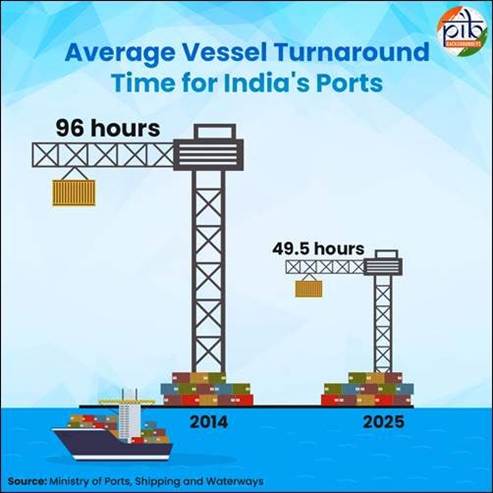
- Improved port efficiency (turnaround time reduced from 96 hrs → 49.5 hrs) reflects logistics competitiveness gains.
Relevance
- GS Paper III: Infrastructure, Logistics, Ports, Blue Economy
- GS Paper II: Centre–State coordination, Institutional frameworks
Practice Question
- “Sagarmala programme seeks to reduce logistics costs and enhance India’s maritime competitiveness. Analyse its achievements and limitations in achieving port-led development.” (250 words)
Overview
- Sagarmala (launched 2015) is a port-led development strategy to enhance logistics efficiency, reduce costs, and boost trade competitiveness.
- India handles ~95% trade by volume and ~70% by value via maritime routes, making ports central to economic growth and global integration.
- With 11,099 km coastline + 14,500 km navigable waterways, programme leverages geographical advantage for multimodal logistics transformation.
Core Features and Strategic Focus
- Focus on port modernization, connectivity, industrial clusters, coastal community development, and waterways transport, ensuring holistic maritime ecosystem development.
- Promotes multimodal integration (road–rail–waterways) to reduce India’s high logistics cost (~13–14% of GDP).
- Encourages PPP-based investments, enhancing private participation and efficiency in port operations.
Infrastructure Expansion and Capacity Creation
- 7 coastal berth projects (₹494 crore) added 9.84 MTPA cargo capacity, strengthening coastal cargo handling capability.
- Development of fishing harbours (11 projects, ₹1,057 crore) benefiting 30,000+ fishermen, improving marine economy productivity.
- Safety and modernization projects (e.g., Mumbai Port firefighting, Kolkata bridge upgrade) enhance operational resilience and efficiency.
Performance and Efficiency Gains
- Major ports handled 915.17 MT cargo (FY 2025–26), achieving 7.06% annual growth, reflecting trade expansion.
- Vessel turnaround time reduced from 96 hours (2014) → 49.5 hours (2025), improving global competitiveness of Indian ports.
- 9 Indian ports in global top 100, indicating improved port performance standards.
Growth of Inland Waterways and Coastal Shipping
- Inland waterway cargo increased from 18.1 MTPA (2013–14) → 145.5 MTPA (2024–25) (~700% growth), reducing pressure on road/rail networks.
- Promotes low-cost, fuel-efficient, and eco-friendly transport modes, aligning with sustainable logistics goals.
Passenger Connectivity and Urban Transport
- 29 Ro-Pax/ferry projects (₹1,233 crore), with 17 completed, benefiting 35 lakh+ passengers.
- Case studies:
- Ghogha–Hazira route reduced travel time from 10 hrs (road) → 4 hrs (sea).
- Mumbai–Mandwa ferry reduced 109 km road distance → 18.5 km sea route.
- Enhances urban mobility, reduces congestion, and supports coastal tourism.
Port-Led Industrialization and Employment
- Development of coastal economic zones (CEZs) promotes manufacturing near ports, reducing logistics cost and export time.
- Estimated 1 crore jobs (40 lakh direct + 60 lakh indirect) through industrial clusters and maritime infrastructure expansion.
- Strengthens integration with global value chains (GVCs).
Coastal Community Development
- Skill development under DDU-GKY convergence trained 7,600+ candidates, with 3,100+ placements.
- Focus on fisheries, tourism, and livelihoods, ensuring inclusive growth of coastal populations.
- Reduces regional disparities and promotes blue economy development.
Institutional Framework
- National Sagarmala Apex Committee (NSAC): Provides policy direction and oversight.
- Maritime States Development Council (MSDC): Ensures centre–state coordination and stakeholder alignment.
- State Sagarmala Committees (SSCs): Identify and monitor state-level projects.
- Sagarmala Finance Corporation Limited (SMFCL): India’s first maritime NBFC, sanctioned ₹4,300 crore loans, addressing sectoral financing gaps.
Sagarmala 2.0: Next Phase
- Envisions integrated maritime ecosystem aligned with Maritime India Vision 2030 and Maritime Amrit Kaal Vision 2047.
- Budgetary support: ₹85,482 crore, catalyzing ₹3.6 lakh crore investments.
- Focus areas: green ports, digitalisation, innovation, coastal development, logistics optimisation.
- Aims to position India as a global maritime hub under Viksit Bharat 2047 vision.
Challenges and Critical Issues
- High logistics cost persists (~13–14% of GDP) due to last-mile connectivity gaps and inefficiencies.
- Project delays and coordination issues between centre, states, and agencies.
- Environmental concerns: Coastal erosion, marine pollution, ecological disruption from port expansion.
- Underutilisation of waterways despite growth, due to draft limitations and infrastructure gaps.
- Financing constraints in large-scale maritime infrastructure projects.
Way Forward
- Strengthen multimodal connectivity (PM Gati Shakti integration) for seamless logistics.
- Promote green ports and sustainable shipping aligned with IMO decarbonisation targets.
- Enhance private sector participation and innovative financing (InvITs, PPP models).
- Improve last-mile connectivity and hinterland linkages to maximise port utilisation.
- Develop skilled maritime workforce and coastal entrepreneurship ecosystems.
Prelims Pointers
- Sagarmala launched in 2015 for port-led development.
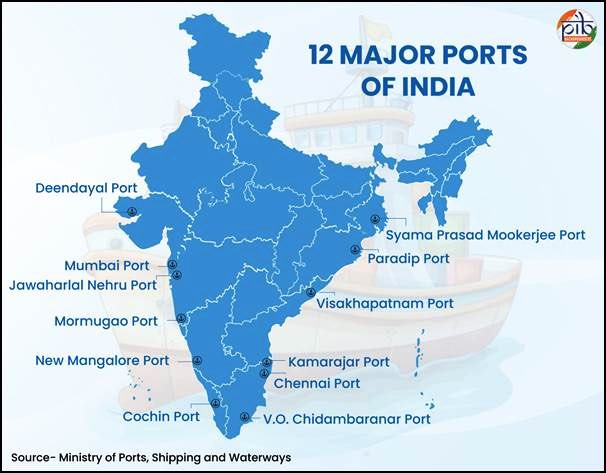
- India: 12 major ports + 200+ non-major ports.
- 95% trade (volume), 70% trade (value) via maritime routes.
- Inland waterways cargo: ~700% growth (2013–14 to 2024–25).
- Sagarmala 2.0: ₹85,482 crore support.


