
Introduction :
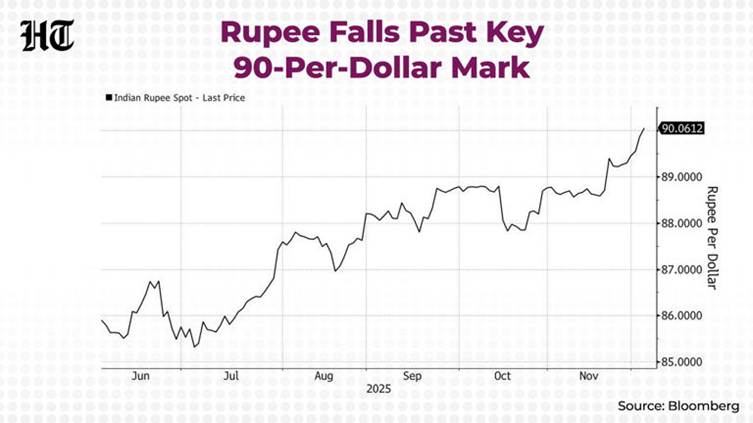
In the month of December, for the very first time, the Indian rupee has depreciated to ₹90 per USD, setting a record low and marking its lowest value in history.
This decline has significantly affected India’s imports and exports, making it a major challenge for the RBI and the overall Indian economy to manage. Let us dive deeper in to this topic to explore the key reasons behind the fall and understand its broader impact.
Why has The Rupee depreciated?
Key Reasons Behind The Rupee’s Depreciation :
There are multiple factors that have contributed to the depreciation of the rupee. Over the past few months, the currency has gradually weakened – falling from around ₹85 per dollar in June to crossing the key ₹90-per-dollar mark in December.
This consistent downward trend reflects rising pressure on India’s external sector and the challenges faced by the RBI in stabilizing the exchange rate. These reasons can broadly be divided/classified into two categories : Domestic factors and Global factors. Let us now examine each category in detail.
Domestic Factors :
Rising Imports
- India’s demand for imported goods has been increasing steadily.
- Eg ; Gold, Crude oil, Electronics, Machinery, etc.
- Since these items are purchased from foreign countries, India must pay for them in US dollars. This increases the demand for dollar and weakens the rupee.
Chain Reaction :
India’s imports from foreign countries increases
↓
Payment to be made in US dollars for imports
↓
Conversion of rupee into dollars
↓
Demand for dollars – rises/increases
↓
Supply of rupee increases – rupees are sold to buy dollars
↓
Dollar becomes stronger and rupee becomes weaker
↓
Rupee depreciates against dollar
High Inflation
- Higher inflation reduces purchasing power and makes Indian goods less competitive in global markets.
- As a result, foreign buyers demand fewer Indian products, reducing the demand for the rupee.
- Lower demand → Rupee depreciates.
FII Withdrawal
- US Federal Reserve has raised/increased interest rates.
- Higher returns in the US make investors move money from India to the US.
- So, FIIs – also referred to as “Hot Money” – are selling their investments in India and moving funds to safer and more profitable markets, causing FII outflow.
- FII outflow → Rupee depreciation
Imports > Exports
- Though India’s total exports grew, but imports increased even faster.
- Eg ; October 2025 – Merchandise exports stood at US $34.38 bn, while imports stood at US $76.06 bn
- Export growth has not kept pace with import growth.
- So, when exports are low, India earns fewer US dollars.
- Lower dollar inflow → Higher dollar demand → Rupee depreciates.
Widening Trade Deficit
- Imports growing faster than exports, lead to a significant trade deficit, resulting in continuous dollar payments.
- This resulted in increased pressure on the rupee.
- Result → Rupee Depreciation
Global Factors
- Strong and Rising US Dollar
- The US dollar has strengthened sharply against most world currencies.
- So, when the dollar gains global strength, other currencies – including the rupee – automatically weakens.
- Strong dollar = Weak rupee
Global Economic Uncertainty
- Globally, markets are facing uncertainty due to geopolitical conflicts like wars, recession fears etc.
- This has resulted in slowing the world demand.
- In times of uncertainty, investors prefer safe-haven assets like US dollar.
- Money leaving emerging markets → Rupee depreciation
Delayed US – India Trade Deal
- The trade agreement between India and US has been delayed, and there is uncertainty about when it will be finalized.
- US representatives are expected to arrive in India next week for further discussions.
- This uncertainty has reduced confidence among foreign investors, who prefer to invest in economies with stable and predictable trade policies.
- Fear of trade disruptions → Lower foreign investment → Fewer dollars enter India → Dollar demand rises → Rupee depreciates
Role of the RBI in Rupee Depreciation :
- Although RBI does not directly set the exchange rate, it intervenes in the foreign exchange market to reduce extreme volatility.
Selling Us Dollars From Forex Reserves
- When rupee weakens sharply, the RBI sells dollars from it’s foreign exchange reserves in the market.
- This increases supply of dollars and slows down rupee depreciation.
Raises Interest Rate
- Higher interest rate attracts foreign investment.
- More dollar inflow → Supports the rupee
Providing Liquidity Support To Banks
- RBI ensures that enough dollars were available in the banking system, helping exporters and importers manage forex risk.
- This, in turn, prevents panic in currency markets.
Impacts Of Rupee Depreciation :
Positive Impacts
- Indian exports become more competitive in global markets
- Households receiving remittances gain
- Reduces import dependence and raises domestic production
Negative Impacts
- Higher cost of imports
- Rise in Overall Inflation
- Widens Trade Deficit
- Affects investor confidence
- Burden on households/consumers
Conclusion :
To ensure long-term stability of the rupee, India must focus on reducing import dependency, boosting exports and maintaining low and stable inflation.
Strengthening domestic production, improving investor confidence and accelerating trade agreements can bring higher dollar inflows. Continued policy support and timely RBI intervention will help prevent excessive volatility and support a stable and resilient rupee in the future.


