
Case 1: Vihaan Kumar Vs the State of Haryana
What Is the Case About?
Whether an arrested person must be informed of the reasons for arrest as a mandatory constitutional requirement under Article 22(1) of the Constitution of India.

Key Rulings:
- Mandatory Constitutional Requirement
- Informing a person of the grounds of arrest is not a formality – it is mandatory under Article 22(1).
- Non-Communication Illegalises Arrest
- Failure to inform the arrested person of the grounds of arrest renders the arrest illegal and any subsequent judicial remand cannot cure the defect.
- Burden On Police
- Once non-communication is alleged by the detained person, the burden shifts to the police to prove compliance.
- Information to Relatives Is Not Compliance
- Informing a relative (wife) or merely entering something in a diary is not sufficient to satisfy Article 22(1).
- Violation of Dignity
- The court admonished treatment like handcuffing and chaining at hospital as inconsistent with human dignity under Article 21.
| Constitutional Provisions Related | Statutory Provisions Related |
| Article 21 – Right to Personal LibertyArticle 22(1) – Right to be Informed on the Grounds of ArrestArticle 22(2) – Production Before Magistrate | Section 47 BNSS – Requires police to communicate to a person arrested the full particulars of the offence for which they are arrested. |
Significance of the Judgement:
- Article 22(1) is sacrosanct – must be fully complied with for arrests made without warrant.
- Arrest without informing grounds = nullified even if remand is granted later.
- Magistrates must ensure compliance when granting remand.
Conclusion:
This judgement reinforces constitutional safeguards protecting arrested persons’ liberty.
Case 2: Gayathri Balaswamy Vs ISG Novasoft Technologies Ltd.
What Is the Case About?
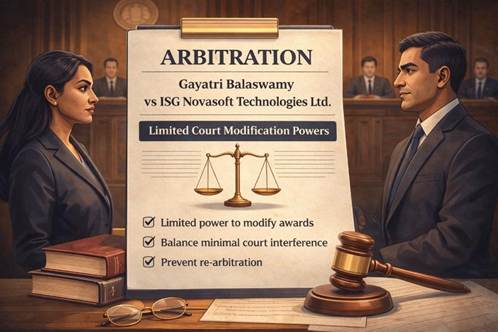
Whether Indian courts have the power to modify an arbitral award under Section 34 & 37 of the Arbitration and Conciliation Act, 1996, instead of merely setting it aside or remitting it.
Key Rulings:
- Limited Power to Modify Awards
- Courts may modify arbitral awards in exceptional cases under Section 34.
- Implied Judicial Power
- Though not expressly stated, modification power is implied to prevent injustice.
- Not An Appellate Review
- Courts cannot re-appreciate evidence.
- Preference Over Setting Aside
- If defects are curable, modification is better than annulling the entire award.
- Narrow And Cautious Use
- Modification allowed only for severable or obvious errors.
- Preserves Arbitration Efficiency
- Prevents delay and avoids fresh arbitration.
- Dissenting View
- Courts should not modify awards unless Parliament explicitly allows it.
| Statutory Law related: Arbitration & Conciliation Act, 1996 – Section 33, 34 and 37Section 33 – Allows correcting an award by the arbitral tribunal but not court modification.Section 34 – Allows a party to apply to a court to set aside an arbitral award on limited grounds.Section 37 – Deals with appeals against orders on setting aside arbitral awards. |
Significance of the judgement:
- Expanded the scope of Judicial Review in arbitration – recognising a limited judicial modification power.
- Tries to balance arbitral autonomy with pragmatic judicial intervention for justice and efficiency.
- Influences how challenges under Section 34 are approached by parties and courts going forward.
Conclusion:
This judgement clarifies that courts have limited power to modify arbitral awards to prevent injustice while preserving the principle of minimal judicial interference.
Case 3: Anjuman Ishaat-e-Taleem Trust Vs State of Maharashtra
What Is the Case About?
Whether the Right of children to Free and Compulsory Education Act, 2009(RTE Act) and related regulations – especially the Teacher Eligibility Test (TET) requirement – apply to minority educational institutions such as those run by the Anjuman Ishaat-e-Taleem Trust.

Key Rulings:
- TET As Minimum Qualification
- Teacher Eligibility Test is a mandatory minimum standard for appointment, continuation and promotion under the RTE framework.
- Protection To Existing Teachers
- In-service teachers appointed earlier may be given time to clear TET; those near retirement may continue without it but cannot claim promotion.
- Doubt On Pramati Ruling
- The court expressed serious doubt on the correctness of Pramati, which exempted minority institution from the RTE act.
- Reference To Larger Bench
- The issue of applicability of the RTE act to minority institution is referred to a larger bench for authoritative decision.
- Balancing Constitutional Rights
- Article 21A (Right to Education) must be harmonised with Article 30(1).
- Status Quo Till Final Decision
- Existing legal position continues until the larger bench settles the issue.
| Constitutional Provisions Related | Statutory Provisions Related |
| Article 21A – Right to EducationFree & compulsory education to children aged 6-14 years.Article 30(1) – Minority rightsRight to establish and administer educational institutions of their choice.Article 19(1)(g)Right to practise any profession or occupation; relevant to regulation of teaching in a profession.Article 14Equality before law invoked while examining uniform application of educational standards.Article 15(4) & 15(5)Enable special provisions for SEBC, linked to RTE objectives.Article 246 – Entry 25, Concurrent listBoth centre & state to legislate on education. | RTE Act, 2009Section 23(1) – minimum qualifications for teachersSection 23(2) – Empowers the academic authority (NCTE) to lay down teacher qualifications.Section 12(1)(c) – Mandates 25% admission for disadvantaged groups.Section 38 – Power of the government to make rules for carrying out the act.National Council for Teacher Education (NCTE) Act, 1993Sections 12 & 14 – Authorise NCTE to prescribe qualifications and norms for teachers and institutions.NCTE Notifications – Make passing TET a minimum eligibility condition for appointment as teacher. |
Judicial Precedents Connected:
- Pramati Educational & Cultural Trust vs Union of India (2014)
- Held RTE Act inapplicable to minority institutions.
- Society for Unaided Private Schools VS Union of India (2012)
- Upheld RTE Act generally, except its application to minority institutions.
- T.M.A. Pai Foundation Vs State of Karnataka (2002)
- Laid down scope of minority rights under Article 30.
- P.A. Inamdar Vs State of Maharashtra (2005)
- Clarified limits on state regulation of private and minority institutions.
Significance of the Judgement:
- Reopens the question whether minority institutions can be completely exempt from the RTE Act.
- Reinforces the importance of minimum teacher qualifications (TET) as part of ensuring quality education under Article 21A.
- Seeks to balance minority rights under Article 30(1) with the state’s constitutional duty to provide effective and uniform education standards.
Conclusion:
This judgement keeps the question of RTE’s applicability to minority institutions open while affirming minimum teacher qualifications as essential to uphold the right to quality education.
Case 4: State of Tamil Nadu Vs Governor of Tamil Nadu
What Is the Case About?
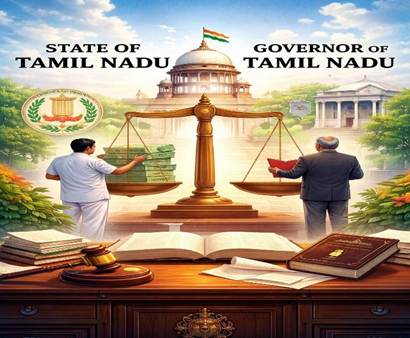
The case deals with the Governor of TN delaying action on bills passed by State Legislature.
Key Rulings: High Court
- No Pocket Veto
- The Governor cannot indefinitely delay giving assent to bills passed by the State Legislature.
- Mandatory Action Under Article 200
- The Governor must either assent, return or reserve a bill; inaction is unconstitutional.
- Time Limit Is Set
- A timeline of 3 months is set for Governor to act.
- Binding Effect of Re-Passed Bills
- Once a bill is re-passed by the Legislature, the Governor is ordinarily bound to grant assent.
- Limited Discretion of Governor
- The Governor must act on the aid and advice of the Council of Ministers except in constitutionally specified situations.
- Judicial Review Allowed
- Courts can review and remedy arbitrary or mala fide delay by the Governor in dealing with bills.
Key Rulings: Supreme Court
- No Mandatory Timeline Imposed
- The court refused to fix any specific time limit for the Governor to act on bills.
- No Coercive Directions to Governor
- The court held that it will not issue commands or pressure the Governor in exercising powers under Article 200.
- Governor’s Discretion Preserved
- The decision on assent was left to the Governor’s constitutional discretion.
- Duty To Follow Constitutional Conventions
- The Governor was reminded to act in accordance with the Constitution and established conventions.
- Judicial Restraint Maintained
- The court limited its interference and avoided entering into the merits of legislative-executive functioning.
| Constitutional Provisions Related | Statutory Provisions Related |
| Article 200Governor’s power to give assent, withhold assent or reserve State bills for the President.Article 163Governor must act on the aid and advice of the Council of Ministers.Article 164Collective responsibility of the Council of Ministers to the State Legislature.Article 168Constitution of the State Legislature.Article 201Procedure when a bill is reserved for the President’s consideration.Article 14Prohibits arbitrariness in State action (used to test unreasonable delay) | Rules of Business of the State Government. |
Significance of the Judgement:
- SC reaffirmed judicial restraint by refusing to impose timelines, preserving the Constitutional balance between the Judiciary and executive.
- It clarified that while the Governor enjoys discretion under Article 200, such discretion must be exercised in accordance with constitutional morality and conventions.
- The ruling emphasizes that constitutional authorities are expected to act responsibly and in good faith, even when courts choose not to intervene directly.
Conclusion:
This judgement underscores that while the SC will not compel the Governor through timelines, the Governor must still act responsibly and in accordance with constitutional principles.
Case 5: Urmila Dixit Vs Sunil Dixit & Ors., 2025
What Is the Case About?
Whether a senior citizen can cancel a gift or property made to a child when the child fails to take care of the parent as promised.

Key Rulings:
- Welfare Law Must Be Interpreted Liberally
- The court held that the Maintenance and Welfare of Parents and Senior Citizens Act,2007 must be interpreted in a way that advances protection and dignity of senior citizens.
- Conditional Gift Can Be Cancelled
- If property is gifted on the condition that the transferee will maintain the senior citizen, failure to do so allows cancellation of the gift.
- Condition Need Not Be Expressly Written
- Even if the gift does not clearly mention maintenance, an implied understanding or surrounding circumstances can prove the condition.
- Neglect or Ill-Treatment Triggers Section 23
- Neglect or refusal to maintain parents amounts to violation under Section 23 of the act, enabling revocation of property transfer.
- Senior Citizens Rights Override Technical Objections
- Procedural or technical objections cannot defeat the substantive rights of senior citizens under the act.
- Objective Is Social Justice, Not Pure Property Law
- The court emphasised that the act is social-welfare legislation, not to be narrowly read like ordinary property law.
| Constitutional Provisions Related | Statutory Provisions Related |
| Article 21 – Right to Life and DignityGuarantees senior citizens the right to live with dignity, which includes care, protection and maintenance.Article 14 – Equality Before LawEnsures elderly persons receive equal legal protection against neglect or exploitation.Article 15(3) – Special ProtectionAllows the State to make special provisions for vulnerable groups, including elderly persons.Article 39(e) & (f) – Directive PrinciplesDirect the State to protect citizens from abuse and ensure humane living conditions.Article 41 – Right to Public AssistanceMandates State support in cases of old age, sickness and disability.Protection of Weaker SectionsEncourages special legal safeguards for socially and economically vulnerable groups, including senior citizens. | Maintenance and Welfare of Parents and Senior Citizens Act, 2007Section 4 – Right to MaintenanceSection 5 – Application for MaintenanceSection 9 – Enforcement of Maintenance OrdersSection 23 – Void Transfer of PropertySection 22 – Protection of Life & Property |
Significance of the Judgement:
- Strengthens protection of senior citizens by allowing cancellation of property transfers when maintenance of the obligations are violated.
- Clarifies liberal interpretation of Section 23 of the senior citizens act to uphold dignity and welfare over technical formalities.
- Reinforces the social-welfare objective of the law, prioritizing justice for elderly persons over strict property rights.
Conclusion:
This judgement reinforces that the law must actively protect senior citizens by allowing cancellation of property transfers when their right to care and dignity is violated.
Case 6: Om Prakash Vs Union of India
What Is the Case About?
Whether the accused can claim the benefit of juvenility (being a minor at the time of offence) even after conviction, and how courts should determine age under juvenile justice law.

Key Rulings:
- Claim of Juvenility Can Be Raised at Any Stage
- The court held that plea of juvenility can be raised even after conviction or during execution of sentence.
- Age on Date of Offense
- The relevant factor is accused’s age on the date of commission of the offence, not at the time of trial or conviction.
- Proper Age Determination Is Mandatory
- Courts must follow the statutory procedure under juvenile justice law to determine age using reliable documentary or medical evidence.
- Benefit of Juvenile Law Must Be Granted If Proven
- If the accused is found to be a juvenile, the protection of the Juvenile Justice Act must be applied irrespective of the gravity of the offence.
- Earlier Admission of Age is Not Conclusive
- A statement made by the accused about age during trial cannot override documentary or scientific evidence.
- Welfare-Oriented Interpretation of Juvenile Law
- The Juvenile Justice Act must be interpreted liberally to advance its rehabilitative and reformative purpose.
| Constitutional Provisions Related | Statutory Provisions Related |
| Article 21 – Right to Life and Personal LibertyIncludes the right to fair trial, due process and protection of children in conflict with law.Article 14 – Right to Equality Ensures equal protection and non-arbitrary treatment in age determination and criminal procedure.Article 15(3)Permits the State to make special laws for children, forming the basis of juvenile justice legislation.Article 39(e) & (f)Direct the State to protect children from abuse and ensure healthy development in dignity. | Juvenile Justice (Care and Protection of Children) Act, 2000/2015Section 2(k)/2(35) – Defines a juvenile as a person who has not completed 18 years of age.Section 7A(JJ Act,2000) – Allows the claim of juvenility to be raised at any stage, even after final disposal of the case.Section 9 (JJ Act, 2015) – Provides the procedure for age determination (documents first, medical test later)Section 15 (JJ Act, 2015) – Provides for preliminary assessment in cases of heinous offences committed by children aged 16-18. |
Significance of the Judgement:
- Affirms that a claim of juvenility can be raised at any stage, even after conviction or during execution of sentence.
- Strengthens procedural safeguards for age determination, ensuring reliance on statutory methods rather than assumptions.
- Reinforces the reformative and welfare-oriented approach of juvenile justice law, prioritizing rehabilitation over punishment.
Conclusion:
This judgement reinforces that juvenile justice laws must be applied liberally to protect children’s rights by ensuring fair age of determination and rehabilitative treatment even after conviction.
Case 7: Padi Kaushik Reddy Vs State of Telangana
What Is the Case About?
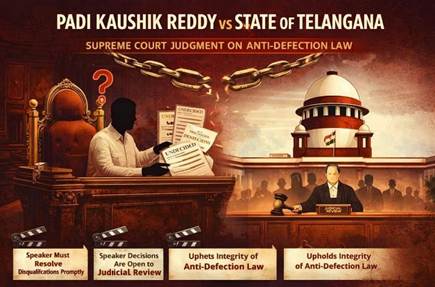
Whether the Speaker of a State Legislative Assembly can indefinitely delay deciding disqualification petitions under the Tenth Schedule, and whether such delay is subject to Judicial Review.
Key Rulings:
- Speaker Has No Absolute Immunity
- The Speaker does not enjoy constitutional immunity while deciding disqualification petitions under the 10th Schedule.
- Speaker Acts as a Tribunal
- While deciding defection cases, the Speaker functions as a quasi-judicial authority and must act fairly and independently.
- Delay Defeats Anti-Defection Law
- Unreasonable delay in deciding disqualification petitions frustrates the object of the 10th Schedule.
- Time-Bound Decision Is Mandatory
- The Court directed the disqualification petitions must be decided within a reasonable and fixed timeframe.
- Judicial Review Is Permissible
- Courts can intervene when the Speaker fails to act or acts arbitrarily in defection matters.
- Need For Institutional Reform
- The Court reiterated the need to reconsider the mechanism for deciding defection cases to ensure neutrality and accountability.
| Constitutional Provisions Related | Statutory Provisions Related |
| Article 102(2)Provides for disqualification of Members of Parliament under the 10th Schedule.Article 191(2)Provides for disqualification of Members of State Legislature under 10th Schedule.10th Schedule (Anti-Defection Law)Lays down grounds and procedure for disqualification of legislators on the ground of defection.Article 212Bars courts from inquiring into legislative proceedings, but does not protect unconstitutional delay or inaction.Article 136Gives the Supreme Court power to exercise appellate jurisdiction over Speaker’s decisions.Article 226Empowers High Courts to exercise Judicial Review over inaction or illegality by constitutional authorities.Article 14Ensures non-arbitrariness and equality.Article 21Protects democratic functioning and rule of law through fair and timely decision-making. | Rules framed under the 10th ScheduleProvides procedural framework for filing and deciding disqualification petitions.Rules of Procedure of the Telangana Legislative AssemblyGovern how the Speaker conducts proceedings, including disciplinary and procedural matters. |
Significance of the Judgement:
- Reinforces that the Speaker has no absolute immunity, and courts can intervene when there is unjustified delay in deciding defection petitions.
- Strengthens the purpose of the anti-defection law by requiring time-bound and bona fide decisions on disqualification.
- Promotes constitutional accountability and neutrality of the Speaker, preventing misuse of office for political advantage.
Conclusion:
This judgement affirms that delays by the Speaker in deciding defection cases undermine constitutional democracy and are subject to judicial scrutiny to uphold the anti-defection law.
Case 8: RE: T.N. Godavarman Thirumulpad Vs Union of India & Ors
What Is the Case About?
Whether the Union and State Governments can permit non-forest activities or diversion of forest land without prior approval of the Central Government under the Forest (Conservation) Act, 1980 and how forests must be protected through continuous judicial oversight.

Key Rulings:
- Broad Interpretation of “Forest”
- The term includes all areas recorded as forest in government records, regardless of ownership or classification.
- Mandatory Central Approval for Forest Diversion
- No non-forest activity can be carried out without prior approval of the Central Government under the Forest (Conservation) Act,1980.
- Continuing Mandamus by the Supreme Court
- The court retained ongoing supervisory jurisdiction to ensure effective implementation of forest conservation laws.
- Creation of Monitoring Bodies
- The court directed the establishment of bodies like the Central Empowered Committee (CEC) to assist in monitoring forest protection.
- Emphasis on Sustainable Development
- Development activities must balance ecological protection with economic needs, applying the principle of sustainable development.
- Application of Inter-Generational Equity
- Forests must be protected not only for present needs but also for the benefit of future generations.
| Constitutional Provisions Related | Statutory Provisions Related |
| Article 48ADirects the State to protect and improve the environment and safeguard forests and wildlife.Article 51A(g)Fundamental duty on citizens to protect and improve the natural environment.Article 21Includes the Right to a healthy and pollution-free environment.Article 32Empowers the Supreme Court to enforce fundamental rights and issue continuing mandamus.Article 142Allows the Supreme Court to pass complete justice orders to protect forests and the environment. | Forest Conservation Act, 1980Section 2 – Core provision prohibiting dereservation or non-forest use of forest land without Union approval.Environment Protection Act, 1986Provides broad powers to the Central Government to protect and improve the environment.Indian Forest Act, 1927Defines categories of forests and regulates forest management.Wild Protection Act, 1972Protects wildlife and forest habitats linked to conservation concerns in the case. |
Significance of the Judgement:
- Expanded the meaning of forest, bringing all recorded forest land under the protection of the Forest Conservation Act, 1980.
- Strengthened environmental governance through continuing mandamus, allowing the Supreme Court to monitor forest conservation on an ongoing basis.
- Established sustainable development and inter-generational equity as binding constitutional principles in environmental protection.
Conclusion:
This judgement transformed forest conservation in India by enforcing strict central control, continuous judicial oversight, and constitutional environmental protection for present and future generations.
Case 9: Yogamaya M.G. Vs Union of India & Ors.
What Is the Case About?
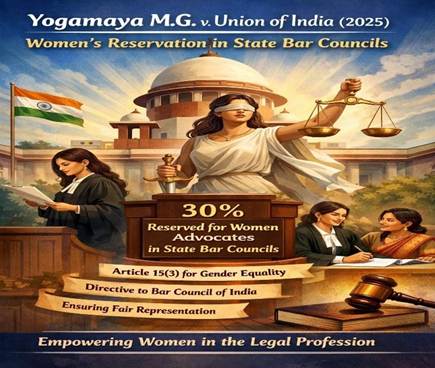
Whether the Supreme Court can direct reservation for women advocates in State Bar Councils to ensure adequate representation and substantive equality under Article15(3).
Key Rulings:
- Reservation for Women in State Bar Councils
- The Supreme Court directed 30% reservation for women advocates in state bar council elections to address chronic under-representation.
- Power to Issue Directions
- The Court held it can issue such directions to enforce substantive equality, even if the Advocate Act does not expressly provide for reservation.
- Interpretation of Proportional Representation
- Provisions under the Advocates Act were interpreted purposively to include gender-based proportional representation.
- Application of Article 15(3)
- The ruling relied on Article 15(3), affirming that special provisions for women are constitutionally valid and necessary.
- Temporary and Corrective Measure
- The reservation was treated as a corrective, enabling measure, not a permanent alteration of the statutory scheme.
- Direction to Bar Council of India (BCI)
- BCI was directed to implement and operationalise the reservation framework in upcoming State Bar Council elections.
| Constitutional Provisions Related | Statutory Provisions Related |
| Article 14 – Equality Before LawGuarantees equality and permits reasonable classification to correct structural inequality in representative bodies.Article 15(1) – Prohibition of DiscriminationProhibits discrimination on grounds of sex, forming the base rule against exclusion of women.Article 15(3) – Special provisions for women Empowers the State to make affirmative/protective measures for women, relied upon to justify reservation.Article 19(1)(g) – Right to practice a professionCovers the legal profession; regulation of Bar Councils must align with constitution.Article 21 – Right to DignityUsed indirectly to support women’s equal participation and dignity in professional governance.Article 142 – Complete JusticeInvoked to issue binding directions to ensure effective implementation of gender representation despite legislative silence. | Advocates Act, 1961Section 3 – Provides for the constitution of State Bar Councils through elected members.Section 3(4) – Allows elections to State Bar Councils by single transferrable vote, interpreted to permit proportional inclusion.Section 15 – Empowers Bar Councils to frame rules governing elections and internal functioning.Section 49 – Authorises BCI to frame rules to carry out the purposes of the Act, including election-related rules.Bar Council of India Rules |
Significance of the Judgement:
- Advances substantive gender equality by recognizing reservation for women in Bar Councils as a constitutional tool under Article 15(3).
- Expands judicial role in institutional reform by allowing courts to issue binding directions where statutory bodies fail to ensure fair representation.
- Strengthens women’s participation in legal governance, addressing structural under-representation within the legal profession.
Conclusion:
This judgement ensured meaningful representation of women in State Bar Councils through reservation by invoking Article 15(3) and directing the Bar Council of India to implement corrective measures to achieve substantive gender equality.
Case 10: Madras Bar Association Vs Union of India
What Is the Case About?
Whether the provisions of the Tribunal Reforms Act, 2021 relating to appointment, tenure and service conditions of tribunal members violate judicial independence and the doctrine of separation of powers.

Key Rulings:
- Judicial Independence as Basic Structure
- The court reaffirmed that independence of tribunals is an essential part of the Constitution’s basic structure.
- Limits on Legislative Re-Enactment
- Parliament cannot reintroduce provisions earlier struck down unless the constitutional defects are genuinely cured.
- Judicial Primacy in Appointments
- Selection of tribunal members must ensure dominance of the judiciary in the Search-cum-Selection Committee.
- Security of Tenure
- Short or uncertain tenure of tribunal members was held to undermine independence and impartial adjudication.
- Executive Control Restricted
- Excessive executive involvement in appointments and service conditions was declared unconstitutional.
- Binding Nature of Earlier Judgements
- Earlier Madras Bar Association rulings were reaffirmed as binding precedents that must be followed in tribunal reforms.
| Constitutional Provisions Related | Statutory Provisions Related |
| Article 14 – Equality Before LawArbitrary executive control over tribunals violates equality and non-arbitrariness.Article 50 – Separation of Judiciary from ExecutiveRequires independence of adjudicating bodies from executive influence.Article 136 – Appellate Jurisdiction of Supreme CourtTribunals function as substitutes to High Courts, making independence essential.Article 226/227 – Power of High CourtsTribunals supplement High Courts and must maintain equivalent safeguards.Article 245-246 – Legislative CompetenceParliament’s law-making power is subject to constitutional limitations.Basic Structure DoctrineJudicial independence and rule of law part of Constitution’s basic structure. | Tribunals Reforms Act, 2021Provisions relating to appointment, tenure, age limits and service conditions of tribunal members.Central legislation challenged for executive dominance.Basis of the constitutional challenge in the 2025 judgement.Tribunal RulesRules governing Search-cum-Selection Committee.Examined for consistency with Supreme Court directions.Finance Act, 2017Earlier law restructuring tribunals, repeatedly examined in Madras Bar Association cases. |
Significance of the Judgement:
- Reinforced judicial independence by limiting executive control over appointments, tenure and service conditions of tribunal members.
- Strengthens separation of powers by holding that Parliament cannot re-enact provisions struck down without curing constitutional defects.
- Protects Rule of Law in tribunalisation by ensuring tribunals function as effective and independent substitutes for courts.
Conclusion:
This judgement ensured that tribunal reforms must comply with constitutional principles of judicial independence and separation of powers, and cannot dilute safeguards already laid down by the Court.


