
Why in News?
Rising Highway Accidents and Tech-Based Solutions
- In January 2026, multiple fatal accidents on Indian highways due to fog, low visibility, and high-speed collisions renewed attention on Vehicle-to-Vehicle (V2V) technology as a preventive road-safety intervention.
Relevance
- GS Paper 2: Public policy for road safety, role of state in preventing accidents, regulatory frameworks for emerging technologies.
- GS Paper 3: Science and technology, Intelligent Transport Systems, infrastructure safety, innovation in public service delivery.
India’s Road Safety Context
Scale of the Problem
- India records over 1.5 lakh road deaths annually (MoRTH data), with highways accounting for a disproportionate share due to overspeeding, poor visibility, and delayed driver reaction times.
Visibility-Related Risks
- Dense fog zones in north India significantly reduce stopping distance and reaction time, making traditional safety tools like headlights, reflectors, and road signage insufficient.
What is Vehicle-to-Vehicle (V2V) Technology?
Core Concept
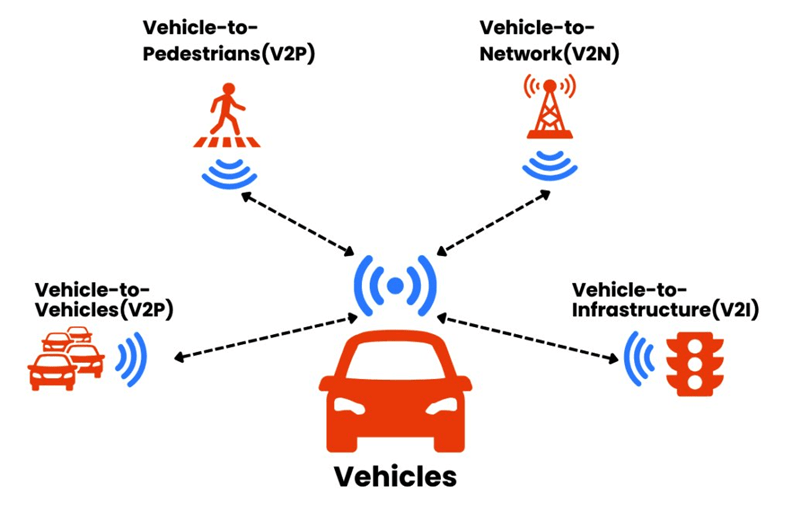
- V2V is a wireless communication system that allows vehicles to exchange real-time data such as speed, position, braking, and direction to prevent crashes before drivers can visually react.
Communication Range
- Vehicles communicate within approximately 200 metres, creating a digital safety bubble beyond the driver’s line of sight.
How V2V Technology Works
Onboard Communication Units
- Each vehicle is fitted with an Onboard Unit (OBU) that continuously broadcasts and receives safety messages from nearby vehicles.
Data Exchanged
- Shared data includes:
- Sudden braking events
- Speed changes
- Vehicle position and direction
- Loss of traction or unsafe distance
Driver Alerts and Safety Outcomes
Real-Time Warnings
- Drivers receive alerts for:
- Sudden braking ahead
- Vehicles stopped beyond visibility range
- Slow or wrong-way vehicles
- Cars approaching from blind spots
: Crash Prevention Mechanism
- Unlike cameras or radars, V2V works even without visual contact, making it particularly effective in fog, curves, and night driving.
Technology Stack Behind V2V
Communication Protocols
- V2V uses Dedicated Short-Range Communications (DSRC) or Cellular V2X (C-V2X), enabling low-latency, high-reliability message exchange.
Privacy-by-Design
- Messages are anonymous and non-trackable, designed only for safety alerts, not surveillance or driver profiling.
Global Experience with V2V
International Adoption
- Advanced economies have tested V2V as part of ADAS (Advanced Driver Assistance Systems), showing significant reductions in rear-end and chain collisions.
Limits of Partial Adoption
- Safety benefits rise sharply only when a large proportion of vehicles are V2V-enabled, creating a network effect.
Cost and Implementation Challenges
Cost Barrier
- Estimated cost is around ₹5,000 per vehicle, affordable at scale but challenging for India’s vast fleet of legacy vehicles.
Mixed Traffic Conditions
- India’s roads host cars, trucks, buses, two-wheelers, tractors, and pedestrians, complicating uniform deployment and standardisation.
Infrastructure and Regulatory Gaps
Absence of Mandates
- Unlike seat belts or airbags, V2V is not yet mandated under Indian vehicle safety regulations.
Spectrum and Standards
- Allocation of spectrum, interoperability standards, and certification frameworks remain underdeveloped for large-scale rollout.
V2V vs Other Road Safety Measures
Complement, Not Replacement
- V2V cannot replace:
- Speed regulation
- Road engineering improvements
- Enforcement and driver behaviour change
- It acts as a preventive overlay, enhancing reaction time.
Limitations
- V2V does not prevent:
- Pedestrian accidents
- Non-connected vehicles
- Deliberate reckless driving
India-Specific Use Cases
High-Impact Zones
- V2V offers maximum benefits in:
- Fog-prone highway corridors
- Accident black spots
- Mountain roads and sharp curves
- Long-haul freight routes
Freight and Commercial Fleets
- Early adoption in trucks and buses could deliver outsized safety gains due to vehicle size, braking distance, and long driving hours.
Way Forward
Phased Adoption Strategy
- Begin with:
- Mandatory V2V in new commercial vehicles
- Pilot corridors on high-risk highways
- Incentives for OEM integration
Policy and Ecosystem Support
- Develop:
- National V2X standards
- Spectrum allocation policy
- Integration with Intelligent Transport Systems (ITS)


