
Why in News ?
- Venezuela’s Supreme Court appointed Vice-President Delcy Rodríguez as Acting President after President Nicolás Maduro was detained by U.S. authorities in New York during a covert night-time operation.
- The U.S. move — conducted without Congressional approval — led Venezuela to term it an “imperialist intervention.”
- India expressed concern for the well-being of Venezuelan people and called for dialogue and regional stability.
Relevance
GS-II | International Relations, Global Politics, India’s Foreign Policy
- Power transition, legitimacy & constitutional processes in foreign states
- U.S. interventionism vs sovereignty debate
- Political instability, sanctions, oil geopolitics, migration crisis
- India’s energy stakes & strategic neutrality
Basics — Political Context of Venezuela
- System: Presidential Republic under the Bolivarian Constitution.
- Ruling establishment: United Socialist Party of Venezuela (PSUV).
- Maduro Presidency: Since 2013, succeeding Hugo Chávez.
- Venezuela faces:
- hyperinflation
- economic sanctions
- oil-sector collapse
- mass outward migration (~7.7 million people since 2015, per UNHCR)
Economic & Security Context
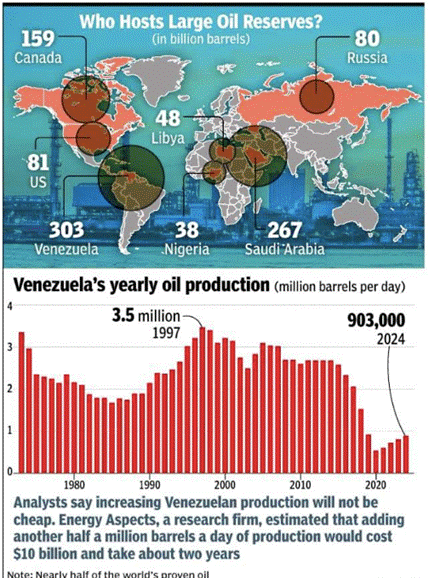
- Venezuela holds the world’s largest proven oil reserves (~303 billion barrels, OPEC).
- Oil output fell from ~3.2 million bpd (1998) to ~0.8–0.9 million bpd (2024, OPEC estimates) due to sanctions + infrastructure decline.
- Political instability worsens:
- currency collapse
- food & fuel shortages
- social protection stress
India’s Position
- India called for:
- peace, dialogue, and stability
- protection of Venezuelan people’s interests
- India has energy-economic stakes:
- historic crude imports & investments by ONGC Videsh in Venezuelan fields (affected by sanctions).
Global Reactions — Likely Trajectories
- Supportive Western blocs may justify action under anti-narcotics/security framing.
- Russia, China, and regional allies likely to condemn U.S. intervention as sovereignty violation.
- Risk of:
- internal political uncertainty
- elite realignments
- street-level mobilisation or repression
Venezuela
- Location & Region
- Located in northern South America; coastline along the Caribbean Sea & Atlantic Ocean.
- Lies north of the Equator; part of the Tropical zone.
- Neighbouring Countries (Clockwise)
- Colombia (W & SW)
- Brazil (S & SE)
- Guyana (E) — includes the disputed Essequibo region.
- Strategic Geography
- Access to Caribbean maritime routes and Atlantic oil-shipping lanes.
- Close proximity to Panama Canal trade corridor (regional relevance).
- Major Physical Features
- Orinoco River Basin (one of South America’s largest river systems).
- Guiana Highlands & tepui plateaus in the southeast.
- Llanos grasslands in central Venezuela.
- Andes extensions in the west (Merida Andes).
- Natural Resources
- Orinoco Belt → among the world’s largest heavy-oil reserves.
- Mineral resources concentrated in Guiana Shield region.
- Geopolitical Hotspots
- Guyana–Essequibo territorial dispute (east).
- Migration corridors toward Colombia & Brazil (west/south crossings).


