
- India at WTO Trade & Environment Week 2026 — Carbon Credit Trading Scheme and NDC Achievements GS3
- E85 Fuel Launch — India's Flex-Fuel Transition GS3
- Sambhar Lake Environmental Crisis — Ecology, Threats & Conservation GS3
- India's 7th Regional Meteorological Centre at Jammu GS3
- NFHS-6: What Was Lost and What Was Gained GS2
- SIPRI Yearbook 2026 — India's Nuclear Arsenal and Military Expenditure GS2
- IMI-Resistant Mustard Hybrids — Solving Orobanche, Creating New Risks GS3
- Quantum Randomness Amplification — A Breakthrough in Digital Security GS3
- Philippines 7.8 Magnitude Earthquake — Places in the News GS2
India at WTO Trade & Environment Week 2026 — Carbon Credit Trading Scheme and NDC Achievements
GS Paper 3 — Environment & Ecology | Climate Change | Indian Economy | GS Paper 2 — Government PoliciesOn World Environment Day (June 5, 2026), India organised "India's Carbon Credit Trading Scheme and Standardisation in Renewable Energy" at the WTO Trade and Environment Week 2026 in Geneva, coordinated by MoEFCC, BEE, Ministry of Power, and MNRE. On June 2, India and Japan held bilateral discussions on trade-restrictive climate measures — including the EU's CBAM — on the sidelines of the same event.
- Non-fossil fuel installed capacity: Reached 52.57% as of February 2026 (PIB cites 53.21% for March 2026) — surpassing the 50% NDC target nearly five years ahead of the 2030 deadline.
- Emissions intensity of GDP: Declined by 37.38% between 2005 and 2022 against the NDC target of 33–35% by 2030. Updated NDC 3.0 (2031–35) raises the target to 47% by 2035.
- Carbon sink: ~2.3 billion tonnes CO₂ equivalent added through forest cover by 2021; NDC 3.0 target raised to 4 billion tonnes by 2035.
- India reiterated adherence to CBDR-RC (Common but Differentiated Responsibilities and Respective Capabilities) and equity as its guiding UNFCCC principles.
The CCTS was notified by the Ministry of Power on June 28, 2023 under the Energy Conservation (Amendment) Act, 2022. It established the Indian Carbon Market (ICM) — an intensity-based baseline-and-credit system (not a pure cap-and-trade). Official ICM start date: January 1, 2025.
- Carbon Credit Certificates (CCCs): Each CCC = 1 tonne CO₂ equivalent reduced/avoided/removed; issued by BEE to entities that over-perform emission intensity targets.
- Compliance mechanism: ~740 obligated entities in nine energy-intensive sectors (refinery, petrochemicals, steel, cement, etc.) carry legally binding emission intensity targets for 2025–26 and 2026–27.
- Offset mechanism: Non-obligated entities may voluntarily register and earn CCCs.
- The CCTS is expected to cover over 700 million tonnes of CO₂e — among the world's largest emissions trading systems at full operation.
| Institution | Role |
|---|---|
| NSCICM | National Steering Committee for ICM; chaired by Secretary, Ministry of Power; co-chaired by Secretary, MoEFCC |
| BEE (Bureau of Energy Efficiency) | Administrator; issues CCCs; under Ministry of Power — NOT MoEFCC |
| CERC | Central Electricity Regulatory Commission; regulates trading of CCCs on power exchanges |
| GCIL | Grid Controller of India Limited; serves as the registry for entity registration and transaction records |
| MoEFCC | Designates covered entities; notifies sectoral GHG emission targets under Environment Protection Act |
India presented progress under the National Green Hydrogen Mission — including notified emission thresholds and technical criteria for classifying hydrogen as "Green Hydrogen." Target: 5 MMT green hydrogen/year by 2030; outlay: ₹19,744 crore.
- Capacity vs. Generation Gap: Non-fossil installed capacity is ~52%, but actual renewable energy generation was only ~22% of total electricity in 2024–25 (CEA Annual Report) — intermittency and storage gaps are the culprit.
- No Coal Phase-Out Plan: India continues building new coal plants; NDC achievements in capacity do not automatically translate into deep decarbonisation.
- ICM Registry Delays: GCIL registry not fully operationalised as of mid-2025 — affects market credibility.
- CBAM Compliance Burden: The EU's Carbon Border Adjustment Mechanism imposes compliance costs on Indian exporters of steel, aluminium, and fertilisers.
- Ambition Gap: Climate Action Tracker notes India's NDC targets will be over-achieved under current policies — may not drive additional emissions reductions.
| Scheme / Policy | Key Detail |
|---|---|
| CCTS, 2023 | Notified by Ministry of Power; establishes ICM; intensity-based baseline-and-credit system |
| National Green Hydrogen Mission | ₹19,744 crore; target 5 MMT green hydrogen/year by 2030 |
| PM-Surya Ghar Muft Bijli Yojana | Rooftop solar for 1 crore households; contributes to non-fossil capacity growth |
| NDC 3.0 (2031–35) | 47% emissions intensity cut, 60% non-fossil capacity, 4 BT carbon sink — all by 2035 |
- Operationalise GCIL registry fully — ICM credibility depends on a robust, accessible, and transparent registry platform.
- Bridge the capacity–generation gap: Invest in battery storage, pumped hydro, and grid flexibility.
- Coal transition roadmap: Develop a credible, just transition plan for coal-dependent regions and workers.
- Multilateral engagement on CBAM: Build WTO/G20 coalitions against unilateral trade-restrictive climate measures that burden developing countries.
- Strengthen Article 6 engagement: Actively participate in Paris Agreement Article 6 mechanisms for international carbon credit trading.
- CCTS: Notified by Ministry of Power (NOT MoEFCC) under the Energy Conservation (Amendment) Act, 2022; establishes the Indian Carbon Market (ICM). A common exam trap is to assume MoEFCC notified it.
- CCC (Carbon Credit Certificate): Issued by BEE; 1 CCC = 1 tonne CO₂ equivalent reduced/removed/avoided; traded on power exchanges regulated by CERC.
- BEE (Bureau of Energy Efficiency): Administrator of CCTS; under Ministry of Power — do not confuse with MoEFCC.
- GCIL (Grid Controller of India Limited): Acts as the registry for the Indian Carbon Market.
- Baseline-and-Credit vs Cap-and-Trade: India's ICM is intensity-based baseline-and-credit — companies earn credits for cutting emission intensity below a target; there is no absolute emissions cap as in the EU ETS.
- CBDR-RC: Common but Differentiated Responsibilities and Respective Capabilities — core UNFCCC principle recognising developed nations' greater historical responsibility for climate change.
- CBAM (EU Carbon Border Adjustment Mechanism): EU policy imposing a carbon cost on imports of steel, aluminium, fertilisers, cement — affects Indian exports to the EU.
- Green Hydrogen: Produced via electrolysis using renewable electricity; classified under the National Green Hydrogen Mission based on notified emission thresholds.
- NDC 3.0 (2031–35): Approved by Cabinet March 2026; targets 47% emissions intensity cut, 60% non-fossil capacity, 4 billion tonne carbon sink — all by 2035.
- Paris Agreement (2015): Adopted at COP21; limits warming to well below 2°C, preferably 1.5°C above pre-industrial levels.
"India's achievements under its Nationally Determined Contributions are impressive on paper, but the gap between installed capacity and actual clean generation reveals structural limits. Critically examine India's carbon market architecture under the Carbon Credit Trading Scheme and its adequacy to meet long-term climate goals."
The Carbon Credit Trading Scheme (CCTS), 2023 was notified under which legislation, and which body acts as its administrator?
Correct Answer: (c)E85 Fuel Launch — India's Flex-Fuel Transition
GS Paper 3 — Energy Security | Agriculture | Indian Economy | GS Paper 2 — Government PoliciesUnion Minister for Petroleum and Natural Gas Hardeep Singh Puri launched E85 fuel at an IndianOil retail outlet in New Delhi on World Environment Day 2026 (June 5, 2026). The rollout commenced at 48 Public Sector OMC retail outlets (IndianOil, BPCL, HPCL). Only three FFV models are currently available in India at launch.
E85 consists of 80–85% ethanol + 14–19% petrol, designed exclusively for Flex-Fuel Vehicles (FFVs) — vehicles capable of running on any ethanol-petrol blend from E20 to E100. It is not compatible with standard petrol or E20 vehicles.
| Blend | Composition | Vehicle Compatibility |
|---|---|---|
| E20 | 20% ethanol + 80% petrol | Modern vehicles (post-2008); standard fuel since 2025 |
| E85 | 80–85% ethanol + 14–19% petrol | Dedicated flex-fuel engine required |
| E100 | 100% ethanol | Purpose-built engine; special cold-start systems needed |
- Ethanol blending rose from 1.53% in 2014 to 20% in 2025 — original 2030 target achieved five years ahead of schedule.
- Substituted ~302 lakh metric tonnes of crude oil imports; saved over ₹1.84 lakh crore in foreign exchange.
- Price: ~₹20/litre cheaper than conventional petrol — economic benefit directly passed to consumers.
- Emissions: Lifecycle GHG emissions reduced by ~61% compared to conventional petrol vehicles.
- Air quality: Near-zero particulate matter emissions → improved urban air quality.
- Engine performance: Research Octane Number (RON) of ~108 (vs ~91–95 for regular petrol) → better knock resistance, higher compression ratios, more efficient combustion.
- Farmer income: Ethanol from sugarcane, maize, and agricultural feedstocks — farmers evolve from Annadatas (food providers) to Urjadatas (energy providers).
- Current: 48 OMC retail outlets → 500 by December 2026 → ~5,000 by December 2027
- Goal: Raise aggregate ethanol blending to ~26% by 2030–31
- Ethanol demand: 312 crore litres | Income to farmers: ₹12,403 crore
- Foreign exchange savings: ₹15,151 crore/year | CO₂ reduction: 66.4 lakh metric tonnes
Brazil has over 80% of its light vehicle fleet operating on flex-fuel technology — the global proof-of-concept for long-term viability of high-ethanol blends.
- Limited FFV availability: Only 3 models at launch; consumer adoption will lag until the auto industry scales up.
- Food vs. fuel tension: High ethanol demand could compete with food grain production; sugarcane and maize diversion risks driving up food prices.
- Water intensity: Sugarcane-based ethanol is water-intensive — a concern in water-scarce regions of Rajasthan, Maharashtra, and Karnataka.
- State taxation inconsistency: Differential state taxes on E85 and FFVs could create price distortions.
- Mandate FFV compatibility through revised BIS automotive norms for new vehicles above a certain engine size.
- 2G Ethanol push: Promote second-generation ethanol from agricultural residue (paddy straw, bagasse) to delink ethanol from food crops.
- Harmonise state taxation on E85 and FFVs to prevent price distortions.
- E85: 80–85% ethanol + 14–19% petrol; exclusively for Flex-Fuel Vehicles (FFVs); priced ~₹20/litre cheaper than petrol.
- FFV (Flex-Fuel Vehicle): Can run on any blend from E20 to E100; equipped with a specialised ECU (Engine Control Unit) that detects ethanol content and automatically adjusts combustion parameters.
- RON (Research Octane Number): Measures a fuel's resistance to engine knock; E85 RON is ~108 vs ~91–95 for regular petrol — higher RON = better engine performance. Do not confuse with RON used as an acronym elsewhere.
- E20: Standard petrol since 2025; 20% ethanol + 80% petrol; compatible with modern petrol vehicles with minimal modification.
- Ethanol blending: Rose from 1.53% (2014) to 20% (2025); original 2030 target achieved five years early.
- National Biofuels Policy, 2018: Expanded feedstocks beyond sugarcane molasses to maize, damaged food grains, surplus rice — key for food-fuel balance.
- 2G Ethanol (Second Generation): Produced from agricultural residue/waste (bagasse, paddy straw) — reduces food vs. fuel competition.
- OMCs: Oil Marketing Companies — IndianOil (IOCL), BPCL, HPCL — the three public sector OMCs managing E85 rollout.
- Brazil's flex-fuel model: Over 80% of light vehicles use flex-fuel technology — the global proof-of-concept cited by India for long-term viability.
"India's E85 fuel launch represents a convergence of energy security, agricultural policy, and environmental goals. Critically examine the opportunities and structural challenges in scaling India's flex-fuel ecosystem."
Assertion (A): E85 fuel can be used in any modern petrol vehicle sold in India after 2020.
Reason (R): E85 has a Research Octane Number (RON) of approximately 108, which is higher than regular petrol.
Which of the following is correct?
Sambhar Lake Environmental Crisis — Ecology, Threats & Conservation
GS Paper 3 — Environment & Ecology | Biodiversity Conservation | Wetlands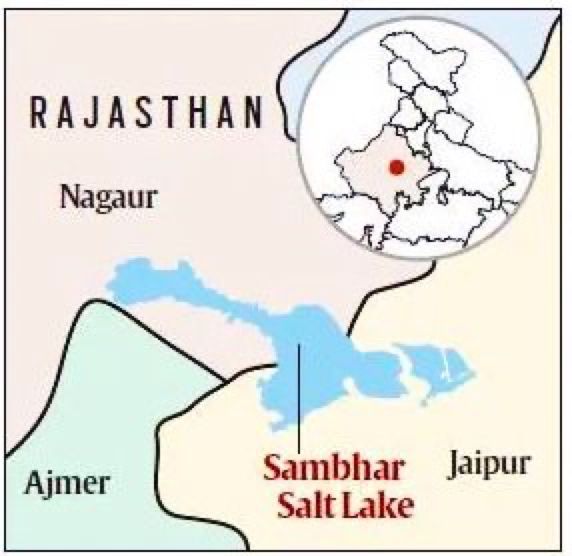
Research reveals that the rapid expansion of industrial and illegal salt pans is severely damaging the hydrology and biodiversity of Sambhar Lake — India's largest inland saline wetland. Satellite analyses (1984–2023) show a drastic decline in wetland area, worsened by industrial brine extraction running year-round.
- Location: ~80 km southwest of Jaipur, Rajasthan; spans Jaipur, Nagaur, and Ajmer districts; within the Aravalli Range.
- Type: India's largest inland saline (saltwater) lake; size fluctuates between 190–230 sq km depending on monsoon.
- Fed by: Six monsoon-dependent rivers — Mentha (Mantha), Rupangarh, Khari, Khandela, Medtha, and Samod.
- Salt production: ~1,96,000 tonnes/year of clean salt — approximately 9% of India's total salt production.
- Ramsar Site: Designated in 1990 as a wetland of international importance.
- Key Biodiversity Area (KBA): Recognised in 2004.
- Avian significance: Vital wintering habitat for Northern Asian migratory birds; India's second-largest flamingo breeding ground.
- Ecological niche: Hypersaline ecosystem supporting halophilic microbes, spirulina, desert foxes, and saw-scaled vipers.
| Aspect | Traditional | Industrial |
|---|---|---|
| Water source | Natural monsoon floodwater | Deep borewells pumping sub-soil brine year-round |
| Season | Seasonal (dry season crystallisation) | Continuous extraction throughout the year |
| Environmental impact | Minimal — works with natural hydrology | Severe; permanently alters hydrology and aquifer levels |
- Illegal units have consumed approximately 30% of the lake's original surface area.
- Wetland area plummeted from 30.7% to just 3.4% of the lake zone.
- Water catchment area fell from 53,000 sq km (1969) to 7,560 sq km (2004).
- A 2019 avian botulism outbreak (caused by Clostridium botulinum toxin in low-oxygen, high-temperature industrial conditions) killed over 20,000 birds.
- High-voltage industrial wires regularly electrocute migratory birds.
- Irreversible collapse risk: Over two-thirds of wetland area lost — without intervention, damage may be permanent.
- Regulatory failure: Overlapping jurisdiction among state forest department, district administration, and Rajasthan Salt Department enables continued illegal expansion.
- Climate vulnerability: Reduced catchment area makes the lake increasingly vulnerable to drought and erratic rainfall.
- RAMSAR obligations: India has international obligations under the Ramsar Convention (1971) to protect designated wetlands — chronic degradation violates this commitment.
- Demarcate and fence the core wetland area; phase out illegal borewells; mandate seasonal extraction with environmental clearances.
- Ecological restoration: Remove illegal embankments and revive natural river channels.
- Unified governance: Create a dedicated Sambhar Lake Authority with clear, non-overlapping jurisdiction.
- Alternative livelihoods: Develop eco-tourism and flamingo-watching circuits for affected communities.
- Sambhar Lake: India's largest inland saline lake; Rajasthan (Jaipur–Nagaur–Ajmer); Ramsar Site since 1990; contributes ~9% of India's total salt production.
- Ramsar Convention (1971): International wetland treaty; named after Ramsar, Iran; India has 89 Ramsar sites (as of 2024). A Ramsar designation is international recognition only — it does NOT automatically confer legal protection under Indian domestic law.
- Key Biodiversity Area (KBA): Sites identified by BirdLife International and IUCN as critical for biodiversity conservation.
- Halophiles: Organisms that thrive in high-salt environments; Sambhar's hypersaline conditions support unique halophilic microbes and spirulina.
- Spirulina: Blue-green algae (cyanobacterium) found in saline/alkaline lakes; commercially harvested as a protein supplement.
- Avian Botulism: Caused by Clostridium botulinum toxin; proliferates in warm, anaerobic (low-oxygen) water — industrial disruption of Sambhar's water chemistry directly triggers this.
- Six feeder rivers: Mentha, Rupangarh, Khari, Khandela, Medtha, Samod — all monsoon-dependent surface water inflows. Industrial salt pans draw on deep groundwater via borewells — a key distinction.
"Sambhar Lake's degradation is as much a governance failure as it is an ecological one. Examine the threats to India's largest inland saline lake and the institutional reforms needed to reconcile salt production with wetland conservation."
Consider the following pairs — Lake : State.
1. Sambhar — Rajasthan
2. Loktak — Manipur
3. Chilika — Andhra Pradesh
4. Kolleru — Andhra Pradesh
Which of the pairs above are correctly matched?
India's 7th Regional Meteorological Centre at Jammu
GS Paper 3 — Science & Technology | Disaster Management | GS Paper 2 — Government PoliciesUnion Minister for Science & Technology and Earth Sciences Dr. Jitendra Singh inaugurated India's 7th Regional Meteorological Centre (RMC) at Jammu on June 5, 2026. He also announced that a similar centre would soon be established in Lucknow — India's proposed 8th RMC — as part of a restructuring of the India Meteorological Department (IMD)'s regional operations.
IMD previously operated through six RMCs at: Mumbai, Chennai, New Delhi, Kolkata, Nagpur, and Guwahati. RMC Delhi covered an unwieldy area including J&K, Ladakh, HP, Uttarakhand, Punjab, Haryana, UP, and Rajasthan simultaneously.
| Centre | Coverage Area |
|---|---|
| RMC Jammu (New — 7th) | Jammu & Kashmir, Ladakh, Himachal Pradesh |
| RMC Lucknow (Proposed — 8th) | Uttar Pradesh and Uttarakhand |
- District-level forecasts, mountain weather forecasts, tourist and city-specific advisories.
- Early warnings for: flash floods, cloudbursts, avalanches, heavy snowfall, thunderstorms, and landslides.
- Pilgrimage safety advisories for Amarnath and Vaishno Devi yatra.
- Support for farmers, transport operators, hydropower projects, security forces, and disaster management agencies.
| Infrastructure | 2014 | 2026 |
|---|---|---|
| Doppler Weather Radars (DWRs) | 0 | 4 operational (Jammu, Srinagar, Leh, Banihal Top); 5 more proposed under Mission Mausam |
| Automatic Weather Stations (AWSs) | 13 | 25 (recently added at Kargil, Ramban, Vaishno Devi) |
| Automatic Rain Gauges (ARGs) | 14 | 16 |
| Daily Rainfall Monitoring Stations | 30 | 85 |
The Srinagar Meteorological Observatory (over 100 years old) has been recognised by the World Meteorological Organization (WMO) as a Centennial Observing Station. Seismic stations in J&K upgraded to digital systems; new observatory proposed at Kishtwar. Five seismic stations transmit near real-time data to the National Centre for Seismology (NCS).
- Spatial variability challenge: High-altitude Himalayan terrain shows extreme weather variation over short distances — dense radar networks cannot fully resolve this.
- Last-mile communication gap: Lead time for flash floods/cloudbursts is extremely short; community-level early warning dissemination remains a bottleneck.
- Inter-agency silos: Weather (IMD), seismology (NCS), and disaster management (NDMA) data managed separately — better integration needed for compound events.
- Complete the five proposed DWRs under Mission Mausam for Anantnag, Rajouri, Baramulla, Kishtwar, and Doda.
- Integrate IMD forecasts with NDMA's Common Alert Protocol for automated last-mile warnings.
- Extend AWS network to all Himalayan pilgrimage and border routes.
- IMD (India Meteorological Department): Under Ministry of Earth Sciences (MoES); primary national weather forecasting agency.
- India now has 7 RMCs: Mumbai, Chennai, New Delhi, Kolkata, Nagpur, Guwahati, Jammu (newest, 2026).
- Doppler Weather Radar (DWR): Measures both precipitation intensity AND wind velocity using the Doppler effect — provides 3D wind field data; far more capable than conventional rain-only radars; critical for detecting thunderstorms, cyclones, and cloudbursts.
- Automatic Weather Station (AWS): Unmanned sensor-based station; automatically collects temperature, humidity, wind speed, pressure, and rainfall in near-real time.
- Mission Mausam: Government programme to modernise and expand India's weather observation and forecasting infrastructure — includes expanding DWR and AWS networks nationwide.
- WMO (World Meteorological Organization): UN specialised agency for meteorology; headquartered in Geneva.
- Centennial Observing Station (WMO): Stations with over 100 years of continuous, high-quality records — globally important for long-term climate baseline data; Srinagar Observatory holds this designation.
- NCS (National Centre for Seismology): Under Ministry of Earth Sciences; monitors earthquakes across India; J&K falls in India's Seismic Zone V — highest-risk zone.
"Dedicated regional meteorological infrastructure is as critical as disaster response capacity for a climate-vulnerable Himalayan region like Jammu & Kashmir. Evaluate the significance of RMC Jammu and the broader challenges in Himalayan weather forecasting."
Which of the following correctly describes a Doppler Weather Radar (DWR)?
Correct Answer: (c)NFHS-6: What Was Lost and What Was Gained
GS Paper 2 — Health | Government Policies & Interventions | Social Issues | Governance & AccountabilityThe Ministry of Health and Family Welfare (MoHFW) released the fact sheets of NFHS-6 on May 29, 2026, covering data from 2023–24 from approximately 6.8 lakh households across all States and UTs except Manipur. The survey sparked significant controversy over the net reduction of 30 indicators — including removal of anaemia, child mortality, sex ratio at birth, sanitation, and clean cooking fuel data.
- Commissioned by: Ministry of Health and Family Welfare (MoHFW). Conducted by: International Institute for Population Sciences (IIPS), Mumbai.
- Frequency: Every ~5 years; conducted since 1992–93 (NFHS-1). Used by UNICEF, UNFPA, USAID, and multilateral agencies for policy planning.
| Round | Year | Key Features | Indicators |
|---|---|---|---|
| NFHS-4 | 2015–16 | Introduced district-level estimates; tablet-based digital interviewing | 114 |
| NFHS-5 | 2019–21 | Added disability, abortion, menstrual hygiene; extended BP/blood sugar tests to all adults 15+ | 131 |
| NFHS-6 | 2023–24 | Added DBTs, digital literacy, Hepatitis-B/C testing; restored HIV biological testing | 101 (43 dropped, 13 added) |
- Mothers receiving at least 4 antenatal check-ups: up ~7 percentage points.
- Spousal violence: Declined from 29.3% (NFHS-5) to 22.3%.
- Stunting in children under 5: Fell by over 6 percentage points.
- Health insurance coverage: Largest rise in West Bengal (33.7% → 88.2%); women's Internet use largest jump in Andhra Pradesh (21% → 63.6%).
- Exclusive breastfeeding (infants under 6 months): Down ~8 percentage points; steepest fall in Haryana (69.5% → 41.2%).
- Modern contraceptive use: Down from 56.4% to 52.7%. Overweight/obesity among women increased in every state.
| Indicator | Last Value (NFHS-5) | Programme Linked To |
|---|---|---|
| Anaemia prevalence | Children: 67.1%; Women 15–49: 57% | Anaemia Mukt Bharat (2018) |
| Infant Mortality Rate | District-level, socio-economic data available | NHM child survival |
| Sex ratio at birth | 929 females/1,000 males | Beti Bachao Beti Padhao |
| Sanitation coverage | 70% households | Swachh Bharat Mission |
| Clean cooking fuel use | 58.6% households | PM Ujjwala Yojana |
| Cancer screening | Introduced only in NFHS-5 | National Cancer Control |
- Official position: The capillary (finger-prick) method used earlier overstated anaemia prevalence; anaemia will now be tracked via the Diet and Biomarkers Survey in India (launched December 2022 at ICMR-National Institute of Nutrition, Hyderabad) using venous blood sampling.
- Critical view: NFHS-5 showed worsening anaemia across 28 States/UTs despite the Anaemia Mukt Bharat campaign (2018); IIPS director Prof. K.S. James was reportedly suspended in July 2023 after refusing to revise unflattering data, and resigned in August 2023. The Lancet (April 2024 cover) asked: "Why is the Government so afraid of showing the real state of health?"
- Data accountability gap: No single survey now provides district-level, socio-economically disaggregated data on IMR, U5MR, anaemia, or sanitation — SRS provides national/state mortality data but lacks this granularity.
- Programme accountability void: Key flagship scheme outcome indicators (Ujjwala, Swachh Bharat, Anaemia Mukt Bharat) are absent from India's most credible health survey.
- Statistical independence: The IIPS director controversy raises serious questions about institutional independence of India's health data architecture.
- SDG reporting gap: India's SDG reporting to the UN on child health, nutrition, and sanitation is weakened by these omissions.
- Restore dropped indicators in the full NFHS-6 national report (not just the preliminary fact sheet).
- Strengthen IIPS autonomy — insulate the institute from political pressure on data methodology and publication.
- Accelerate release of Diet and Biomarkers Survey results to avoid any anaemia tracking continuity gap.
- Parliamentary Standing Committee on Health should examine the rationale for indicator removal.
- NFHS: National Family Health Survey; commissioned by MoHFW; conducted by IIPS (International Institute for Population Sciences), Mumbai.
- NFHS-6 (2023–24): 101 indicators — down from 131 in NFHS-5; 43 dropped, 13 added; covers 6.8 lakh households.
- Anaemia Mukt Bharat (AMB): Launched 2018 under the National Health Mission (NHM); targets 3 percentage point annual reduction in anaemia — its outcome data is now absent from NFHS-6.
- Diet and Biomarkers Survey: Launched December 2022 at ICMR-NIN (National Institute of Nutrition), Hyderabad; uses venous blood sampling (more accurate than finger-prick) for anaemia measurement.
- SRS (Sample Registration System): Managed by Office of the Registrar General of India (ORGI); provides national and state-level birth/death rates, IMR, MMR — but does NOT provide district-level or socio-economically disaggregated data.
- SDGs: 17 Sustainable Development Goals (UN, 2015); NFHS directly tracked SDG 2 (anaemia), SDG 3 (child mortality), SDG 6 (sanitation) — all partially compromised by NFHS-6 omissions.
"The credibility of a nation's health data is as important as the quality of its health infrastructure. Critically examine the controversy surrounding the removal of key indicators from NFHS-6 and its implications for India's public health accountability and governance."
Which of the following statements about the National Family Health Survey (NFHS) is/are correct?
1. NFHS is conducted by IIPS under the Ministry of Health and Family Welfare.
2. NFHS-6 (2023–24) tracks more health indicators than NFHS-5 (2019–21).
3. The Sample Registration System (SRS) can substitute NFHS for district-level, socio-economically disaggregated child mortality data.
SIPRI Yearbook 2026 — India's Nuclear Arsenal and Military Expenditure
GS Paper 2 — International Relations | Security Issues | India & Its Neighbourhood | Nuclear DoctrineThe Stockholm International Peace Research Institute (SIPRI) Yearbook 2026, released on June 8, 2026, estimated India's nuclear arsenal has grown to approximately 190 warheads by early 2026 (up from ~180 in 2025). The report described Operation Sindoor (May 2025) as an "unusually severe military crisis" and noted the first-ever integration of cyber operations into an active India-Pakistan military conflict.
- Estimated warheads (early 2026): ~190 (up from ~180 in 2025).
- Modernisation increasingly focused on long-range weapons capable of reaching targets throughout China, while also addressing Pakistan-specific deterrence.
- India and Israel primarily produce plutonium (not highly enriched uranium) for their nuclear weapons programmes.
| Metric | Figure (Start of 2026) |
|---|---|
| Total global nuclear warheads | ~12,187 |
| In military stockpiles (potentially usable) | ~9,745 |
| Deployed (on missiles/aircraft, ready for use) | ~4,012 |
| Nine nuclear-armed states | US, Russia, UK, France, China, India, Pakistan, North Korea, Israel |
SIPRI's key finding: All nine nuclear-armed states are "increasingly relying on nuclear weapons as instruments of national power" — reversing decades of disarmament efforts.
- Described as an "unusually severe military crisis" between India and Pakistan.
- India struck Pakistani air and missile bases likely to have nuclear-related roles.
- Both countries took measures to prevent further escalation despite heightened tensions.
- First-ever integration of cyber operations into active India-Pakistan military conflict — a new and dangerous escalation dimension.
- 2025 military expenditure: $92.1 billion — increase of 8.9%; India ranked 5th globally (behind US, China, Russia, Germany).
- India was the world's second-largest importer of major arms during 2021–25, accounting for 8.2% of global arms imports.
- Five largest importers (2021–25): Ukraine, India, Saudi Arabia, Qatar, Pakistan — collectively ~35% of global imports.
- No-First-Use (NFU): India will not be the first to use nuclear weapons.
- Massive retaliation: Any nuclear attack — including a tactical one — will be met with a massive nuclear counter-strike (NOT proportional/limited response).
- Credible minimum deterrence: India does not seek numerical parity; maintains only what is sufficient to deter.
- Civilian command: Nuclear Command Authority (NCA) — Political Council chaired by the Prime Minister; Executive Council chaired by the National Security Advisor (NSA).
- Escalation risk: Operation Sindoor showed conventional conflict near nuclear thresholds is increasingly feasible — India-Pakistan crisis management mechanisms remain critically weak.
- Cyber-nuclear nexus: First documented cyber integration into a nuclear-risk conflict — no clear international norms govern this escalation pathway.
- Two-front deterrence gap: India's shift toward China-focused longer-range systems reflects recognition that Pakistan-centric deterrence alone is insufficient.
- Import dependence: India remains the world's second-largest arms importer despite Atmanirbhar Bharat in defence.
- Revive the 1988 Agreement on Non-Attack on Nuclear Installations and restore India-Pakistan direct hotline communications.
- Push for bilateral/multilateral norms on non-use of cyberattacks against nuclear command-and-control infrastructure.
- Accelerate Atmanirbhar Bharat in defence to reduce strategic import dependence.
- SIPRI: Stockholm International Peace Research Institute; Swedish independent research institute; publishes the SIPRI Yearbook annually on armaments, disarmament, and international security.
- India's warheads (2026): ~190; up from ~180 in 2025.
- 9 nuclear-armed states: US, Russia, UK, France, China, India, Pakistan, North Korea, Israel. India, Pakistan, and Israel are the three states outside the NPT (Non-Proliferation Treaty).
- Global stockpile (2026): ~12,187 total; ~9,745 in military stockpiles; ~4,012 deployed on missiles/aircraft.
- India's Nuclear Doctrine: No-First-Use (NFU) + Credible Minimum Deterrence + Massive Retaliation — even a tactical nuclear attack triggers a massive response; India does NOT subscribe to proportional or limited nuclear response.
- NCA: Political Council chaired by PM; Executive Council chaired by NSA.
- India's military expenditure (2025): $92.1 billion — 5th largest globally (US, China, Russia, Germany, India).
- India — 2nd largest arms importer (2021–25): 8.2% of global imports; Ukraine was the largest.
- 1988 Agreement on Non-Attack on Nuclear Installations: India-Pakistan CBM; both exchange lists of nuclear sites annually on January 1.
- Operation Sindoor (May 2025): India's military response to Pahalgam terror attack; SIPRI calls it "unusually severe military crisis."
"SIPRI Yearbook 2026's findings on India's nuclear modernisation and Operation Sindoor reflect a South Asian security environment increasingly prone to escalation. Critically examine India's nuclear doctrine in the context of its evolving two-front deterrence challenge."
Which of the following statements about India's nuclear doctrine is NOT correct?
Correct Answer: (c)IMI-Resistant Mustard Hybrids — Solving Orobanche, Creating New Risks
GS Paper 3 — Agriculture | Food Security | Science & Technology | BiotechnologyFrom the Rabi 2026–27 season, Indian farmers are set to begin wide-scale cultivation of imidazolinone (IMI)-resistant mustard hybrids, commercially introduced through the Clearfield® Production System by BASF India in partnership with Corteva Agriscience India (launched February 2026, Jaipur). These non-GMO hybrids address the Orobanche parasitic weed problem. However, geneticist Prof. Deepak Pental (University of Delhi) has cautioned in Current Science against over-reliance on a single herbicide mode of action.
- Scientific names: Orobanche aegyptiaca (also reclassified as Phelipanche).
- Type: Obligate root holoparasite — attaches to mustard roots underground via haustoria; siphons water, nutrients, and carbon from the host plant.
- Why manual weeding fails: The parasite is underground and most damaging before it becomes visible above ground.
- Severity: Yields in affected Haryana fields fell from 9–12 quintals/acre to ~6 quintals/acre; up to 50% yield loss in severe cases.
- Seed persistence: Each plant produces thousands of seeds viable in soil for up to 20 years.
- Affected regions: Primarily Rajasthan, Haryana, Madhya Pradesh.
India imported ~16 million tonnes of edible oils in 2024–25 at approximately ₹1.6 lakh crore — the second-largest import bill after crude oil. Mustard is India's most vital domestically produced oilseed; Orobanche suppression directly contributes to this import vulnerability.
- Developed through mutation breeding — selecting naturally occurring beneficial genetic mutations — not transgenic/GM technology.
- Key enzyme: ALS (acetolactate synthase) — essential for plant amino acid synthesis and growth.
- Normal mustard is killed by IMI herbicides because IMI inhibits ALS. In the new hybrids, a single DNA mutation renders the ALS enzyme resistant — allowing IMI to be sprayed over the entire field, killing Orobanche while the crop is unharmed. The herbicide moves through the soil and plant into the parasite.
- Hybrid: Pioneer-45S42CL (Corteva); herbicide: Kifix® (BASF — imazapyr + imazapic); single spray after 25 days of sowing.
- Year-after-year IMI use creates strong directional selection pressure — gradually favouring Orobanche plants with natural resistance mutations.
- This leads to: (1) emergence of resistant weed populations; (2) erosion of herbicide efficacy; (3) strategic failure of the entire production system.
- "A single herbicide mode of action cannot be the foundation of a sustainable weed management strategy in any agriculture." — Prof. Pental.
- Crop rotation with non-host crops to starve Orobanche seeds in soil.
- Herbicide rotation — alternate IMI with other modes of action to prevent resistance buildup.
- Manual weeding as backup to remove herbicide-tolerant survivors.
- GM mustard options: Glyphosate-resistant GM mustard lines developed by researchers — offering multiple chemical options; pending regulatory approval.
- Orobanche (Broomrape): Obligate root parasite (Orobanche aegyptiaca / Phelipanche); attaches to mustard roots via haustoria; seeds viable in soil for up to 20 years; cannot be reached by manual weeding.
- Haustoria: Specialised root-like structures used by parasitic plants to penetrate host roots and extract water and nutrients — the key mechanism of Orobanche damage.
- IMI Herbicides (Imidazolinones): Inhibit the ALS (acetolactate synthase) enzyme; normally lethal to mustard; IMI-resistant hybrids have a mutated ALS unaffected by the herbicide.
- ALS (Acetolactate Synthase): Enzyme essential for plant amino acid synthesis and growth; target of both IMI and sulfonylurea herbicides.
- Mutation Breeding vs GM: Mutation breeding selects natural genetic mutations — non-transgenic, non-GMO. GM inserts foreign DNA — transgenic. IMI-resistant mustard is non-GMO.
- Clearfield® System: Non-GMO herbicide-tolerant crop system by BASF; deployed with Corteva seeds in India; uses Kifix® herbicide (imazapyr + imazapic).
- Directional Selection: Evolutionary pressure where consistent use of one herbicide selects for resistant weed individuals — leads to resistant populations over time.
- Edible oil imports (2024–25): ~16 million tonnes; ~₹1.6 lakh crore — India's second-largest import bill after crude oil.
- Prof. Deepak Pental: Senior geneticist, University of Delhi; also worked on GM mustard (DMH-11) development — his caution on IMI single-mode dependence is scientifically significant.
"IMI-resistant mustard hybrids offer a technological solution to one of India's most persistent agricultural challenges, but also introduce new evolutionary risks. Critically evaluate this technology in the context of India's edible oil security and sustainable weed management."
Which of the following best explains why IMI-resistant mustard hybrids can selectively kill Orobanche without harming the crop?
Correct Answer: (c)Quantum Randomness Amplification — A Breakthrough in Digital Security
GS Paper 3 — Science & Technology | Cybersecurity | Emerging TechnologiesResearchers at ETH Zürich published a landmark study in Nature demonstrating randomness amplification for the first time — using quantum entanglement and a Bell test to convert weakly random (biased) data into certified perfectly random numbers. This addresses the foundational weakness of modern digital security: even the best random number generators retain subtle, predictable biases.
- All modern cryptographic systems use random numbers to generate encryption keys. Even a small bias allows sophisticated attackers to dramatically reduce the guesses needed to crack a key.
- Even quantum-mechanical random number generators are not entirely immune to systematic bias from heat, noise, and hardware imperfections.
Computer scientists Miklós Santha and Umesh Vazirani proved in 1986 that classical computers cannot eliminate bias from a weakly random source — no amount of post-processing can remove predictability if the input has even a small bias. This was the theoretical barrier quantum physics needed to break.
- A Bell test proves quantum entanglement — two particles so linked that measuring one instantly determines the other, regardless of distance.
- Measuring an entangled particle creates new information that did not exist before the measurement — the universe didn't "know" the answer until the moment of measurement; outcomes are fundamentally unpredictable.
- Two particles entangled and placed 30 metres apart. Bell violation score: 2.271 — above the classical limit of 2.0; proves quantum physics governs the randomness.
- Biased bits and Bell test outcomes combined using a two-source extractor — designed so an attacker with any advantage predicting either string has zero advantage predicting the combined output.
- Scale: 5.3 billion biased bits + 2.6 billion Bell test bits → 1.3 billion trials → 45 million certified perfectly random bits. Failure probability: 1 in a trillion.
- Protocol is device-independent — quality guaranteed without trusting the hardware manufacturer.
| Feature | ETH Zürich Protocol | Commercial Quantum RNG |
|---|---|---|
| Randomness quality | Certified perfect (device-independent) | High quality but not certified |
| Output rate | ~1,400 bits/second | ~1 billion bits/second |
| Practical readiness | Research grade; not deployable yet | Deployed commercially |
Important caveat: Better randomness will NOT protect against future quantum computer attacks on current encryption. That requires post-quantum cryptography — migration to quantum-resistant algorithms like CRYSTALS-Kyber and CRYSTALS-Dilithium (standardised by NIST, USA in 2024).
- India's National Quantum Mission (NQM) — launched 2023, ₹6,003 crore over 8 years — makes quantum cryptography directly relevant to India's digital security agenda.
- Dr. Urbasi Sinha (Raman Research Institute, Bengaluru) leads India's Quantum Information and Computing lab and commented on the ETH Zürich study — underscoring Indian research linkages.
- Quantum Entanglement: Two particles correlated such that measuring one instantly determines the state of the other, regardless of distance — purely quantum; Einstein called it "spooky action at a distance."
- Bell Test: Physics experiment to prove quantum entanglement; a Bell violation score above 2 proves quantum (not classical) physics governs the system — the classical physics limit is exactly 2.
- Santha-Vazirani Limit (1986): Classical computers cannot amplify weak randomness — even small biases cannot be eliminated by classical post-processing alone. ETH Zürich demonstrated quantum physics can overcome this.
- Randomness Amplification: Converting a weakly random (biased) source into certified, perfectly random bits — now demonstrated for the first time using quantum physics.
- Device-Independent Security: Randomness quality provable from observable statistics (the Bell score) alone, without trusting the hardware — the gold standard for cryptographic security.
- Post-Quantum Cryptography: Encryption algorithms resistant to quantum computer attacks; standardised by NIST (USA) in 2024; examples: CRYSTALS-Kyber (key encapsulation), CRYSTALS-Dilithium (digital signatures). Better randomness does NOT solve the quantum computing threat.
- National Quantum Mission (India, 2023): ₹6,003 crore over 8 years; targets quantum computers (50–1,000 qubit range), QKD, quantum sensing, and quantum communication infrastructure.
- NIST Randomness Beacon: US National Institute of Standards and Technology broadcasts 512 certified random bits every 60 seconds — used for lotteries, jury selection, and voting machine audits.
"Quantum physics is emerging as the foundation for the next generation of cryptographic security. Examine the significance of the randomness amplification breakthrough and its implications for India's National Quantum Mission and digital security infrastructure."
Assertion (A): The ETH Zürich randomness amplification experiment demonstrates that perfectly random numbers can be generated from biased inputs using quantum entanglement.
Reason (R): In quantum mechanics, measuring an entangled particle creates new information that did not exist before the measurement, making the outcome fundamentally unpredictable.
Which of the following is correct?
Philippines 7.8 Magnitude Earthquake — Places in the News
GS Paper 2 — International Relations | Places in News | GS Paper 3 — Disaster Management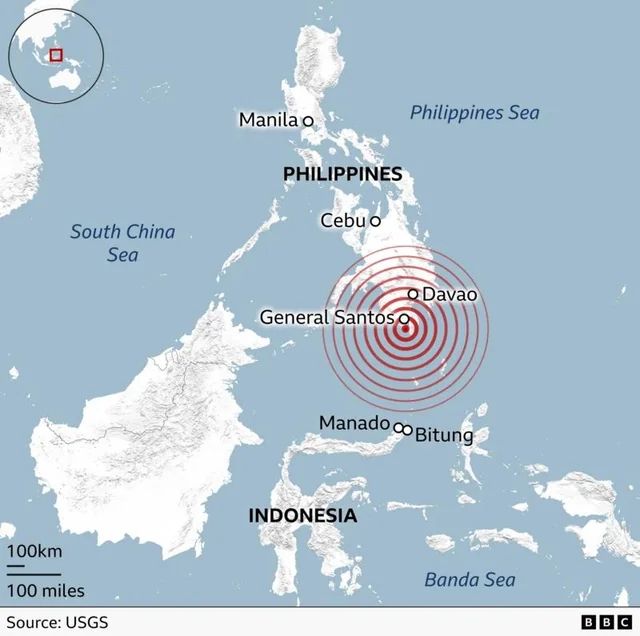
A powerful 7.8-magnitude earthquake struck approximately 20 km off the coast of Sarangani province in southern Mindanao, Philippines, on June 8, 2026, at 7:37 AM local time. The quake — the strongest to hit the Philippines in 2026 — killed at least 35 people and injured over 200. It triggered tsunami warnings across the Philippines, Indonesia, Palau, Taiwan, Papua New Guinea, and southern Japan. Waves up to 1 metre (3 feet) hit coastal areas; all warnings cancelled after six+ hours.
- Magnitude: 7.8 (initially 7.0 by PHIVOLCS; rapidly upgraded). Epicentre: ~20 km off Sarangani province; depth ~33 km.
- Most affected: General Santos City — Notre Dame of Dadiangas University and other buildings collapsed; casualties in South Cotabato and Davao Occidental.
- Landslide: Deadly landslide in Sarangani province killed 13 villagers.
- Possible seismic source: Cotabato Trench (under PHIVOLCS investigation).
- Response: President Ferdinand Marcos Jr. ordered immediate disaster response; NDRRMC and military mobilised.
| Place | Significance |
|---|---|
| Sarangani Province | Southernmost province of Mindanao; epicentre; site of deadly landslide |
| General Santos City | Major port city; ~700,000 people; regional hub for tuna export industry; most affected urban area |
| Mindanao | Second most populous Philippine island (after Luzon); southern Philippines |
| Cotabato Trench | Deep ocean trench off Mindanao; probable seismic source of the earthquake |
| Sulawesi, Indonesia | Tremors felt 420 km away in Manado; tsunami warning issued |
| Sabah, Malaysia | Malaysian state on Borneo island; tsunami warning issued and cancelled |
- The Philippines lies on the Pacific Ring of Fire — ~40,000 km arc around the Pacific Ocean; accounts for ~90% of the world's earthquakes and ~75% of its volcanoes.
- Sits at the convergence of the Philippine Plate, Eurasian Plate, and Pacific Plate.
- The country has 7,641 islands; largest island: Luzon; second largest: Mindanao.
- India's Andaman & Nicobar Islands also lie on the Ring of Fire and face similar earthquake-tsunami compound risks.
- The Indian Tsunami Early Warning Centre (ITEWC) — operated by INCOIS (Indian National Centre for Ocean Information Services) under MoES, Hyderabad — issued relevant Indian Ocean alerts.
- India-Philippines relations fall under India's Act East Policy; both are Indo-Pacific partners.
- Urban vulnerability: Significant building collapses in General Santos City raise questions about building code enforcement in seismically active zones.
- Communication blackout: Power outages cut off affected communities from disaster coordination channels immediately — a universal last-mile challenge.
- School timing: The quake struck on the first day of classes — significantly increasing civilian exposure, especially children.
- Philippines: Archipelago of ~7,641 islands; capital Manila (on Luzon); largest island: Luzon; second largest: Mindanao.
- Ring of Fire: ~40,000 km arc around the Pacific Ocean; accounts for ~90% of world's earthquakes and ~75% of world's volcanoes.
- PHIVOLCS: Philippine Institute of Volcanology and Seismology; under DOST (Department of Science and Technology), Philippines — NOT the Department of Environment and Natural Resources.
- NDRRMC: National Disaster Risk Reduction and Management Council — Philippines' apex disaster management body.
- Cotabato Trench: Deep ocean trench off southern Philippines (Mindanao); a major seismogenic zone; probable source of the June 8 earthquake.
- General Santos City: Southern Philippine port city; ~700,000 people; regional hub for the tuna export industry.
- INCOIS: Indian National Centre for Ocean Information Services, Hyderabad; under MoES; operates India's ITEWC (Indian Tsunami Early Warning Centre).
- Pacific Tsunami Warning Centre (PTWC): Based in Hawaii, USA; issues regional Pacific tsunami warnings. India's ITEWC covers the Indian Ocean.
- India's Seismic Zones: India has 5 seismic zones (I to V); Zone V = highest risk; includes Andaman & Nicobar, northeastern India, Himalayan regions, and parts of Gujarat.
"Coastal megacities in seismically active regions face compounded risks from earthquakes, tsunamis, and infrastructure failures. Using the Philippines 2026 earthquake as a case study, discuss the challenges of urban disaster preparedness in developing countries."
Which of the following statements about the Pacific Ring of Fire is NOT correct?
Correct Answer: (c)

