
13 July 2026
Contents
Weaving Sustainability: India’s Textile Sector and the Circular Economy Pathway
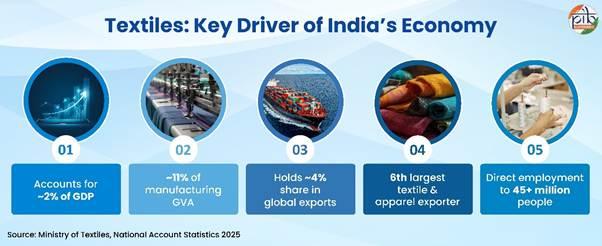
- India’s textile sector — the “spinning wheel” of industrial growth — is the world’s sixth-largest textile and apparel exporter (~4% global export share), contributing ~2% of GDP and ~11% of manufacturing GVA (National Account Statistics 2025).
- The government released a factsheet and the report “Mapping of Textile Waste Value Chain in India” (2026), showcasing how circular economy principles are being embedded across the textile value chain — from raw material input to post-consumer waste management.
- Global markets are shifting towards environmentally responsible production; the EU’s Digital Product Passport (DPP) compliance cliff (2027) adds regulatory urgency for Indian textile exporters.
- Circular Economy (CE): a regenerative model contrasted with the linear “take-make-dispose” approach. Core actions — Reuse (return without change), Upcycling (convert to higher value), Downcycling (convert to lower value, e.g., cotton rags → industrial wipes), and Recycling (break down to raw material).
- India has a centuries-old tradition of textile reuse, repair and resource-conscious production — from dhobis and darzis to Panipat (Haryana), globally known as the “Cast-off Capital”, which mechanically reprocesses second-hand textiles into blankets, yarn and shoddy fibre.
- Key legislative anchors: Environment (Protection) Act, 1986 (parent law); Environment Protection Rules, 1986 (effluent discharge standards for textile units); Stockholm Convention (ratified by India in 2006) targeting Persistent Organic Pollutants (POPs), including certain textile chemicals.
- Solid Waste Management Rules, 2026: came into force 1 April 2026 under the Environment (Protection) Act; incorporate Extended Producer Responsibility (EPR) principles and mandate gradual use of Refuse Derived Fuel (RDF) by industrial units — rising from 5% to 15% over six years.
- MSMEs account for over 80% of India’s textile and apparel production capacity (Economic Survey 2023-24) — making MSME-targeted sustainability interventions structurally critical.
- National Programme for Organic Production (NPOP): Certifies organic fibres including organic cotton; standards recognised by the European Commission and Switzerland for unprocessed plant products; covers accreditation of certification bodies and promotion of organic products.
- Jute-ICARE (Improved Cultivation and Advanced Retting Exercise, launched 2015): Promotes scientific jute cultivation through high-yielding certified seeds and retting accelerators; expanded from 130 blocks in 7 states → 289 blocks in 10 states; coverage grew from ~1.11 lakh ha → 2.15 lakh ha (2024-25).
- New Age Fibre Mission (MM-III): Mini-mission under the Mission for Cotton Productivity; promotes allied natural fibres as eco-friendly synthetic alternatives; focuses on climate-smart cultivation, mechanisation and innovation.
- National Fibre Scheme: Strengthens self-reliance across natural, man-made and new-age fibres; reduces import dependence; encourages innovation in advanced textile materials.
- Hazardous chemical restrictions: Benzidine-based dyes restricted; 70 azo dyes prohibited; Stockholm Convention (2006) restricts POPs including harmful textile chemicals from the supply chain.
- Pilot — “Eliminating Hazardous Chemicals from the Textile Fashion Supply Chain in India”: Covers 400 factories across 8 clusters and 4 fashion houses; targets reduction of 10,530 tonnes of harmful chemicals and mitigation of 1,47,000 tCO₂eq.
- PM MITRA Parks (Mega Integrated Textile Region and Apparel): 7 parks approved with an outlay of ₹4,445 crore (up to 2027-28) at Virudhunagar (TN), Warangal (Telangana), Navsari (Gujarat), Kalaburagi (Karnataka), Dhar (MP), Lucknow (UP) and Amravati (Maharashtra); built around the ‘5F’ vision — Farm → Fibre → Factory → Fashion → Foreign; sustainability integrated via CETPs, wastewater recycling and waste management; MoUs for investments >₹27,434 crore signed as of December 2025.
- RAMP Programme — MSE-GIFT: Supports green technology adoption in MSMEs; provides 2% annual interest subvention on term loans up to ₹2 crore and 75% credit guarantee coverage.
- RAMP Programme — MSE-SPICE (Scheme for Promotion and Investment in Circular Economy): Helps micro and small enterprises adopt circular and resource-efficient practices; provides 25% capital subsidy for eligible plant and machinery; promotes nationwide awareness.
- Textile Sector under the Indian Carbon Market (ICM): Greenhouse Gas Emission Intensity (GEI) targets notified under the Carbon Credit Trading Scheme (CCTS); textile units must disclose Scope-1 (direct emissions) and Scope-2 (indirect — purchased electricity, heat) emissions; outperformers earn tradeable Carbon Credit Certificates.
- Tex Eco Initiative: Promotes globally competitive and environmentally sustainable textile manufacturing; aligns India’s textile industry with international sustainability standards and green market opportunities.
- Of the ~7.8 million tonnes of textile waste managed annually, over 90% is sourced from domestic pre-consumer (factory scrap) and post-consumer waste; >70% is recovered into recycling, upcycling, downcycling or reuse.
- Pre-consumer recovery (factory scrap): ~95% collected and reintegrated; the spinning sector demonstrates near-closed-loop circularity with almost all spinning waste reprocessed within production.
- Post-consumer recovery (discarded textiles): ~55% diverted from landfills through collection and sorting networks — a significant but improvable rate reflecting weak household-level collection infrastructure.
- The waste ecosystem supports 40–45 lakh livelihoods, with women from marginalised communities playing a major role in collection, sorting and redistribution.
- National Technical Textiles Mission (NTTM): R&D projects sanctioned to convert textile waste, biomass and bio-residues into carbon fibres and functional textiles.
- Report “Mapping of Textile Waste Value Chain in India” (2026): Data-driven blueprint for turning textile waste into an economic resource; highlights Panipat as the leading mechanical recycling hub; notes emerging chemical recycling technologies for fibre recovery at molecular level.
- India’s first Municipal Textile Recovery Facility in Belapur, Navi Mumbai: integrates collection, sorting, upcycling and livelihoods; collected 30 MT of post-consumer textile waste; reached 1.14 lakh families.
- Eco-Mark Scheme, 2024: Textiles identified as an eligible category; 13 Indian Standard titles notified; Eco-Mark granted to products meeting criteria on resource use, climate impact, biodiversity, energy use, waste and hazardous substances.
- Kasturi Cotton and Silk Mark: Traceability and quality branding initiatives for premium Indian cotton and silk — build global identity and support responsible sourcing and supply chain transparency.
- MoU (2024) between Textiles Committee, GeM (Government e-Marketplace) and SCOPE (Standing Conference of Public Enterprises): institutionalises public procurement of upcycled textile products, creating demand-side pull for circularity.
- SURE (Sustainable Resolution): Led by CMAI, Reliance Brands Limited (RBL), UN India and the Ministry of Textiles — one of India’s largest voluntary sustainability commitments; drives industry transition towards cleaner, more responsible fashion.
- Circle Back Campaign: Raises awareness among students about textile recycling; exhibitions such as Vastra Katha at Bharat Tex 2024 and 2025 showcased sustainable textile practices.
- ESG Task Force: Constituted to guide sustainable production, certification and exports; enables platforms like Circular Samvaad and the Cluster Exchange Mechanism.
- Bharat Tex (India’s flagship global textile event — editions 2024, 2025, 2026): showcases circular textiles, technical textiles, MSME innovations and policy dialogue on a single integrated platform.
- Recovery of >70% of textile waste nationally — with the pre-consumer loop at ~95% — is a strong baseline, largely driven by industry-embedded networks rather than mandates alone.
- A multi-layered policy architecture: PM MITRA (production infrastructure), RAMP (MSME green finance), ICM (carbon market discipline) and Eco-Mark (demand-side standards) operate across the value chain simultaneously.
- GeM-linked upcycled product procurement creates institutional demand-side pull — a rare and effective market-creation mechanism for circular outputs.
- The Belapur Municipal Textile Recovery Facility offers a replicable model combining collection, upcycling, technology and livelihoods in a single circular ecosystem.
- India lacks a dedicated legislative framework for textile circularity; unlike the EU or China, there are no strict textile recycling mandates; EPR for textiles remains unformulated — the SWM Rules 2026 are a step but are not sector-specific.
- Post-consumer recovery remains at ~55% vs ~95% pre-consumer, revealing the weakness of household-level collection infrastructure — a structural gap that policy has yet to close.
- Chemical (molecular-level) recycling — critical for true textile-to-textile circularity — is nascent and capital-intensive; Panipat dominates mechanical recycling but cluster-level facilities are needed at other textile hubs (Surat, Tiruppur, Ludhiana).
- The 2027 EU Digital Product Passport (DPP) compliance cliff poses traceability and data-infrastructure challenges across India’s fragmented MSME textile clusters.
- Over 90% of textile waste workers are informal, with limited social protection or formalisation — circular economy growth must address this structural inequality to be truly inclusive.
- Enact a dedicated Textile EPR framework under the Environment (Protection) Act, mandating producers to manage end-of-life garments — similar to the existing plastic EPR rules.
- Scale chemical recycling infrastructure through NTTM R&D support and public-private partnerships; mechanical recycling alone cannot achieve true textile-to-textile fibre circularity.
- Expand Municipal Textile Recovery Facilities beyond Navi Mumbai to major textile clusters (Surat, Tiruppur, Ludhiana) to bridge the post-consumer recovery gap.
- Formalise waste worker livelihoods — link sorters and collectors to social security, MSME registration and skill certification under the SURE framework.
- Accelerate DPP readiness for export clusters: incentivise digital traceability adoption before the 2027 EU compliance deadline.
Q1. Consider the following statements regarding India’s textile circular economy: (1) India’s pre-consumer textile waste recovery rate is nearly 95%. (2) MSE-SPICE provides 2% interest subvention on term loans for circular economy machinery. (3) The Solid Waste Management Rules, 2026 incorporate Extended Producer Responsibility principles. Which of the above are correct?
A) 1 and 2 only B) 1 and 3 only C) 2 and 3 only D) 1, 2 and 3Q2. The ‘5F’ vision associated with PM MITRA Parks refers to:
A) Farm → Fabric → Factory → Fashion → Foreign B) Farm → Fibre → Factory → Fashion → Foreign C) Fibre → Fabric → Finishing → Fashion → Foreign D) Farm → Fibre → Fabric → Fashion → FinanceQ3. (Assertion–Reasoning) Assertion (A): India’s post-consumer textile waste recovery rate (~55%) is significantly lower than its pre-consumer rate (~95%). Reason (R): Household collection infrastructure for discarded garments is weak, unlike established factory-level scrap networks.
A) Both A and R are true, and R is the correct explanation of A B) Both A and R are true, but R is NOT the correct explanation of A C) A is true, R is false D) A is false, R is trueIndia’s Clean Sweep at IPhO 2026: All Five Win Gold, Joint World No. 1
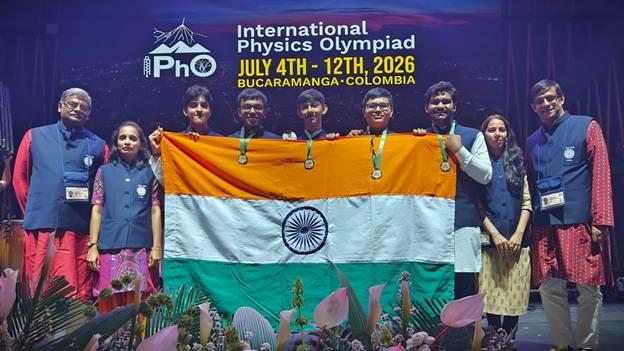
- All five members of India’s team won Gold Medals at the 56th International Physics Olympiad (IPhO) 2026 in Bucaramanga, Colombia, securing a joint World No. 1 rank alongside China, Kazakhstan, Russia, South Korea and Taiwan, among 381 students from 87 countries.
- The achievement is attributed to the National Olympiad Programme run by HBCSE-TIFR under the Department of Atomic Energy (DAE) — a multi-stage talent identification and mentoring system sustained over decades.
- India’s gold medalists: Kanishk Jain (Pune, Maharashtra), Riddhesh Anant Bendale (Indore, MP), Rishit Garg (Dwarka, New Delhi), Shresth Suraiya (Mumbai, Maharashtra), Svarit Joshi (Ahmedabad, Gujarat).
- International Physics Olympiad (IPhO): Annual international competition for pre-university (school-level) students; participants tested on theoretical and experimental physics far beyond standard curricula. First held in Warsaw, Poland, in 1967 with 3 countries; now spans 87+ countries. Each country can send up to 5 students.
- HBCSE (Homi Bhabha Centre for Science Education): A National Centre of TIFR (Tata Institute of Fundamental Research); functions as an aided institution under DAE; is India’s nodal agency for all international Science and Mathematics Olympiads (Physics, Chemistry, Biology, Astronomy, Mathematics).
- National Olympiad Programme — 5-stage selection process:
- NSE (National Standard Examination) — Stage 1, conducted by IAPT (Indian Association of Physics Teachers).
- INPhO (Indian National Physics Olympiad) — HBCSE.
- OCSC (Orientation-cum-Selection Camp) — intensive residential camp; final 5 selected.
- Pre-departure training — advanced theory + lab experiments.
- International Olympiad participation.
- Department of Atomic Energy (DAE): Oversees India’s nuclear and atomic energy programmes including BARC, TIFR, NPCIL and AERB; provides long-term institutional funding for HBCSE’s Olympiad programme as a science capacity investment.
- Constitutional anchor — Article 51A(h): Fundamental Duty — “to develop the scientific temper, humanism and the spirit of inquiry and reform” — the constitutional foundation for STEM Olympiad culture.
- India at IPhO 2025 (Paris): Won 3 Gold + 2 Silver medals — strong but not a clean sweep; the 2026 5/5 Gold is India’s finest IPhO performance to date.
- Team leadership and mentoring: Led by Prof. Anwesh Mazumdar (HBCSE-TIFR) and Dr. Leena Joshi (St. Xavier’s College, Mumbai); scientific observers Prof. Ananda Dasgupta (IISER Kolkata) and Ms. Nisha Kelkar (Gogate-Joglekar College, Ratnagiri).
- HBCSE training methodology: Residential orientation camps; advanced problem-solving; laboratory experiments beyond standard curriculum; mentoring by TIFR and IISER faculty — connecting school-level talent to frontier research culture.
- Geographic diversity of winners (Pune, Indore, Delhi, Mumbai, Ahmedabad) suggests the Olympiad talent pool is not purely metro-centric, signalling breadth in India’s STEM ecosystem.
- India’s joint No. 1 alongside China, Russia and Kazakhstan — countries with highly structured, state-sponsored STEM pipelines — underlines India’s competitiveness despite relatively lower per-student state investment in school science.
- Complementary national programmes: NEP 2020 emphasises critical thinking and scientific temper; Atal Tinkering Labs (ATL) under the Atal Innovation Mission (NITI Aayog) promote STEM culture in schools; PM SHRI Schools under NEP serve as preparatory ecosystems.
- Institutional continuity: HBCSE’s decades-long patient investment — identifying, training and mentoring over years, not months — is the structural differentiator over commercially driven coaching models.
- DAE’s sustained funding model demonstrates that long-term, non-commercial science investment yields compounding dividends in national scientific prestige and the talent pipeline.
- Multi-state winner geography suggests that India’s talent pool is widening beyond the top-tier metros, reflecting the expanded reach of the NSE (Stage 1) feeder programme.
- IPhO success represents a very narrow talent peak — the system excels at identifying the top 0.001%, but broad school-level science quality in rural and semi-urban India remains weak.
- The 5-stage process is largely English-medium and urban-accessible in practice; language and geographic barriers exclude many talented students from vernacular-medium and semi-urban schools.
- No guaranteed pathway from Olympiad excellence to India-based research careers; many IPhO medalists pursue higher education abroad — a brain drain concern for the national innovation ecosystem.
- China and South Korea maintain state-level structured STEM pipelines with dedicated curriculum tracks; India’s system relies more on individual initiative and the HBCSE programme, without equivalent national school-level integration.
- Scale the Olympiad feeder programme to regional language mediums; partner with State Boards and Navodaya Vidyalayas to widen the talent funnel beyond English-medium urban students.
- Create a national alumni network of IPhO / IMO / IChO medalists to mentor the next generation; formalise the mentorship chain through HBCSE.
- Strengthen STEM infrastructure in Tier-2 and Tier-3 cities via Atal Tinkering Labs and PM SHRI Schools as preparatory ecosystems for Olympiad culture.
- Link Olympiad excellence to Indian research fellowships (INSPIRE, JRF, BS-MS programmes at IISERs) to reduce post-IPhO brain drain.
- Institutionalise the Olympiad programme in NEP 2020 implementation frameworks — recognise Olympiad participation in school assessment and college admission.
Q1. Consider the following statements regarding the International Physics Olympiad (IPhO) 2026: (1) It was held in Bogotá, Colombia. (2) India secured the joint World No. 1 rank alongside five other countries. (3) HBCSE-TIFR functions under the Department of Science and Technology (DST). Which of the above are correct?
A) 1 and 2 only B) 2 only C) 1 and 3 only D) 1, 2 and 3Q2. (Match the Following) Match List I (Olympiad stage) with List II (Conducting body): A. NSE (Stage 1) · B. OCSC (Orientation-cum-Selection Camp) · C. INPhO // 1. HBCSE-TIFR (residential camp) · 2. IAPT · 3. HBCSE-TIFR. Choose the correct match:
A) A-2, B-1, C-3 B) A-1, B-2, C-3 C) A-2, B-3, C-1 D) A-3, B-1, C-2Q3. Which Fundamental Duty under the Indian Constitution is most directly linked to promoting a culture of science Olympiads and STEM education?
A) Article 51A(e) — Promote harmony and the spirit of common brotherhood B) Article 51A(h) — Develop the scientific temper, humanism and the spirit of inquiry and reform C) Article 51A(j) — Strive towards excellence in all spheres of individual and collective activity D) Article 51A(b) — Cherish and follow the noble ideals of the freedom struggle

