
Contents
Strengthening Rural Credit for Inclusive Growth in India
- India’s rural credit ecosystem has undergone a structural transformation — from informal moneylender dependence to a multi-institutional, policy-driven formal credit architecture spanning SCBs, RRBs, Cooperative Banks, SFBs and NABARD.
- NABARD’s 45th Foundation Day (12 July 2026) and the NABARD Rural Economic Conditions & Sentiments Survey (RECSS) highlight continued rural momentum: 77.2% of rural households reported higher consumption; 51% rely exclusively on formal credit.
- The GLC target for FY 2025–26 was ₹32.50 lakh crore, with ₹5 lakh crore dedicated to Animal Husbandry, Dairying and Fisheries — a fourfold increase from ₹8 lakh crore in FY 2014–15.
- Pre-Independence & early post-Independence: Rural credit was dominated by informal moneylenders charging usurious rates; the All-India Rural Credit Survey (1954) documented this structural failure and recommended institutional alternatives.
- 1955: National Agricultural Credit (Long-term Operations) Fund created; State Bank of India (SBI) established as successor to the Imperial Bank — first deliberate institutional rural credit push.
- 1969: Nationalisation of 14 major commercial banks under the Banking Companies (Acquisition and Transfer of Undertakings) Act — reoriented banking policy toward priority sectors, especially small farmers.
- 1976: RRB Act, 1976 established Regional Rural Banks — co-owned by Centre (50%), State (15%) and sponsor bank (35%) — specifically for rural and semi-urban credit delivery.
- 1982: NABARD (National Bank for Agriculture and Rural Development) established under the NABARD Act, 1981 — integrating financing, developmental and supervisory functions for agriculture and rural development; apex refinancing institution for rural credit.
- 1992: SHG–Bank Linkage Programme (SHG-BLP) launched by NABARD — pioneered micro-credit through group collateral, particularly targeting women excluded from formal banking.
- 1998: Kisan Credit Card (KCC) Scheme launched — revolving, flexible credit line replacing multiple loan applications; ATM-enabled; one-time documentation.
- 2014: PMJDY (Pradhan Mantri Jan Dhan Yojana) launched — universal banking access; core of the JAM (Jan Dhan–Aadhaar–Mobile) Trinity for digitally-targeted welfare delivery and DBT.
- 2015: MUDRA Scheme (PMMY) launched — collateral-free credit to non-corporate, non-farm micro/small enterprises in three tiers: Shishu (up to ₹50,000), Kishore (up to ₹5 lakh) and Tarun (up to ₹10 lakh).
- 2022 onwards: Jan Samarth Portal and e-KCC — end-to-end digital credit delivery; loan sanction within ~2 days via Common Service Centres (CSCs).
- Constitutional basis: Article 43 (living wages); 97th Constitutional Amendment Act, 2011 (Part IXB for cooperative credit societies); Directive Principles of State Policy (Part IV).
- Scheduled Commercial Banks (SCBs): ~120 operating nationwide; rural branches increased from 41,464 (2014) to 56,193 (July 2025) — a 35% expansion; deliver services via branches, Business Correspondents and digital platforms.
- Regional Rural Banks (RRBs): 28 operational across states/UTs; 22,000+ branches in 700 districts; co-ownership: Centre (50%), State (15%), Sponsor Bank (35%); focus on small/marginal farmers, artisans and agricultural labourers.
- Co-operative Banks: Multi-tier rural structure — 34 StCBs (State Co-operative Banks), 352 DCCBs (District Central Co-operative Banks) and PACS at grassroots; 1,458 Urban Cooperative Banks; rural co-operative credit was India’s first formal rural credit channel.
- Small Finance Banks (SFBs): 11 operational; introduced post Union Budget 2014–15; licensed by RBI; serve unbanked and underserved segments through low-cost, tech-driven operations.
- NABARD’s refinance role: Provides concessional refinance to rural financial institutions via STCRCF (Short-Term Cooperative Rural Credit Fund), STRRBF and LTRCF (Long-Term Rural Credit Fund) — funded from PSL shortfall flows.
- Priority Sector Lending (PSL): RBI mandate — 18% of ANBC (Adjusted Net Bank Credit) for agriculture overall; sub-target of 14% for non-corporate farmers and 10% for small & marginal farmers; banks can trade PSLCs (Priority Sector Lending Certificates) to meet shortfalls.
- Modified Interest Subvention Scheme (MISS): Subsidised KCC crop loans at 7% (effective 4% on prompt repayment with additional 3% incentive); Union Budget 2025–26 raised KCC loan limit from ₹3 lakh to ₹5 lakh; collateral-free agricultural loan limit raised to ₹2 lakh from January 2025.
- Kisan Credit Card (KCC): Total applications — ~739 lakh (commercial banks), 365+ lakh (RRBs), 1,178+ lakh (Cooperative banks) as on 8 July 2026; extended to allied sectors (dairy, fisheries, animal husbandry) in 2019; JLGs and SHGs also covered.
- PM Dhan Dhanya Krishi Yojana (PM-DDKY): Approved July 2025; targets 100 low-performing agri-districts; convergence of 36 Central schemes across 11 Ministries; top-performing districts (May 2026): Banka (Bihar), Mahoba (UP), Charaideo (Assam), Kishanganj (Bihar), Tikamgarh (MP).
- PMJDY: Over 58.63 crore accounts opened (24 June 2026); deposits exceeding ₹3 lakh crore; 55.7% women account holders; 77.8% in rural and semi-urban areas; RuPay debit cards; links KCC to RuPay platform.
- DAY-NRLM (Deendayal Antyodaya Yojana – National Rural Livelihoods Mission): Renamed from NRLM in March 2016; restructured from SGSY (Swarnajayanti Gram Swarozgar Yojana); 19.83 lakh SHGs operational; ₹13.28 lakh crore disbursed since inception; 50,548 Bank Sakhis deployed, enabling ₹12.18 lakh crore in credit linkage since 2013–14.
- PACS Modernisation: Government approved 2 lakh new multipurpose PACS; 32,836 new societies registered, 15,793 dairy/fishery cooperatives strengthened; 61,842 of 79,630 approved PACS migrated to Common ERP-based national software (March 2026).
- Jan Samarth Portal (June 2022): One-stop digital platform linking government-sponsored loan and subsidy schemes including KCC; end-to-end coverage for beneficiaries, financial institutions and government agencies.
- Jan Dhan Darshak App: Locates banking service points (branches, ATMs, Bank Mitras, CSCs); 99.92% of villages had a banking outlet within 5 km radius as of March 2025.
- Institutional deepening is measurable: 56,193 rural bank branches (2025) vs 41,464 (2014); 51% households on exclusive formal credit signals a structural shift away from informal sources.
- JAM Trinity convergence — Jan Dhan + Aadhaar + Mobile — enables targeted DBT, reducing leakages and enabling real-time benefit transfers to the rural poor.
- SHG-BLP is a globally cited model for women’s financial inclusion; ₹13.28 lakh crore disbursed through SHGs reflects genuine scale and social impact.
- Digital last-mile delivery (e-KCC, Jan Samarth Portal, Common ERP for PACS) reduces transaction costs and informational asymmetry between borrowers and institutions.
- GLC targets are disbursement metrics, not outcome metrics — they do not capture loan utilisation, repayment quality or whether credit reached marginal farmers versus agri-corporates.
- RECSS divergence: RECSS Round 10 (March 2026) showed only 32% of households reported income growth and real agricultural GVA growth moderated to 2.4% in 2025–26 — a divergence from PIB-cited consumption figures warranting scrutiny.
- Cooperative bank governance weaknesses remain a structural vulnerability — the Punjab & Maharashtra Co-operative Bank collapse (2019) exposed regulatory gaps; RBI supervisory transfer (2020) is a partial fix.
- PSL compliance via PSLCs allows banks to trade certificates rather than actually lend to the sector — potentially distorting the intent of mandated agricultural credit.
- Last-mile credit gap persists — tenant farmers, oral lessees and tribal households still face collateral and documentation barriers despite KCC expansion to JLGs and SHGs.
- Shift GLC monitoring to outcome metrics — crop loan utilisation, repayment rates and income change post-credit — rather than disbursement volumes alone.
- Strengthen cooperative bank governance through professionalised boards, regular external audits and swift RBI/NABARD supervisory intervention for stressed institutions.
- Mandate PACS digitisation completion across all 79,630 approved societies within a defined timeline; integrate with e-NAM and APMC digital platforms for market-linked credit.
- Scale the PM-DDKY convergence model from 100 low-performing districts to all aspirational districts, using NABARD’s District Credit Plans (DCPs) as an evidence base.
- Expand Bank Sakhi and BC network with performance-linked incentives to deepen last-mile reach, especially in tribal and North-East geographies.
Q1. Consider the following statements regarding Priority Sector Lending (PSL) for agriculture: (1) Banks must allocate at least 18% of ANBC to agriculture overall. (2) A sub-target of 10% of ANBC is prescribed for small and marginal farmers. (3) Priority Sector Lending Certificates (PSLCs) allow banks to buy/sell PSL compliance. Which of the statements above is/are correct?
A) 1 and 2 only B) 2 and 3 only C) 1 and 3 only D) 1, 2 and 3Q2. (Assertion–Reasoning) Assertion (A): The SHG–Bank Linkage Programme has disproportionately benefitted women in rural India. Reason (R): Women traditionally lacked credit history and collateral, making them ineligible for individual formal loans, but group collateral under SHGs bridges this gap.
A) Both A and R are true, and R is the correct explanation of A B) Both A and R are true, but R is NOT the correct explanation of A C) A is true, R is false D) A is false, R is trueQ3. Match List I (Scheme) with List II (Key Feature): A. MUDRA Scheme (PMMY) · B. Modified Interest Subvention Scheme (MISS) · C. PM-DDKY // 1. 36 schemes convergence across 100 low-performing agri-districts · 2. Subsidised crop loans at 7% (4% on prompt repayment) via KCC · 3. Collateral-free loans to non-farm micro/small enterprises. Choose the correct match:
A) A-3, B-2, C-1 B) A-2, B-3, C-1 C) A-3, B-1, C-2 D) A-1, B-2, C-3India’s First Hydrogen-Powered Train: Advancing Green Rail Mobility
- India’s first indigenous hydrogen fuel cell-powered train was inaugurated on 17 July 2026 at Jind Railway Station, Haryana, by Prime Minister Narendra Modi — flagged off as ‘Namo Green Rail’.
- Operates on the Jind–Sonipat section, Northern Railway; designed by RDSO (Research, Design & Standards Organisation) and manufactured at ICF (Integral Coach Factory), Chennai — entirely indigenously.
- Aligns with the National Green Hydrogen Mission (approved January 2023) and India’s net-zero by 2070 commitment under Panchamrit pledges at COP26, Glasgow (2021).
- Hydrogen as energy carrier: Energy density of 120 MJ/kg vs diesel’s 43 MJ/kg — nearly 3x more energy-dense; emits only water vapour when used in fuel cells; zero direct carbon emissions.
- Global context: Germany’s Coradia iLint (by Alstom, 2018) was the world’s first commercial hydrogen passenger train — operated in Lower Saxony on standard/narrow gauge. India’s train is the first on broad-gauge in the world.
- Indian Railways net-zero target: Indian Railways aims for net-zero carbon emissions by 2030 (its own target, predating the national 2070 commitment); over 68% of traction is already electrified.
- National Green Hydrogen Mission: Approved January 2023; target — 5 MMT (million metric tonnes) of Green Hydrogen per annum by 2030; total outlay ₹19,744 crore; nodal ministry — MNRE (Ministry of New and Renewable Energy).
- RDSO: Research, Design & Standards Organisation, Lucknow — technical arm of Indian Railways for design approval and rolling stock specifications.
- ICF Chennai: Integral Coach Factory — public sector unit under Ministry of Railways; manufactures LHB coaches, EMU rakes and the hydrogen trainset.
- PESO: Petroleum and Explosives Safety Organisation — statutory body under Ministry of Commerce; licenses storage and dispensing of compressed/flammable gases including hydrogen.
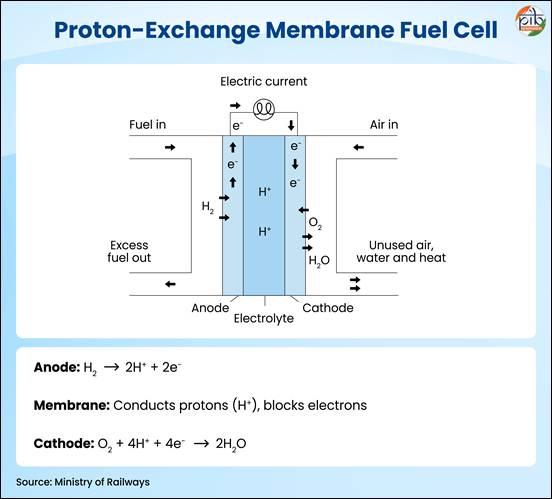
- Propulsion system: Proton Exchange Membrane Fuel Cell (PEMFC) — hydrogen reacts with oxygen across a Perfluorosulfonic Acid (PFSA) polymer membrane, generating electricity + water vapour + heat; 1,200 kW total propulsion capacity.
- Trainset composition: 10 coaches — 2 Hydrogen Driving Power Cars (DPCs) + 8 Trailer Coaches (TCs); each DPC houses fuel cells, Lithium Iron Phosphate (LFP) batteries (for regenerative braking energy storage) and hydrogen storage cylinders.
- Hydrogen storage: 27 hydrogen cylinders per trainset; ~300 kg hydrogen consumption daily; range ~250 km per refuelling; fares set at ₹5–₹25.
- Energy advantage: Hydrogen at 120 MJ/kg vs diesel at 43 MJ/kg — nearly 3x more energy-dense; low maintenance and manageable carbon footprint across lifecycle if produced from renewables.
- Jind Hydrogen Facility: India’s largest railway hydrogen storage and refuelling facility; storage capacity ~3,000 kg at a time; hydrogen produced via electrolysis process (green hydrogen); licensed by PESO.
- International standards: Compliance with NFPA-2 (National Fire Protection Association) and ISO 19880 Series; certified by TÜV SÜD, Germany (independent third-party safety assessment).
- Safety architecture: Hydrogen leak detectors at production, storage and dispensing points; flame detectors; automatic hydrogen supply cut-off on heat/flame/smoke detection; loco pilot emergency mode for safe train movement; real-time system health dashboard in cabin; 24×7 monitoring of refuelling system.
- Maintenance facility: Shakurbasti, Delhi; trained and certified personnel; technical staff to accompany train in initial phase; standby compressor for uninterrupted refuelling.
- Train numbers: 74010 (Jind → Sonipat, depart 7:40 AM, arrive 9:40 AM) and 74009 (Sonipat → Jind, depart 10:40 AM, arrive 1:00 PM); daily service.
- Route halts: Jind Junction → Jind City → Pandu Pindara Junction → Lalit Khera → Bhambhewa → Isapur Kheri → Butana → Khandrai → Gohana Junction → Rabrah → Lath → Mohana → Barwasni → Sonipat New.
- Countries with hydrogen trains: Germany (Alstom Coradia iLint, 2018), Japan, China, USA — India now joins this group; distinction of being first on broad-gauge globally.
- Full indigenisation (RDSO design + ICF manufacturing) embeds technological capability within Indian Railways — critical for long-term scaling and maintenance self-sufficiency under Atmanirbhar Bharat.
- PEMFC + LFP battery hybrid provides energy resilience — batteries absorb regenerative braking energy and support during fuel cell power fluctuations.
- Hydrogen from electrolysis at Jind using renewable electricity creates a truly zero-emission corridor — directly advancing the National Green Hydrogen Mission.
- India is the first country to operate hydrogen trains on broad-gauge tracks — a significant technological distinction from Germany’s narrow/standard-gauge Coradia iLint.
- Single-route pilot: Scalability across Indian Railways’ 68,000 route-km network depends on cost reduction in hydrogen production, storage and fuel cells; current economics favour electrification over hydrogen for most routes.
- Green hydrogen economics: At current costs (~₹250–300/kg), hydrogen traction is significantly more expensive than electric or diesel; Mission target of below ₹150/kg by 2030 is ambitious but unproven.
- Energy conversion losses: The electrolysis → compression → fuel cell chain has lower round-trip efficiency than direct electric traction — raises whether non-electrifiable routes are a better strategic focus.
- Hydrogen refuelling infrastructure is limited to Jind; nationwide scaling requires parallel infrastructure investment that is not yet planned or funded.
- Maintenance capability at scale remains untested — hydrogen fuel cells have different failure modes from diesel or electric traction, requiring new skill sets across Railway workshops.
- Designate 10–15 non-electrifiable Himalayan and North-East rail corridors as next hydrogen pilots — where green hydrogen can most cost-effectively replace diesel traction.
- Mandate renewable electricity sourcing for the Jind electrolysis plant to ensure full lifecycle zero-emission status; integrate with PM-KUSUM solar-agriculture grid where feasible.
- Pursue domestic R&D cost reduction for PEMFC membranes through RDSO–IIT collaboration, reducing import dependence on PFSA membrane materials.
- Publish a clear Hydrogen Rail Roadmap 2030 with milestones for fleet size, route coverage, infrastructure investment and cost-reduction targets.
- Integrate with the National Green Hydrogen Mission’s strategic hydrogen hub planning to co-locate rail refuelling with industrial hydrogen production for economies of scale.
Q1. Consider the following statements regarding India’s hydrogen train project: (1) The trainset was designed by RDSO and manufactured at ICF, Chennai. (2) It uses a Proton Exchange Membrane Fuel Cell (PEMFC) that emits only water vapour and heat. (3) The hydrogen storage facility at Jind was certified by the NDMA. Which are correct?
A) 1 and 2 only B) 2 and 3 only C) 1 and 3 only D) 1, 2 and 3Q2. (Assertion–Reasoning) Assertion (A): Hydrogen fuel cell technology is considered the cleanest propulsion option currently available for rail transport. Reason (R): The PEMFC generates electricity by reacting hydrogen and oxygen, producing only water vapour and heat — zero direct carbon emissions.
A) Both A and R are true, and R is the correct explanation of A B) Both A and R are true, but R is NOT the correct explanation of A C) A is true, R is false D) A is false, R is trueQ3. Which of the following best describes a strategic advantage of deploying hydrogen trains on non-electrifiable routes in India?
A) Lower round-trip energy efficiency than electric traction B) Elimination of diesel traction on routes where overhead electrification is geographically or economically unviable C) Reduced need for hydrogen storage infrastructure D) Higher operational speed than electric trains on mountain routes‘White Rabbit Technology’ — Indian Standard Time Distribution Network, Bengaluru
- Union Minister Pralhad Joshi inaugurated the ‘White Rabbit Technology’-based IST Distribution Demonstration Network on 16 July 2026 at the Regional Reference Standards Laboratory (RRSL), Jakkur, Bengaluru.
- Under the vision of ‘One Nation, One Time’ — a historic step toward establishing a uniform, highly precise and domestically sovereign time standard across India, eliminating reliance on foreign time sources like GPS.
- Nodal agency: Legal Metrology Division, Ministry of Consumer Affairs; key collaborators: NPL (National Physical Laboratory), ISRO, BSNL and SEBI.
- Indian Standard Time (IST): UTC+5:30; maintained at NPL (National Physical Laboratory), New Delhi under CSIR (Council of Scientific & Industrial Research); India does not observe Daylight Saving Time.
- Coordinated Universal Time (UTC): Primary global time standard maintained by the International Bureau of Weights and Measures (BIPM), Paris; national metrology labs synchronise their national realisations (e.g., UTC(NPL) for India) to UTC.
- GPS time dependency problem: India’s financial markets, telecom networks, power grids and defence systems currently synchronise to GPS (US NAVSTAR system) — a foreign-controlled constellation; GPS denial, spoofing or jamming creates a critical national security and economic vulnerability.
- White Rabbit Technology — origin: Developed at CERN (European Organisation for Nuclear Research) in collaboration with GSI Helmholtz Centre, Germany and other partners; originally designed for particle accelerator control and data acquisition timing; open-source hardware and software.
- Legal Metrology in India: Governed by the Legal Metrology Act, 2009 (replaced the Standards of Weights and Measures Act, 1976); Legal Metrology Division under Ministry of Consumer Affairs handles national standards and traceability.
- RRSL: Regional Reference Standards Laboratories — state-level metrology labs maintaining secondary standards traceable to NPL; Jakkur (Bengaluru) RRSL under Karnataka Government is the first demonstration site.
- Sub-nanosecond accuracy: Synchronises distributed nodes to within <1 nanosecond — far exceeding standard NTP (Network Time Protocol) which achieves only millisecond accuracy; approximately 1 million times more precise than NTP.
- Mechanism: Enhanced PTP (Precision Time Protocol / IEEE 1588) combined with Synchronous Ethernet (SyncE) over fibre-optic links; achieves both frequency synchronisation and phase alignment simultaneously.
- Sovereign, fibre-based: Unlike GPS (satellite-dependent, US-controlled), White Rabbit operates on domestic fibre infrastructure (BSNL’s optical fibre network) — entirely under Indian sovereign control.
- Scalability: Can synchronise 1,000+ nodes across a network; suitable for national-scale rollout via BharatNet and National Optical Fibre Network (NOFN) infrastructure.
- International compliance: Operates in compliance with global UTC protocols — India remains internationally interoperable while eliminating GPS dependence.
- Financial markets: High-frequency trading, stock exchange timestamps (SEBI mandate), banking transaction sequencing — sub-nanosecond accuracy prevents arbitrage fraud and ensures audit trail integrity.
- Telecommunications: Network synchronisation for 4G/5G base stations — reduces handoff errors, improves spectrum efficiency and supports future 6G rollout.
- Power grids: Phasor Measurement Units (PMUs) in India’s Integrated Power Grid require precise time synchronisation for fault detection, angle measurement and grid stability.
- Defence and security: Navigation, radar coordination, encrypted communications and military operations depend on precise, sovereign time — GPS denial scenarios in conflict zones (relevant given India’s strategic neighbourhood) make indigenous time distribution essential.
- Digital governance: E-governance transactions, digital signatures, blockchain-based land records and court e-filings all require tamper-proof, traceable timestamps — sovereign IST distribution strengthens the integrity of Digital India infrastructure.
- Strategic autonomy: Eliminates GPS dependence for critical infrastructure time synchronisation — reduces vulnerability to GPS spoofing, jamming or US denial; especially significant in India’s security context.
- Sub-nanosecond precision directly enables SEBI’s high-frequency trading timestamp mandates and future quantum-secure communication networks.
- Open-source, fibre-based architecture leverages BSNL’s existing BharatNet optical fibre network — minimises greenfield infrastructure cost.
- Multi-institutional convergence (NPL + ISRO + BSNL + SEBI) reflects a coherent whole-of-government approach to a horizontal infrastructure need across defence, finance and telecom sectors.
- Currently a demonstration network at a single RRSL in Bengaluru — national rollout roadmap, timelines, capital expenditure and nodal institutional ownership are not yet publicly specified.
- BharatNet coverage gaps in North-East India, Lakshadweep and Andaman mean the national network will have synchronisation dead zones unless NavIC satellite backup is integrated.
- Attack surface shifts: If White Rabbit nodes are compromised via cyberattacks, adversaries can manipulate time signals across dependent systems (financial markets, power grids) — the threat vector moves from GPS to fibre infrastructure.
- Statutory mandate needed: A national time synchronisation requirement (compelling banks, telecom firms, power utilities to adopt IST-WR nodes) needs a statutory basis — possible via amendments to Legal Metrology Act, 2009 or SEBI/TRAI/CEA regulations.
- Scale from demonstration to a National IST Distribution Grid — leverage BharatNet’s 6+ lakh km optical fibre to connect NPL → RRSLs → state capitals → critical infrastructure nodes in a hierarchical architecture.
- Integrate NavIC (India’s indigenous GNSS) as a satellite-based backup layer to White Rabbit fibre — ensuring synchronisation continuity during fibre disruption scenarios.
- Issue SEBI/RBI/TRAI/CEA mandates requiring financial exchanges, telecom base stations and power grid PMUs to synchronise to IST-WR nodes within a defined transition timeline.
- Establish cybersecurity protocols specific to White Rabbit nodes — encryption of PTP packets and anomaly detection at each node.
- Develop domestic White Rabbit hardware manufacturing under PLI/Make in India to reduce import dependence on CERN-ecosystem vendors and build scale for national deployment.
Q1. Consider the following statements regarding White Rabbit Technology: (1) It was originally developed at CERN for particle accelerator timing. (2) It achieves sub-nanosecond synchronisation using enhanced PTP over fibre-optic links. (3) It depends on GPS satellites for its primary time reference. Which are correct?
A) 1 and 2 only B) 2 and 3 only C) 1 and 3 only D) 1, 2 and 3Q2. Match List I (Institution) with List II (Role in the IST-WR network): A. NPL · B. BSNL · C. SEBI // 1. Fibre-optic backbone for signal distribution · 2. Financial market time-stamping standards · 3. Primary atomic clock and UTC(NPL) reference. Choose the correct match:
A) A-3, B-1, C-2 B) A-1, B-3, C-2 C) A-3, B-2, C-1 D) A-2, B-1, C-3Q3. The ‘One Nation, One Time’ initiative primarily addresses which of the following? (1) India’s dependence on US GPS for critical infrastructure time synchronisation. (2) Millisecond-level inaccuracies in stock exchange timestamps under current NTP. (3) India’s lack of an indigenous satellite navigation system.
A) 1 and 2 only B) 2 and 3 only C) 1 only D) 1, 2 and 3

