What Is Extreme Poverty?
- Defined by the World Bank as living on less than $2.15/day (2017 PPP).
- Core indicators: lack of food security, no access to sanitation, healthcare, electricity, education.
- Used globally to measure SDG-1 implementation.
Relevance
GS 1 – Society
- Global poverty trends, demographic transitions.
- Regional disparities (Asia vs Africa).
- Social indicators: education, health, inequality.
GS 2 – International Relations / Social Justice
- SDG-1, SDG-10 performance.
- Role of institutions (World Bank, IMF, UN).
- Governance gaps in fragile states.
GS 3 – Economy
- Growth–poverty elasticity.
- Structural transformation, employment, productivity.
- Climate vulnerability and conflict economics.
- Global poverty projections and economic stagnation in Africa.
What Has Happened Since 1990? (Global Background)
- 1990: 2.3 billion people in extreme poverty.
- 2024: Decline by 1.5 billion, one of the largest improvements in human history.
- Drivers:
- Rapid Asian growth (China, Indonesia, India, Bangladesh).
- Structural transformation (manufacturing, urbanisation).
- Trade integration.
Why Rapid Decline Is Slowing Now
- In the 1990s, most poor people lived in fast-growing Asian economies.
- Today, most extremely poor live in stagnating African economies (Madagascar, DR Congo, Malawi, Mozambique, Burundi, CAR).
- GDP per capita in these countries has not grown for decades.
Projections (World Bank + IMF)
A. Up to 2030
- Extreme poor decline from 831 million (2025) to 793 million (2030).
- Decline modest; nowhere close to earlier pace.
B. After 2030
- Reversal begins: number starts rising due to:
- Stagnant African economies
- High fertility
- Climate vulnerability
- Weak state capacity
C. Geographic shift
- 1990: Most poor in Asia.
- 2024–2040: Majority in Sub-Saharan Africa.
Why Progress Is Stalling ?
- Economic stagnation in core African states (per capita income same as 1950 in Madagascar).
- Mean incomes below poverty line → redistribution alone cannot eliminate poverty.
- Population growth outpacing economic growth.
- Climate shocks and conflicts.
- Weak human capital: low productivity, poor education, poor health.
How Latin American Countries Fit Into This Picture (Panama, Bolivia, Mexico, Brazil)
A. Mexico
- Middle-income country with moderate poverty reduction.
- Extreme poverty dropped significantly 1990–2015; stagnated thereafter.
- Drivers:
- Manufacturing-based growth (NAFTA)
- Social transfer programmes (Oportunidades)
- Challenges:
- Regional disparity (South vs North)
- Crime, informality
- Slow post-2015 GDP growth
B. Brazil
- Major decline in extreme poverty 2003–2014 (Bolsa Família, commodity boom).
- Recent stagnation due to:
- Political instability
- Low productivity
- Commodity cycle downturn
- Still far ahead of Africa; baseline poverty much lower.
C. Panama
- One of Latin America’s fastest-growing economies; extreme poverty declined sharply (Canal services, logistics).
- Challenges:
- High inequality
- Indigenous-region poverty pockets remain.
D. Bolivia
- Poverty reduction since 2005 due to:
- Hydrocarbon boom
- Cash transfer schemes
- But growth slowdown post-2014 → stagnation.
- Still better trajectory than African stagnators but not Asian-style high growth.
Overall Latin America Trend
- No stagnation as deep as Africa, but insufficient growth to replicate Asian-style poverty elimination.
- Inequality a persistent drag across region.
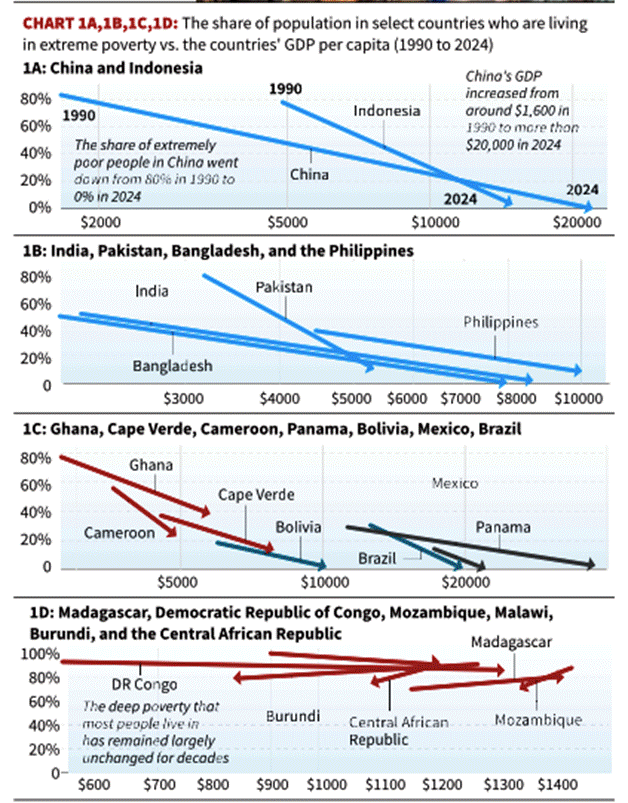
Chart Logic Explained (Charts 1A–1D & Chart 2)
Charts 1A & 1B (High-growth Asian countries)
- China, Indonesia, India, Bangladesh → large initial poverty shares (>60%)
- Rapid GDP/capita rise → large decline (<10%).
Charts 1C (Latin America – e.g., Mexico, Brazil, Bolivia, Panama)
- Lower initial extreme poverty.
- Reduction is slower because:
- Growth moderate, not explosive.
- Inequality high.
- Poverty is more structural, less mass-extreme.
Charts 1D (African stagnators)
- DR Congo, Malawi, Burundi, CAR, Mozambique
- GDP/capita stagnant for decades.
- Extreme poverty remains >50%.
Chart 2 (Projections to 2040)
- Shows a break from past trend:
- Decline until 2030
- Rise afterward
- Latin America stays low-extreme-poverty but not driving global reduction.
- Asia essentially exits extreme poverty.
- Africa drives global numbers upward.
Key Insight: Redistribution vs Growth
- Countries like Madagascar, DR Congo:
- Mean income < poverty line
- Even perfect redistribution keeps everyone poor
- Only sustained GDP growth can eliminate extreme poverty.
Why Future Looks Different From Past
- Earlier gains came from countries that were poor but grew rapidly.
- Now most extremely poor live in countries with:
- Very low state capacity
- Fragile institutions
- Climate vulnerability
- Conflict
- Weak human capital
- Without structural transformation, the poverty trap deepens.
Implications for SDGs
- SDG-1 (End Poverty by 2030) will not be met.
- SDG-10 (Inequality) becoming more central.
- Africa becomes global development priority.
Policy Lessons
- Growth-first strategy essential in low-income countries.
- Need strong investment in:
- Education
- Health
- Agricultural productivity
- Climate resilience
- Governance reforms
- Redistribution works only after basic growth begins.