
Contents
Indiahandmade: A Digital Platform for India’s Craft Heritage
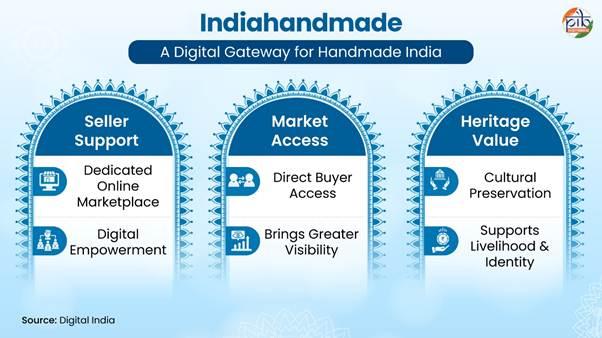
- Indiahandmade, a dedicated digital marketplace for India’s handloom and handicraft artisans, has crossed a fresh milestone of over 64 lakh artisans and weavers brought into digital commerce, per an official government fact-sheet.
- Developed by the Digital India Corporation (DIC) under the Ministry of Textiles, the platform connects artisans directly with buyers, reducing intermediaries and strengthening livelihoods.
- The Digital India initiative was launched on 1 July 2015 to build digital public infrastructure across governance, payments and, increasingly, traditional livelihoods.
- Indiahandmade was officially launched in April 2023 by the Ministry of Textiles; indiahandmade.com is designed and developed by DIC (under MeitY) as a national mission — not merely an e-commerce site — to conserve and promote India’s handloom and handicraft heritage.
- India has an estimated 64.66 lakh handloom and handicraft artisans nationally, making artisan livelihoods a significant informal-sector employment base.
- GI (Geographical Indication) tag: legal recognition of a product’s regional origin (e.g., Pashmina shawls). ODOP (One District One Product): a scheme giving each district’s signature product dedicated market visibility.
- Direct market access: artisans, weavers, Self-Help Groups (SHGs), producer companies and rural enterprises sell directly to buyers; entire sale proceeds credited directly to artisans’ bank accounts without deductions — a zero-commission model.
- Seller-support tools: simplified digital registration, regional-language support, AI-powered listings, integrated order management, secure payments and free logistics/shipping.
- Buyer trust mechanisms: free shipping, purchase protection, secure payments and buyer support — reinforcing confidence in handcrafted products at competitive prices.
- Categories span apparel, home décor, furnishings, paintings, furniture, religious items, stationery, musical instruments, jewellery, bags and footwear — with dedicated visibility for GI-tagged and ODOP products.
- Onboarded artisans grew from a few thousand in early phases to over 64 lakh by July 2026 — already exceeding the original 60 lakh+ target set under the Atmanirbhar Bharat vision.
- Illustrative case: Dastkar Bamboo Producer Company has sold bamboo and cane handicrafts on the platform for three years, reporting steadier incomes and sustained demand for a craft that earlier struggled to find buyers beyond local markets.
- Disintermediation directly raises artisan earnings — a structural fix rather than a subsidy-based intervention.
- Embedding GI/ODOP visibility links e-commerce policy with regional-identity and IPR goals, reinforcing Vocal for Local.
- AI-assisted listings and multilingual support meaningfully lower the digital-literacy barrier for rural sellers.
- Onboarding 64 lakh artisans does not by itself indicate active, repeat sellers; conversion from “onboarded” to “regularly transacting” needs independent verification — Verification Required.
- Logistics and last-mile fulfilment in remote and tribal belts remain a known constraint for e-commerce generally; specific Indiahandmade fulfilment data is unavailable — Verification Required.
- As a single government-run marketplace, the platform competes with well-funded private players (Amazon Karigar, Flipkart Samarth); differentiation depends on sustaining trust and the zero-commission structure at scale.
- Publish transaction-level metrics (active sellers, repeat orders, income uplift), not only onboarding counts, for credible impact assessment.
- Strengthen logistics for fragile handmade goods to reduce damage-in-transit and returns.
- Expand GI/ODOP curation with provenance certification and storytelling to build buyer trust and premium pricing power.
Q1. Consider the following statements about Indiahandmade: (1) It was launched in 2023 by the Ministry of Textiles. (2) It is developed by the Digital India Corporation. (3) Sellers are charged a standard platform commission on every sale. Which are correct?
A) 1 and 2 only B) 2 and 3 only C) 1 and 3 only D) 1, 2 and 3Q2. The “ODOP” (One District One Product) scheme, referenced on the Indiahandmade platform, primarily aims to:
A) Standardise minimum support prices across districts B) Give each district’s distinctive product dedicated market visibility and promotion C) Regulate GST rates on handicrafts D) Certify organic farming practicesQ3. Match List I with List II: A. GI Tag · B. ODOP · C. Zero-commission model // 1. Full sale proceeds to artisan · 2. Legal recognition of regional origin · 3. District-level product promotion. Choose the correct match:
A) A-2, B-3, C-1 B) A-1, B-2, C-3 C) A-3, B-1, C-2 D) A-2, B-1, C-3Ayushman Bharat Digital Mission: India’s Digital Health Backbone
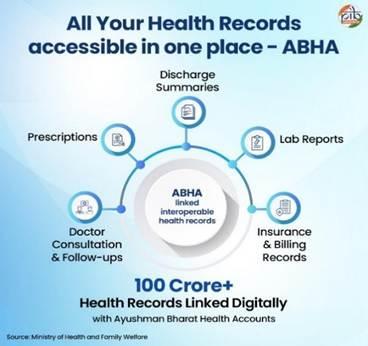
- ABDM has crossed 104 crore linked health records and 93 crore ABHA accounts (official fact-sheet, 6 July 2026), making it one of the world’s largest digital health ecosystems.
- The mission recently rolled out Aarogya Setu 2.0 (launched 29 June 2026) as a unified citizen-facing gateway, alongside AI-governance initiatives SAHI and BODH.
- ABDM was launched in September 2021 by the Government of India to build an integrated, citizen-centric national digital health ecosystem, in pursuit of Universal Health Coverage (UHC).
- ABHA (Ayushman Bharat Health Account): a 14-digit unique digital health identifier, analogous to Aadhaar for the health sector, enabling consent-based, portable health records.
- ABHA growth trajectory: 14.7 cr (2021) → 30.4 cr (2022) → 50.6 cr (2023) → 72.2 cr (2024) → 84.5 cr (2025) → crossed 90 cr in 2026, reaching 93 cr+ by July 2026.
- Aarogya Setu origin: built during COVID-19 as a contact-tracing app under a public-private partnership guided by NIC; later handed to the National Health Authority (NHA) and repurposed under ABDM.
- Core ABDM building blocks: ABHA, Healthcare Professionals Registry (HPR), Health Facility Registry (HFR), Health Information Exchange & Consent Manager (HIE-CM), Unified Health Interface (UHI), National Health Claims Exchange (NHCX).
- Launched 29 June 2026 by Union Health Minister J.P. Nadda at Vigyan Bhawan; functions as a single citizen-centric digital gateway: ABHA creation, health-record management, Scan & Register, Scan & Pay for hospital payments.
- AI-powered “Smart Reports” using OCR digitise uploaded documents; the app integrates Google’s Gemma AI model and an open-source Medical Data Toolkit converting unstructured medical documents into the HL7 FHIR standard format.
- Displays AB-PMJAY wallet and private insurance details via NHCX; shows real-time blood-unit availability via e-RaktKosh; enables teleconsultation and appointment booking via UHI.
- Companion launches: Ayushman Sarathi (WhatsApp chatbot for PM-JAY), Drug Registry, Common LOINC Codes for India (CLCI), Bharat Health Terminology Service (BHTS).
- Scan and Share: launched 2022 under ABDM by NHA; per an Indian Institute of Health Management Research (IIHMR) study, cut patient waiting times from ~1 hour to 2–5 minutes; over 23.21 crore ABHA-linked tokens issued (as on 18 June 2026).
- Digital Health Incentive Scheme (DHIS): reimburses digitisation expenses. Disbursed (as on 18 June 2026): ₹107+ crore to hospitals, ₹2.95 crore to diagnostics/labs/pharmacies, ₹26+ crore to Digital Solution Companies (DSCs).
- eSushrut@Clinic: lightweight Hospital Management Information System by C-DAC, launched June 2026 for small clinics — 2,200+ facilities onboarded, generating 1,633+ health records; access gated via verification through HPR and HFR.
- NHCX: standardises claims exchange among payers, providers, beneficiaries and regulators — speeds up claim decisions and cuts administrative costs. UHI: an open, UPI-like protocol for healthcare built on interoperability, fair discoverability, credential verification and open protocols; five live services — blood bank discovery, PM-JAY hospital search, Jan Aushadhi Kendra discovery, ambulance booking, doctor consultation.
- SAHI (Strategy for Artificial Intelligence in Healthcare for India) and BODH (Benchmarking Open Data Platform for Health AI): launched 17 February 2026 at the India AI Impact Summit. SAHI is a national policy roadmap with 32 recommendations across five pillars. BODH, developed by IIT Kanpur with NHA, lets developers train models on-site on real-world health data without accessing raw patient records, returning only trained model weights.
- Privacy-by-design: no central government data repository — records stay with the creating entity; apps must clear a sandbox and security audit before going live.
- Interoperability-first architecture (UHI, NHCX) mirrors the proven UPI model — open protocols reduce platform lock-in.
- BODH’s weights-only training is a genuinely privacy-preserving approach to health AI, balancing data utility with patient confidentiality.
- Measurable impact: Scan and Share cutting wait times from ~60 minutes to 2–5 minutes is a concrete efficiency gain.
- Large account/record volumes measure enrolment, not necessarily quality of linked data or active usage.
- DHIS disbursement (₹107 cr to hospitals vs ₹2.95 cr to diagnostics/pharmacies) shows uneven uptake across facility types.
- Aarogya Setu’s history — a discontinued 2022 data-sharing protocol flagged via an RTI by the Internet Freedom Foundation — raises legitimate data-governance trust concerns.
- SAHI/BODH are frameworks and testbeds, not binding regulation; enforcement of SAHI’s liability recommendations depends on downstream rule-making — Verification Required.
- Move health-AI governance from framework to enforceable regulation, particularly on liability allocation.
- Track outcome metrics (reduced duplicate testing, faster claims settlement, rural access) rather than only enrolment numbers.
- Extend DHIS uptake among smaller diagnostic centres and pharmacies through simplified onboarding.
- Rebuild public trust through transparent, publicly auditable consent and data-sharing protocols.
Q1. Consider the following statements: (1) ABHA is a 14-digit unique digital health identifier. (2) ABDM maintains a single central government server storing all patient health records. (3) Apps must clear a sandbox and security audit before connecting to ABDM. Which are correct?
A) 1 and 2 only B) 1 and 3 only C) 2 and 3 only D) 1, 2 and 3Q2. (Assertion–Reasoning) Assertion (A): BODH enables AI developers to benchmark models on real-world health data without compromising patient privacy. Reason (R): BODH allows model training on-site and returns only trained model weights, not raw patient data.
A) Both A and R are true, and R is the correct explanation of A B) Both A and R are true, but R is NOT the correct explanation of A C) A is true, R is false D) A is false, R is trueQ3. The “Scan and Share” service under ABDM primarily helped reduce:
A) Health insurance premium costs B) Patient waiting time for outpatient registration C) Cost of AI model training D) Number of registered health facilities

