
Contents
Prambanan Temple Complex: India-Indonesia Heritage Diplomacy in Action
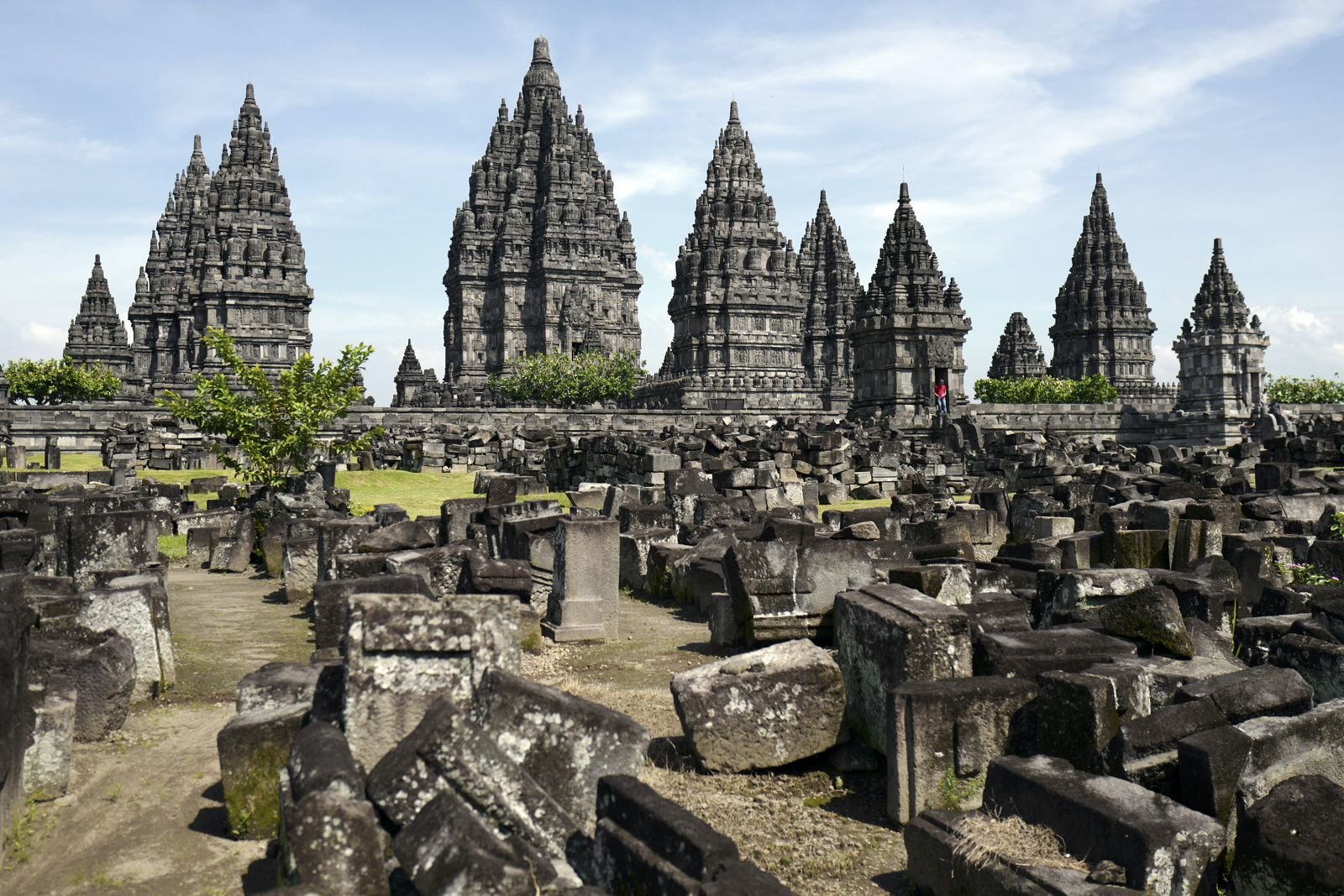
- Prime Minister Narendra Modi visited the UNESCO World Heritage Prambanan Temple Complex in Yogyakarta, accompanied by President H.E. Mr. Prabowo Subianto of Indonesia.
- The two leaders unveiled a plaque marking the commencement of the Archaeological Survey of India's (ASI) conservation and restoration project at the temple complex.
- Prambanan, built in the 9th century, is the largest temple complex in Indonesia dedicated to the Trimurti — Lord Brahma, Lord Vishnu and Lord Shiva — and stands as a symbol of shared India-Indonesia civilisational heritage.
- The Archaeological Survey of India (ASI), functioning under the Ministry of Culture, is India's premier body for archaeological research, excavation and heritage conservation, both within India and through cultural-diplomacy projects abroad.
- India's engagement in Southeast Asian heritage sites is not new — ASI has earlier undertaken extensive documentation of the Borobudur Temple Compounds, a Buddhist UNESCO site, also in Indonesia.
- Such heritage-conservation initiatives form part of India's Act East Policy, which emphasises deeper economic, strategic and cultural engagement with Southeast Asia.
- The project follows the understanding reached during President Prabowo's State Visit to India in 2025, when both leaders agreed to explore India's assistance in restoring the Prambanan temples.
- The visit and plaque-unveiling formalise ASI's role as the lead Indian agency for the conservation and restoration work at the complex.
- India's track record includes a successful history of heritage restoration across several World Heritage Sites in Southeast Asia, reinforcing confidence in ASI's technical capacity for this project.
- The Prambanan complex is described as an enduring symbol of shared civilizational and cultural heritage between India and Indonesia, anchoring a bilateral relationship increasingly built on cultural as well as strategic ties.
- The initiative reflects India's enduring commitment to preserving shared civilizational heritage across the wider Indo-Pacific and Southeast Asian region.
- Builds on ASI's demonstrated regional expertise, including prior documentation work at Borobudur, lending technical credibility to the restoration mandate.
- Strengthens civilisational soft power and people-to-people ties, complementing India's economic and strategic outreach under the Act East Policy.
- High-level leadership involvement — a joint plaque-unveiling by both Heads of State — signals strong political commitment to the project's continuity.
- The publicly available information covers the project's launch and intent; detailed aspects such as funding structure, timeline and technical scope are Verification Required.
- Long-term success of such cross-border conservation efforts depends on sustained bilateral coordination and continued institutional support beyond the ceremonial launch.
- Formalise a detailed project framework specifying ASI's technical scope, funding arrangement and monitoring mechanism for transparent implementation.
- Use the Prambanan initiative as a template to expand India's heritage-diplomacy footprint across other Southeast Asian sites with shared Hindu-Buddhist heritage.
- Link the restoration effort with tourism and cultural-exchange promotion to deepen bilateral engagement beyond the conservation project itself.
Q1. Consider the following statements regarding the Prambanan Temple Complex: (1) It is dedicated to the Trimurti — Brahma, Vishnu and Shiva. (2) It was built in the 9th century. (3) ASI is undertaking its conservation project for the first time in Indonesia. Which of the statements given above are correct?
A) 1 and 2 only B) 2 and 3 only C) 1 and 3 only D) 1, 2 and 3Q2. The Archaeological Survey of India functions under which of the following Ministries?
A) Ministry of External Affairs B) Ministry of Tourism C) Ministry of Culture D) Ministry of Housing and Urban AffairsPinaka Long Range Guided Rocket: Boosting Indigenous Precision-Strike Capability
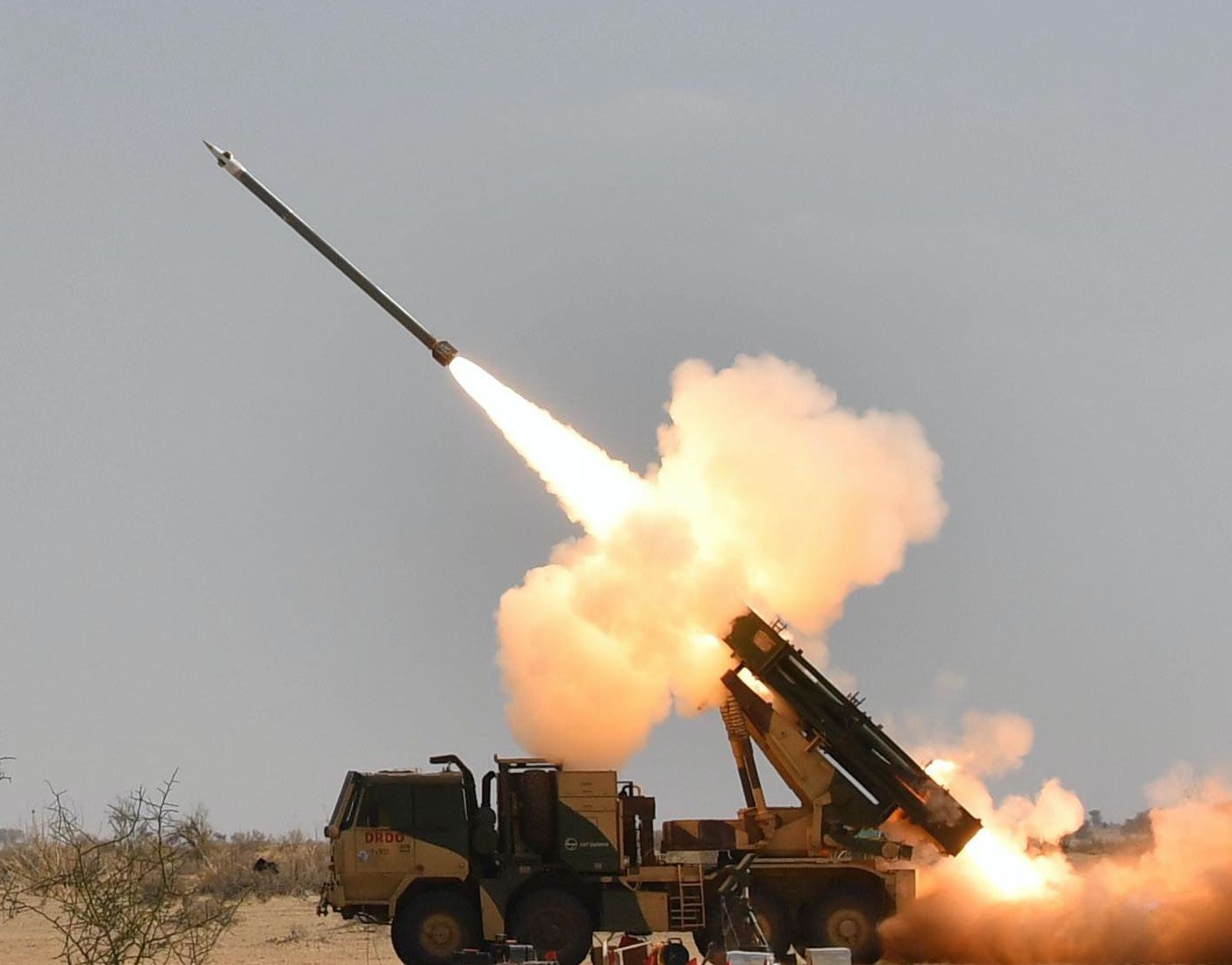
- DRDO conducted a successful flight-test of the Pinaka Long Range Guided Rocket (LRGR) at the Integrated Test Range (ITR), Chandipur, on 8 July 2026.
- The rocket was tested for a user-defined minimum range of 60 km, demonstrating all in-flight manoeuvres as planned and impacting the target with precision along the predicted trajectory.
- The Pinaka Multi-Barrel Rocket Launcher (MBRL) system, developed by DRDO, has been a mainstay of Indian Army artillery since its first operational use in the 1999 Kargil War.
- Successive variants — Guided Pinaka and Enhanced Pinaka — progressively extended range and introduced precision-guidance kits, converting unguided rockets into precision-strike munitions.
- LRGR is the latest, longer-range guided evolution of this family, intended to bridge the operational gap between conventional artillery and tactical missile systems.
- Key labs involved: Armament Research and Development Establishment (ARDE) — lead design agency; High Energy Materials Research Laboratory (HEMRL); Defence Research and Development Laboratory (DRDL); and Research Centre Imarat (RCI). The trial was coordinated by ITR and the Proof & Experimental Establishment (PXE).
- The rocket was tested for a user-defined minimum range of 60 km; the maximum range figure was not disclosed — Verification Required.
- The LRGR demonstrated all planned in-flight manoeuvres and impacted the target with textbook precision, following the predicted trajectory exactly.
- All deployed range instruments tracked the flight throughout its trajectory, confirming guidance and navigation performance.
- The rocket was launched from the in-service Pinaka launcher, demonstrating that Pinaka variants of different ranges can be fired from the same launch platform — a key logistics and interoperability benefit for artillery units.
- Raksha Mantri Shri Rajnath Singh congratulated DRDO, the Indian Army and industry, describing the test as a major milestone in indigenous design and development capability for long-range guided rockets.
- Defence Secretary and DRDO Chairman Shri Rajesh Kumar Singh closely monitored the trial and complimented the teams involved.
- Reinforces indigenous precision-strike capability, reducing dependence on imported guided-munition systems in line with Atmanirbhar Bharat objectives in defence.
- Launcher commonality across Pinaka variants lowers lifecycle costs and simplifies logistics for the Indian Army.
- Continues a track record of sequential successful DRDO trials, indicating sustained indigenous R&D momentum in guided-artillery development.
- As a single flight-test, this establishes proof of one performance parameter (minimum range); full operational induction typically requires repeated trials across range and payload conditions — the induction timeline is Verification Required.
- Precise maximum range, warhead type and guidance-kit specifications have not been publicly disclosed, limiting full assessment of the capability gain.
- Undertake repeat trials across the full range envelope before user (Army) evaluation trials and formal induction.
- Continue indigenisation of guidance and seeker components to reduce reliance on any imported sub-systems in future variants.
- Institutionalise DRDO-industry-Army collaboration frameworks to shorten the trial-to-induction cycle for guided artillery systems.
Q1. With reference to the Pinaka Long Range Guided Rocket (LRGR), consider the following statements: (1) It was tested at the Integrated Test Range, Chandipur. (2) It was launched from a dedicated new launcher built specifically for the LRGR. (3) The Armament Research and Development Establishment (ARDE) is its lead design agency. Which of the statements given above are correct?
A) 1 and 2 only B) 1 and 3 only C) 2 and 3 only D) 1, 2 and 3Q2. The Pinaka Multi-Barrel Rocket Launcher system was first used operationally by the Indian Army during:
A) The 1971 Indo-Pak War B) The 1999 Kargil War C) Operation Parakram (2001–02) D) The 1962 Sino-Indian War

