
Why is it in News?
- Winter Session begins under concerns of possible Special Intensive Revision (SIR) of electoral rolls and persistent parliamentary disruptions.
- Editorials warn that routine gridlocks, declining debate quality, and shrinking sittings are eroding Parliament’s institutional health.
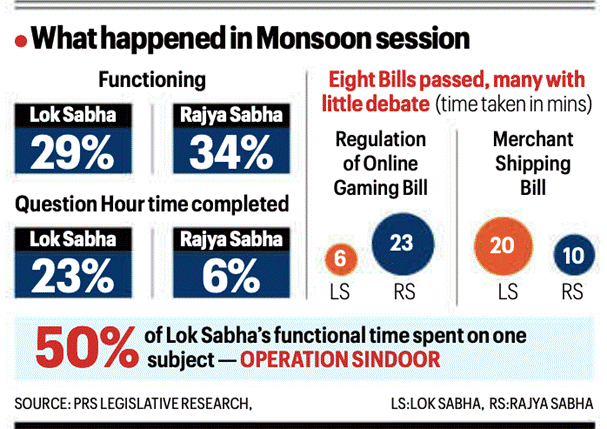
- Monsoon Session saw alarmingly low productivity: Lok Sabha 29%, Rajya Sabha 34%; Question Hour disrupted massively.
- Former Lok Sabha Secretary-General P. D. T. Achary warns diminishing deliberation is undermining the constitutional purpose of Parliament.
Relevance
GS 2 – Polity & Governance
- Declining productivity of Parliament; weakening deliberative democracy.
- Articles 107–111 (legislative procedure), Article 118 (rules of procedure).
- Executive accountability erosion: Question Hour dilution, minimal scrutiny.
- Parliamentary Committees declining → weak legislative oversight.
- Issues of federalism and political polarisation affecting legislative functioning.
GS 2 – Parliament & Democratic Institutions
- Institutional decline: low sittings, disruptions, majoritarian tendencies.
- Anti-defection law reducing debate autonomy.
- Role of LoP, floor coordination failures, legislative planning deficits.
Basics: Role & Purpose of Parliament
- Legislature’s core functions: lawmaking, executive accountability, financial oversight, deliberation.
- Article 107–111: legislative procedure; Article 118: rules of procedure.
- Question Hour, Zero Hour, Committees: designed to anchor accountability.
- Parliamentary norms: deliberation, consensus-building, scrutiny of government.
Declining Productivity
- Monsoon Session 2024: LS 29%, RS 34% functioning; Question Hour barely operated.
- Sharp fall from historic norms: Sessions in 1950s–70s averaged 120+ sittings, now often ~60–70 sittings/year.
- 17th Lok Sabha (2019–24): worst average in decades; RS fared slightly better but also downward.
Routine Disruptions Becoming Norm
- Disruptions no longer exception; increasingly weaponized tactics by both treasury & opposition benches.
- Loss of debate time: Eight Bills passed with little or no debate (some under 10 minutes).
- “Operation Sindoora” data: 50%+ of LS time spent on disruptions.
Breakdown in Floor Coordination
- Erosion flows from failure of dialogue between Leader of the House & Leader of Opposition.
- Pre-legislative consultation is minimal → Bills rushed.
- All-party meetings have become symbolic, not substantive.
Declining Scrutiny of Bills
- Only 13–15% of Bills sent to Parliamentary Standing Committees in recent years (down from 60%+ a decade ago).
- Bills increasingly passed without clause-by-clause debate.
- Examples: Online Gaming Bill, Merchant Shipping Bill passed with less than 10 minutes of debate.
Majoritarianism vs. Parliamentary Spirit
- With strong majority governments, tendency to treat Parliament as legitimising body, not deliberative body.
- Opposition protests → Government bypasses debate via guillotine, voice vote, short notices.
Question Hour Dilution
- Most crucial accountability tool; its repeated suspension directly reduces executive oversight.
- Data: Only 23% (LS) & 36% (RS) Question Hour utilization in Monsoon Session.
Institutional Consequences
- Weakening parliamentary norms → rising executive dominance.
- Bills passed without scrutiny risk constitutional infirmities, litigations, and policy incoherence.
- Public trust erodes; Parliament becomes “acclamation chamber” not deliberative institution.
Structural Reasons Behind Gridlocks
- Polarized politics, absence of consensus-building culture.
- Anti-defection law reduces inner-party debate; MPs have little autonomy.
- Televised sessions incentivize disruptions for media visibility.
- Poor legislative planning: late circulated Bills, minimal notice.
Need for Institutional Reforms
- Mandatory minimum sittings (UK-style: 120 days).
- Revive Business Advisory Committee & ensure cross-party coordination.
- Mandatory Committee reference for all non-emergency Bills.
- Reform anti-defection law to allow intra-party dissent.
- Time-bound debate mechanism like UK’s “Westminster Hall debates”.
Comparative Perspective
- Arend Lijphart: consensus democracies require negotiation → India drifting to majoritarianism.
- Mansbridge: deliberative democracy thrives on transparency & debate → absent in current legislature.
- Garrett & Tsebelis: strong executives without veto players reduce scrutiny → India fits this pattern.
Conclusion
- Parliamentary gridlocks reflect deep institutional decay, not episodic political friction.
- Declining deliberation, shrinking sittings, and minimal scrutiny threaten executive accountability and constitutional balance.
- Reviving Parliament requires structural reforms + political will to restore dialogue, debate, and democratic deliberation.


