
Why Is It in the News?
- New U.S. (Trump administration)–led peace plan for the Russia–Ukraine war has been circulated to stakeholders.
- The plan is far less favourable to Ukraine than the 2022 Istanbul framework.
- Comes amid Ukrainian battlefield setbacks (Pokrovsk, Kupiansk), Western fatigue, domestic corruption scandals, and Trump’s shift in U.S. policy.
- Marks a major turning point: Ukraine is weaker, Russia stronger, and Western alignment fractured.
Relevance
GS-II: International Relations
- Power shifts in Russia–Ukraine conflict; failure of 2022 Istanbul process.
- Changing US foreign policy under Trump; “Reverse Kissinger” realignment attempt.
- Europe’s strategic autonomy gaps & NATO credibility questions.
GS-I/World History
- Territorial annexation, violation of post-1945 norms; coercive peace frameworks.
GS-II: Global Governance
- Erosion of international law due to legitimising territorial conquest.
- UN diplomacy limitations; great-power politics shaping peace frameworks.
Timeline of Peace Attempts (2022–2025)
A. Early 2022: Belarus → Turkey Talks
- Days after Russia invaded (Feb 2022), both sides opened negotiations in Belarus.
- Russian troops pushed towards Kharkiv and Kherson, aiming for a quick victory.
B. March 2022 Istanbul Talks
- Mediated by Turkey; first serious diplomatic breakthrough.
- Ukraine indicated willingness to:
- Renounce NATO membership,
- Recognise Russian as an official language,
- Accept neutrality under multilateral security guarantees.
- Russia signalled readiness to:
- Withdraw to pre-Feb 24, 2022 lines, keeping Crimea and parts of Donetsk/Luhansk.
- Fiona Hill & Angela Stent (Foreign Affairs, 2022):
- Both sides reached a tentative interim settlement outline.
C. Collapse of the Istanbul Process
- Western powers hesitant to offer hard security guarantees to Ukraine.
- Boris Johnson reportedly urged Kyiv to continue fighting.
- Zelenskyy grew confident after Russia withdrew from Kyiv–Chernihiv.
- Result: Ukraine resumed war → later expelled Russian forces from Kharkiv and Kherson (late 2022).
- Russia retaliated by:
- Annexing four more regions (Sept 2022),
- Launching partial mobilisation,
- Settling into a long-war strategy.
Shift in Strategic Landscape (2023–2025)
A. Military
- 2023 Ukrainian counter-offensive failed decisively → military option closed.
- Russia adapted to sanctions, stabilised economy, and improved defence lines.
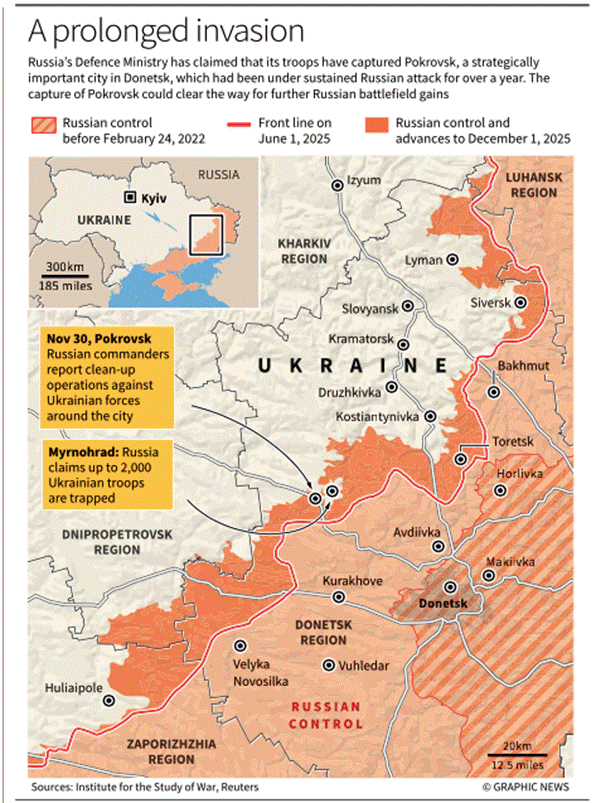
- By 2024–25: Russia regained initiative → capture of Pokrovsk marks major advance.
B. Political
- Zelenskyy extended term under martial law; recent corruption scandals eroded legitimacy.
- U.S. under Biden: “support as long as it takes”.
- U.S. under Trump:
- Views war as lost,
- Shifts burden to Europe,
- Seeks potential reset with Russia, including a “Reverse Kissinger” (tilting Russia away from China).
Trump’s 28-Point Peace Plan: Key Features
A. Territorial Settlement (Favors Russia)
- Crimea, Luhansk, Donetsk recognised as “de facto Russian”.
- Ukraine must withdraw from Donetsk (Russia currently controls ~80%).
- Contact lines in Kherson and Zaporizhzhia frozen → Russia keeps captured areas.
- Other seized territories outside annexed oblasts returned by Russia.
B. Military Terms
- Ukraine must cap military strength at 600,000 personnel.
- Demilitarised buffer areas likely around the frontline.
C. NATO Issue (Core Russian Demand)
- Ukraine must constitutionally renounce NATO membership.
- NATO must legally commit that Ukraine will never be admitted.
- Ukraine can join the EU.
D. Security Guarantees
- Separate 3-point draft proposes NATO-style assurances for 10 years, renewable.
- Significant Russian attack treated as threat to transatlantic security.
E. Sanctions & Russia’s Reintegration
- Russia to be reintegrated into global economy.
- Sanctions can be lifted; Russia could rejoin G8.
- Long-term U.S.–Russia economic cooperation (conditional).
- Russia to enact legal non-aggression commitments.
Why Is the Plan Considered Pro-Russia?
- Ukraine loses ~20% of its pre-2014 territory permanently.
- NATO door shut irreversibly.
- Russia’s gains legitimised; its losses not fully reversed.
- Security guarantees for Ukraine remain vague.
- Russia receives economic reintegration even without full withdrawal.
- U.S. role shifts from active military supporter to mediator with Russia.
Zelenskyy’s Dilemma
If he accepts:
- Effectively admits Russian victory.
- Major political blow at home → backlash from military, nationalist groups.
- Legitimacy crisis given expired term + corruption scandals.
- Loss of territory becomes permanent.
If he rejects:
- U.S. may withdraw support, further isolating Ukraine.
- Risk of losing more territory in prolonged war.
- Europe alone cannot sustain Ukraine financially/militarily.
Europe’s Position
- Germany, France, U.K. vow continued support but lack U.S.-scale capability.
- European unity under strain due to energy, defence readiness, budget fatigue.
- Europe fears Trump’s plan may entrench Russian strategic advantages.
Ground Reality (Dec 2025)
A. Russia
- Controls:
- All of Crimea,
- All of Luhansk,
- ~80% of Donetsk,
- Significant parts of Kherson & Zaporizhzhia,
- Slowly advancing in Kharkiv region.
- War economy stabilised; military industrial production revived.
B. Ukraine
- Facing power outages due to strikes on grid.
- Economic collapse prevented only through Western aid.
- Morale eroding; no feasible path to offensive victory.
Why Istanbul Moment Cannot Return ?
- 2022: Russia was on back foot → willing for concessions.
- 2025: Russia has battlefield momentum + geopolitical leverage.
- Ukraine now negotiating from weakness, not parity.
- Trump plan reflects changed power balance, not diplomatic creativity.
Implications for Global Politics
A. U.S.–Russia–China Triangle
- Trump may pursue Reverse Kissinger:
- Draw Russia away from China to weaken Beijing.
- Success uncertain due to deep Russia-China alignment.
B. NATO Credibility
- Forcing Ukraine to give up NATO path may weaken NATO’s moral authority.
- Sets precedent that military pressure can force Western concessions.
C. International Law
- Legitimising territorial conquest undermines post-1945 rules.
Conclusion
- Peace efforts collapsed in 2022 due to Western hesitation and Ukrainian optimism.
- Strategic balance shifted sharply in Russia’s favour over 2023–25.
- Trump plan formalises Ukraine’s territorial losses and neutrality.
- Ukraine in 2025 faces its toughest moment: military setbacks + political crisis + U.S. pressure.
- The new plan is a coercive peace, not a negotiated settlement.


